
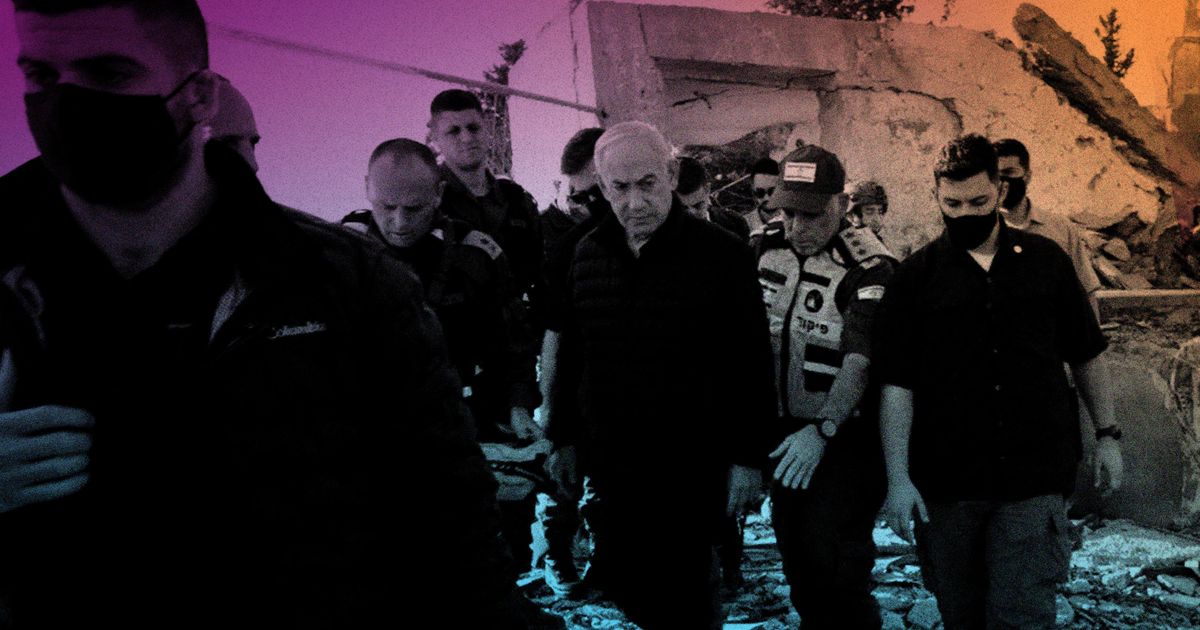
Photo-Illustration: Intelligencer; Photo: Government handout/Getty Images
Unlike the United States, where war with Iran is unpopular, Israel is fully embracing its bombing campaign against Tehran and other cities. It’s an effort that has achieved clear successes — the killing of Ayatollah Ali Khamenei, the degradation of Iran’s military capabilities — but is fraught with risk for Israel’s security and reputation. To learn more about Israel’s strategic objectives and the many problems bombing Iran probably will not solve, I spoke with Danny Citrinowicz, senior researcher in the Iran and Shi’ite Axis Program at Israel’s Institute for National Security Studies. Previously, Citrinowicz served as the head of various Israel Defense Intelligence units over 25 years, including the Iran branch in the Research and Analysis Division.
A few days ago, you summed up the Israeli perspective on the war in Iran as follows to the Financial Times: “If we can have a coup, great. If we can have people on the streets, great. If we can have a civil war, great. Israel couldn’t care less about the future … [or] the stability of Iran.”
Yes, people are quoting me everywhere.
Well, it’s a pretty eye-grabbing quote. The thing I don’t understand about it is that you’re saying Israel doesn’t really care about the stability of Iran, but at the same time, I thought Israel’s No. 1 reason for attacking and disabling Iran was to prevent it from obtaining a nuclear weapon. Those two impulses seem at odds. If they create a completely chaotic and unstable situation, wouldn’t that leave things in an even more precarious situation than they are now?
The main purpose of Israel right now is to prevent Iran from being a strategic threat to the State of Israel — a strategic threat meaning missiles and nuclear weapons. Everything else we couldn’t care less about. And if Iran is in chaos, it definitely won’t have the ability to develop nuclear bombs or invest in building missiles. It wouldn’t pose any threat to the State of Israel. You have to remember that after the 12-Day War last year, we saw the problem in just focusing on the strategic capabilities. We attacked their nuclear and missile sites, but immediately after the war ended, they rebuilt the capacity. So the understanding is that this is not just about their strategic abilities; it’s about depriving the regime of the capability to actually control Iran.
Benjamin Netanyahu understands he has a historical opportunity to undermine the regime in a way where it won’t pose a threat to Israel. Undermining it really will pose a threat to the UAE or Qatar or whatever because there will be refugees, maritime issues, and everything. It’s a huge country that could collapse into itself. That’s the main problem for Turkey, for Turkmenistan, for Azerbaijan. But it’s not a problem for Israel. From Israel’s standpoint, Iran is a country far away from us. If they can’t reach us with missiles and if they can’t build a new capacity, that’s the best scenario. Of course, we would like to have a western Iran that would cooperate and negotiate with Israel and return to the years before 1979. But if that’s not possible, and I don’t think we’ll be able to do it, the other option is creating a situation where they don’t pose any threat to us.
What about the problem of all the enriched uranium in Iran, which could fall under anyone’s control if things get really chaotic?
This is definitely a risky strategy. You’ll still probably have some sort of strategic capacity in Iran. You’ll still have 140 kilos of 60 percent enriched uranium, which nobody knows who will control. If you create mayhem and lose control over those sites, bad things can happen. You have ISIS in Iran, you have Al Qaeda in Iran, you have other extreme elements. But it’s not like Israel had any choice in a way. For Netanyahu, it was a dream come true to have the president of the United States willing to go the extra mile to undermine this regime. It doesn’t matter what happens in the end; Israel already won. Even if the war ends tomorrow, Iran will have to focus on building for years before they’ll be a threat to us.
The real question is, When are we saying enough is enough? President Trump said he wanted unconditional surrender, but that’s not going to happen. You have to do other, more dramatic things in order to get there. So this is the main problem: There’s no exit strategy. But the grand strategy of Israel, I think, has already been fulfilled.
And it’s very popular in Israel — I saw a poll in which the war had an 82 percent approval rating.
In Israel, there is no opposition on the Iranian issue. It’s unfortunate. I’ve thought people should say, “You promised eight months ago that this problem has been solved, and now we’re back on the same issue.” And by the way, if this regime stays, I think we’ll encounter that problem again. But people think Iran is the country that wants to destroy us, and you can always justify war with Iran regardless of the price we’re going to pay. The thing is that people in Israel do not understand that the price we are going to pay concerns the standard of life for all of us. This war costs trillions of shekels. People say, “We are solving the main problem we have and then we’ll decrease the defense budget.” But the defense budget in Israel will never decrease. You’ll have new threats even if you won’t have Iran tomorrow. And on top of what we are discussing now, we have a very complex issue now on our northern border because Hezbollah started that war again.
That was a predictable consequence of all this. Perhaps Israel thinks it can finish off Hezbollah once and for all.
I think there is a little bit of hubris in that. We fought two years against Hamas in Gaza, and we decapitated all the leadership there. But we still have Hamas in Gaza. And I don’t believe we can demilitarize Hezbollah — it’s not going to happen. If you want to get close to that, you have to put boots on the ground that will go way beyond I think the Litani River. I’m not sure this is what we aim to do after almost three years of constant war. So we are in a dilemma right now: How are we going to close this war of attrition in a way that will serve our interests? Hezbollah is not going anywhere in Lebanon. So the question is, What does Israel intend to do? I think we waited for Hezbollah to attack because once we killed Khamenei, they wouldn’t be able to stay out. Now there’s the possibility that the Houthis will enter the war against Israel. So we have to remember that even if the war with Iran ends tomorrow, we may still have problems with its proxies.
Once Netanyahu had the opportunity to work with President Trump, I don’t think there was any other choice but to join in because it was too good to be true. But the war won’t solve the outcome of everything in terms of Lebanon or maybe Iraq or maybe Yemen. The Palestinian issue goes without saying. And there is a lot of anger in the Gulf states about the fact that this war started, which they asked us not to start, and that we don’t know how it’s going to end. Also the Iranians still have the ability to strike oil-production sites. Operationally, we’re hammering them day and night under constant pressure, but I don’t think we can measure the success of this campaign only by that.
And there’s the possibility that Iran will now redouble its efforts to get a nuke because it’s the only way to keep the country safe. As you were saying, you could see a sequel to this in the near future.
If the regime stays and survives, I have no doubt the new supreme leader will at least consider rushing to a bomb. Let’s assume this regime will still be there in three, four years’ time. They could have a nuclear bomb and then what will we say about this war? So I think we have to be very careful with our assessments. Yes, we have major operational achievements. Iran is finding it very hard to launch missiles; it’s obvious that it’s struggling. But still, let’s have a little bit of patience to see how things develop because Iran still has the capacity to cause damage in the Middle East.
How good is this war politically for Netanyahu? It would seem completely aligned with his usual interest of maintaining power and not going to prison.
He’s considering pushing the election a little bit earlier because he thinks he can build on this. You don’t hear the opposition leaders talking about the war. Politically, it’s a win-win situation from all sides: He’s working with the U.S., so there are amazing operational opportunities. Nobody’s challenging him, nobody can counter him, and he’s not going to trial because there’s a war. And none of this will hurt him in a very close and tight election.
So look, as long as President Trump will continue this war, whether Trump is there a week, a month, a year — it doesn’t matter. We will be there.
This interview has been edited for length and clarity.
Sign Up for the Intelligencer Newsletter
Daily news about the politics, business, and technology shaping our world.
Vox Media, LLC Terms and Privacy Notice