
Ontario Premier Doug Ford says the province plans to compensate Toronto for the value of the land on which Billy Bishop Airport sits, as well as any lost revenue.CARLOS OSORIO/Reuters
Ontario Premier Doug Ford has confirmed he will seize land from the City of Toronto so he can override objections from Mayor Olivia Chow and execute his plan to expand runways at the downtown Billy Bishop Airport to allow for jets.
Mr. Ford, speaking to reporters at Queen’s Park on Tuesday, confirmed a report in The Globe and Mail that said he is looking to expropriate Toronto’s stake in the island airport to cut the city out of the intergovernmental deal that governs the facility and bans jets.
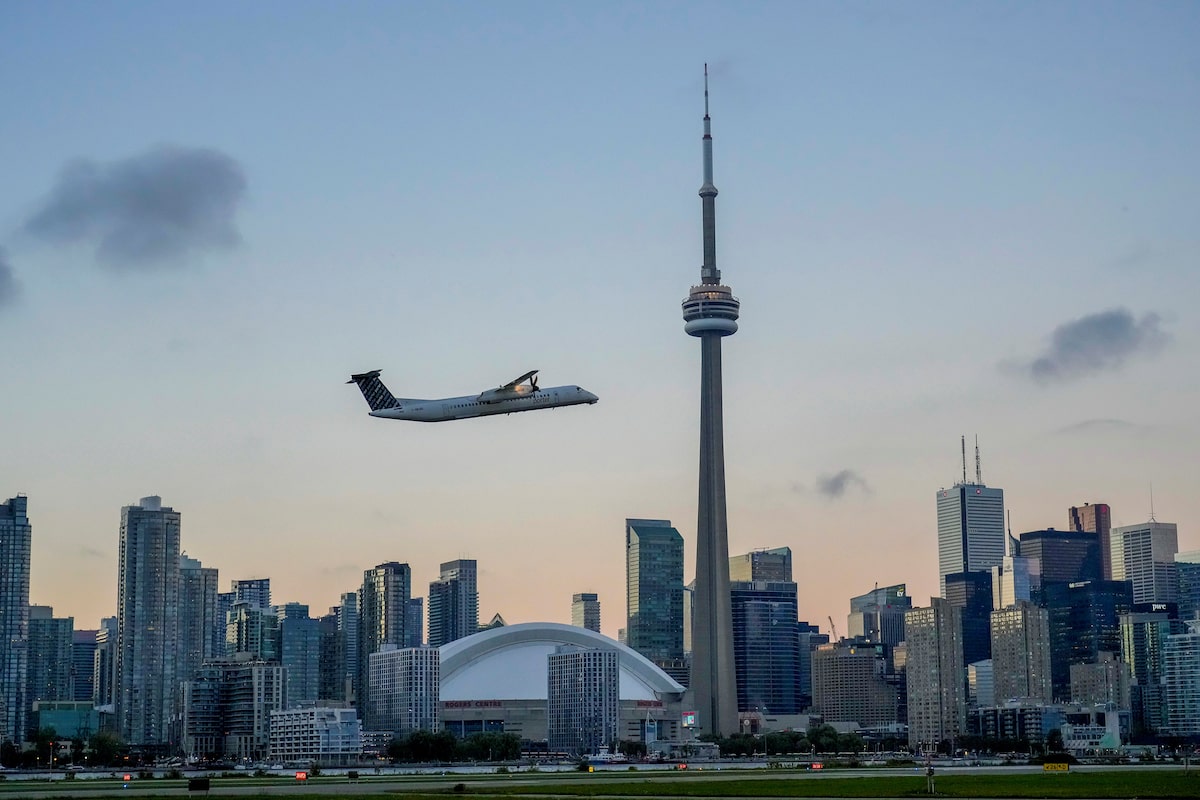
Both Air Canada and Porter Airlines currently fly only 78-seat turboprop planes out of the island airport. In 2013, Porter made an unsuccessful push for approval to fly jets there that it said would be as quiet as the turboprops.
Alex Bozikovic: If Toronto can’t imagine its future, Doug Ford will
The flying of jets to the small waterfront airport has been a contentious issue in Toronto politics in past decades, with activists warning that the popular parks and beaches of the Toronto Islands, and the homes of waterfront residents, would harmed by a busy, noisy flight path. But many business travellers relish the convenience of the smaller waterfront airport, compared with the massive Pearson International to the city’s northwest.
Ms. Chow, whose career in politics has taken her from city councillor to NDP MP and now back to city hall, has opposed allowing jets or expanding the island airport for years.
On Tuesday, the Premier said he had hosted Ms. Chow at his home within the past week and talked to her about the plan. He added that the province plans to compensate the city for the value of the land as well as any lost revenue, which could total up to $5-million a year.
“I was very straightforward with her that we will be taking over the airport,” Mr. Ford said.
“This is a crown jewel. We’re one of the largest cities in North America. Other cities like New York and Chicago have two airports. And this is an economic driver. It’s going to create competition,” he said, adding that the downtown airport was more convenient for many than Pearson.
The flying of jets to the small waterfront airport has been a contentious issue in Toronto politics.Fred Lum/The Globe and Mail
Mr. Ford’s move is needed for the province to influence the airport’s future, as it has long been governed by a tripartite agreement between the city, the Toronto Port Authority (a federal agency) and the federal government.
A senior provincial government source familiar with the discussions said Ontario is looking to replace Toronto in the tripartite agreement within a matter of months. The province expects the airport could be upgraded and expanded as early as 2030, the source said.
The Globe and Mail is not naming the source as they are not authorized to speak about internal discussions.
Asked to comment, Shirven Rezvany, a spokesman for Ms. Chow, said in an e-mail that the mayor has not seen a formal proposal and that any decision on the airport must be made with input from Torontonians.
“The Mayor will continue to insist that the provincial and federal governments work with the city and make sure Toronto is at the table when big decisions are made about our waterfront,” the e-mail reads.
The Premier wouldn’t say Tuesday how many more flights or passengers his expansion plans would allow.Chris Young/The Canadian Press
Speaking to reporters at City Hall on Tuesday morning, before Mr. Ford publicly announced his intentions, Ms. Chow said she maintains her opposition to flying jets in and out of Billy Bishop − but also acknowledged the province has the power to expropriate the land.
“I don’t support jets,” the mayor said, calling for a balanced approach to the future of the waterfront. “Jets are noisy and … they’re over at Pearson.”
In a statement on Tuesday, Norm Di Pasquale of the community group NoJetsTO condemned Mr. Ford’s plan: “Ford’s thoughtless decision to steal city land at the airport shuts Torontonians out of a debate that could have disastrous effects for our revitalized waterfront.”
Mr. Ford would not say how many more flights or passengers he envisions landing at the airport, which currently accommodates 2.8 million travellers a year. Larger volumes could increase noise complaints and may require changes to the parking and street access to the airport from the mainland.
He said he’s going to do “everything we can to reduce the noise,” and that the expansion will likely include only smaller jets. He suggested only a small number of people oppose the idea.
Ford eyes artificial island for massive convention centre, sources say
Mr. Ford has in recent days also floated the idea of building a two-million-square-foot convention centre on infill land or an artificial island to the west of Toronto’s waterfront. He suggested on Tuesday that convention attendees could fly into Billy Bishop and then be ferried to the convention centre, where he said there would also be hotels. No formal plans for this vision have been released.
At an event at Billy Bishop on Monday, federal Transport Minister Steven MacKinnon said Ottawa is taking a “long look” at the expansion issue alongside its partners, including the city. He said cutting the city out of the tripartite agreement was not Ottawa’s decision.
The port authority has said it supports allowing small, modern jets, which it says would be as quiet or quieter than the existing turboprop planes at the island.
Nieuport Aviation, now controlled by J.P. Morgan Asset Management Inc. of New York, bought the terminal from Porter in 2015 for more than $700-million.
In an e-mailed statement, Nieuport CEO Jennifer Quinn said she welcomed the “modernization” of the airport. She said support for it has “grown steadily over many years among travellers, businesses and communities.”
According to Ontario’s lobbyist registry, Nieuport has retained consultants to pitch the provincial government on its vision for the future of the island airport in recent months.
Among them is Mark Lawson, a senior aide to Mr. Ford from 2019 to 2021. He has also served as the vice-president for communications and external relations for Therme Group Canada, the Austrian-owned company set to build a waterpark and spa at the province’s nearby Ontario Place site. Mr. Lawson did not immediately respond to requests for comment.
On Monday, a spokesperson for Porter said the airline had “no specific information” about plans to allow jets. In a statement, Air Canada said it would continue to work with stakeholders on the future of the airport but did not directly address Mr. Ford’s proposal.
Airport expansion of a sort is already under way. Just last year, the city agreed to allow the expansion of the airport’s runway buffer areas, as required by new Transport Canada rules.
The move will see the land extended 150 metres into the lake on each end, to allow the current turboprop planes used by Porter Airlines and Air Canada to continue landing there. That work must be done by July 2027. Toronto also approved an extension of the tripartite agreement on the airport to 2045.
When the issue of allowing jets last reared its head, via a proposal from Porter Airlines in 2013, the airline said it would need an additional 168 metres on each end of Billy Bishop’s runways.
John Gradek, who teaches aviation leadership at McGill University, said Porter’s recent expansion – which included a base at Toronto Pearson in 2022 where it flies Embraer jets – has brought higher costs for gate fees, lease payments and other expenses. So the prospect of consolidating its operations at Billy Bishop could be attractive, he said.