
 Play Brightcove video
In the Strait of Hormuz – a critical waterway which transports a fifth of the world’s crude oil – three commercial ships have been struck by projectiles. ITV News International Editor Emma Murphy, US Correspondent Dan Rivers and Business Editor Joel Hills have the latest
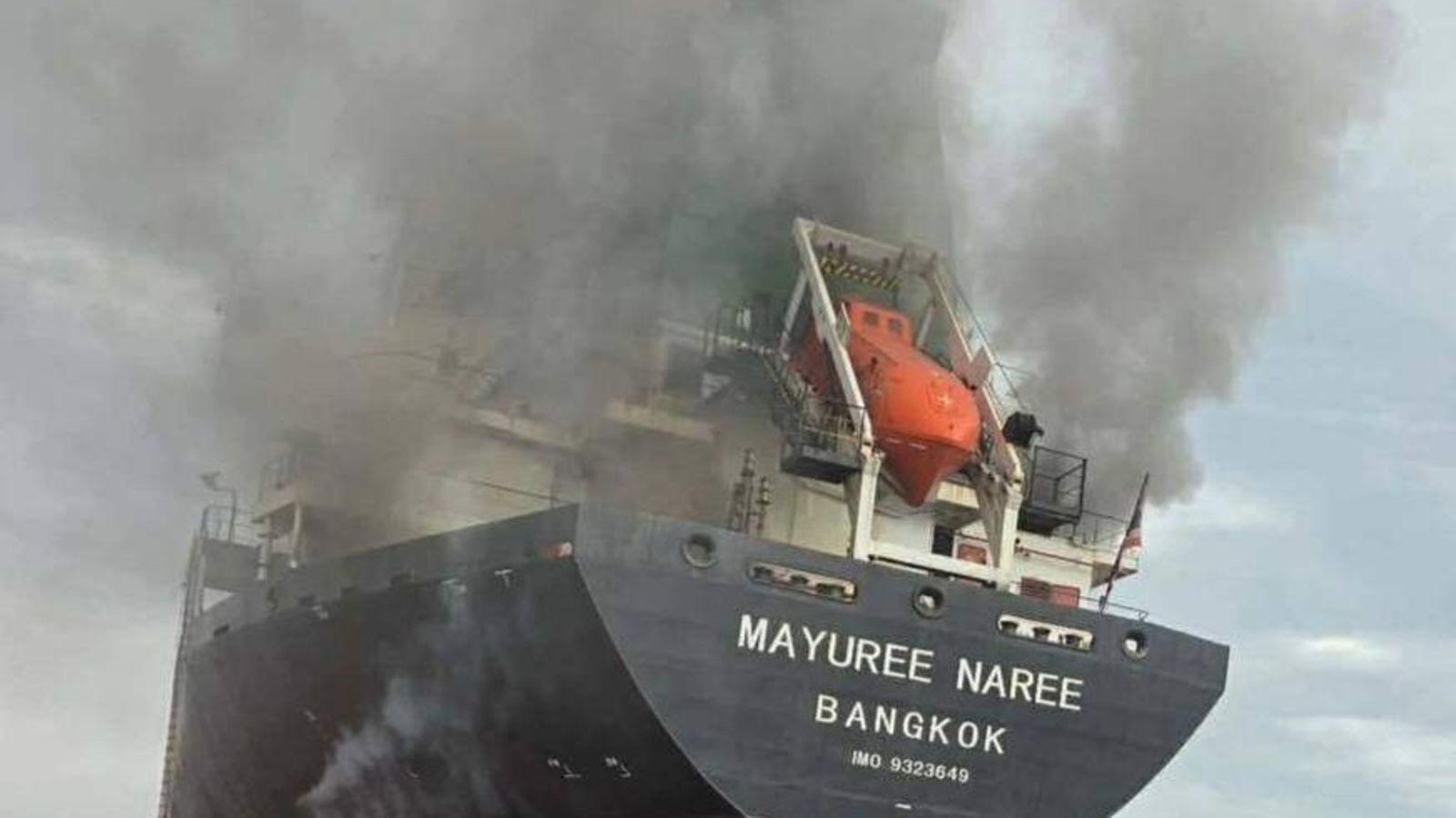
At least three ships targeted by Iran in Strait of Hormuz, with a Thai cargo ship being set on fire.
“All their navy is gone”: US President Trump says he thinks shippers should be using the Strait
US Central Command warns all civilians to get away from the Strait as they target the Iranian military
Amid widespread economic uncertainty, the largest ever volume of emergency oil reserves will be released
Sir Keir Starmer has said the government is doing “everything we can to make sure those energy bills don’t rise”
Pressure mounts on Trump to outline what targets must be met to end the conflict
Iran’s new supreme leader was injured in an attack, but is “safe”, Iran’s state media said
Iran targets Dubai airport, injuring four people
The joint US-Israeli strikes have killed at least 1,230 people in Iran since the war began in late February, according to officials
As missiles fly across the skies in the Middle East, much of the world’s focus is pinpointed on a body of water barely 20 miles wide at its narrowest point.
On Wednesday, Iran attacked three cargo ships across the Strait of Hormuz, with one Thai-flagged vessel catching fire after being targeted, triggering an evacuation. Three crew members are missing, officials said.
The Strait of Hormuz has become one of the Iranian’s most effective tools in the conflict, using it to pile economic pressure on the West by restricting vital oil and gas exports.
The United Nations estimates that the total number of ships travelling through the Strait dropped by 97% in the first week of the war.
US President Donald Trump is under pressure to ensure the Strait re-opens quickly, as markets fluctuate over fears that exports will be obstructed for longer than was anticipated.
He appeared to try to abate fears over dangers in the Hormuz when he spoke outside the White House on Wednesday, declaring Iran’s navy dead in the water.
“I think they should use the Strait of Hormuz. We took out just about all of their mine ships out in one night.
“We’re up to boat number 60, I didn’t realise they had that big a navy. I would say it was big and ineffective. But just about all their navy is gone and in the sea.”
The US President’s comments came barely an hour after US Central Command warned all civilians to stay away from Iranian ports along the Strait of Hormuz, as they “conduct military operations that threaten international shipping”.
“Iranian naval forces have positioned military vessels and equipment within civilian ports serving commercial maritime traffic,” it said in a statement.A surge in oil prices points to what may be Iran’s most effective weapon and the United States’ biggest vulnerability in continuing the campaign: Damaging the world economy.
Ships line up outside the Strait of Hormuz, as seen from the United Arab Emirates. Credit: AP
Nations pledge record release of emergency oil reserves
Oil prices remained well below Monday’s peaks but the price of Brent crude, the international standard, was still up some 20% Wednesday from when the war began. Consumers around the world are already feeling the pain at the pump.
The International Energy Agency agreed on Wednesday to release the largest volume of emergency oil reserves in its history, in a bid to counter the war’s impact on energy markets.
The Paris-based organisation said it will make 400 million barrels of oil available from its member countries’ emergency reserves, more than twice the amount they released four years ago in response to Russia’s invasion of Ukraine.
US Interior Secretary Doug Burgum told Fox News before the announcement that it’s appropriate for countries to release oil from their strategic reserves because the challenges in the Strait of Hormuz pose a “temporary transit problem.”
Problems could continue though, as Iran’s allies, the Houthis in Yemen, are also threatening to close Bab el-Mandeb, a major trade route between Europe and Asia, intelligence sources told ITV News, which would have a near-immediate impact on the availability and cost of imports like electronics and household goods.
The strait, which lies between Yemen and Djibouti, also provides a route for oil and liquefied natural gas to Europe.
The Chancellor of the Exchequer and Prime Minister respond to questions in relation to the war
Rachel Reeves stated on Wednesday that the trade disruption from the Middle East is “certainly not good for the British economy”.
Appearing at the Treasury Committee, Reeves added that it would be “unwise to speculate” about the Iran wars’ impact on UK inflation and interest rates.
At Prime Minister’s Question Time, Sir Keir Starmer faced a question from Liberal Democrat leader Sir Ed Davey about the price of energy bills.
Davey asked: “This week, families across the country have seen petrol prices rise at the pump, mortgage rates go up and fixed energy deals get more expensive. All because of a war they did not start and do not support.”
The Prime Minister said the government is doing “everything we can to make sure those energy bills don’t rise”.
He added: “The most important thing, the most effective thing, we can do is to work with our allies to find a way to de-escalate the situation.”
The SNP’s Westminster leader, Stephen Flynn, told the Commons: “Donald Trump’s war in Iran is illegal and the situation that has unfolded since is verging on insane”.
“The economic consequences of which will be stark for the global economy, but for every single person living on these isles too, and whether the Prime Minister accepts it or not he did indeed take us into that war when he allowed the Americans to use UK bases just last week.”
Also in PMQs, Starmer said prior to this: “I took the decision that we should not join the initial US-Israeli offensive against Iran.”
Rescuers search through the rubble of the school after the airstrike on February 28th. Credit: AP
The investigation into the airstrike on an Iranian school
The New York Times reported on Wednesday that a preliminary investigation into the air strike on an Iranian school has found the United States responsible, with the paper citing US officials as its anonymous sources.
On the first day of the conflict, a strike hit a girls’ school in Minab, Southern Iran, killing at least 165 people, the majority reported to be children.
The strike prompted outrage, with Unesco calling it “a grave violation of humanitarian law”.
A week later, when Trump was asked who was responsible, he pinned the blame on Iran. “Based on what I’ve seen, that was done by Iran,” Trump told reporters, as he said Iranian munitions were “very inaccurate”.
On Monday, footage analysed by investigative group Bellingcat appeared to show a munition consistent with a Tomahawk missile striking an IRGC base, which is situated adjacent to the girls’ school. Smoke was also seen rising from the vicinity of the school.
The New York Times reported that the preliminary investigation found that “outdated targeting data” may have led to the strike, as the school was in a building that was formerly part of the IRGC base. Questions remain on how this outdated information was not double-checked and had not found its way to the top of central command.
When asked on Wednesday afternoon for his response to the report, President Trump said: “I don’t know about it”.
US President Donald Trump spoke to reporters as he left the White House on Wednesday. Credit: AP
Iran strikes out
Iran continued to fire missiles and drones at targets across the Gulf on Wednesday, including at oil infrastructure in Saudi Arabia, saying it had launched its most “intense operation” of the war.
Two Iranian drones injured four people after they hit near Dubai International Airport on Wednesday morning. Flights have continued at the airport, despite the incident.
Iran under fire
The Israel Defence Forces (IDF) said on Wednesday they had begun “a wide-scale wave of strikes targeting Iranian terror regime infrastructure”, adding that they were also simultaneously striking Hezbollah infrastructure in Beirut.
The strikes show no sign of letting up. Israel’s Chief of the General Staff to Aircrews said on Wednesday that “no one is immune” and Israel knows how to “reach anyone” who poses a risk to them.“We are engaged in an operation that is further degrading the Iranian regime and its foundations, and pushing the threat further away. So far we have eliminated many thousands of the regime’s operatives and commanders. We will continue to degrade the terror regime and its military capabilities.”
Outside the White House on Wednesday, US President Donald Trump provided no insight into what targets needed to be met to end the military operation.
When asked what more the US needed to do, Trump said, “More of the same, and we’ll see how that all comes out.”
“Right now they’ve lost their navy, they’ve lost their air force, they’ve got no anti-aircraft apparatus at all. They have no radar, their leaders are gone. We could do a lot worse.
“We’re leaving certain things that if we take them out… they literally would never be able to build their country back.”
Meanwhile, UK warship HMS Dragon is on its way to Cyprus after a British base on the island was hit by a drone.
A destroyed building that housed a branch of Al-Qard Al-Hassan, run by Hezbollah which was hit by an Israeli airstrike. Credit: AP
Subscribe free to our weekly newsletter for exclusive and original coverage from ITV News. Direct to your inbox every Friday morning.
Iranian women footballers and the World Cup
Six members of the Iranian women’s football team will remain in Australia after being granted asylum, the country’s Home Affairs Minister, Tony Burke, has confirmed.
Another member of the team had also been granted asylum, but she later changed her mind and planned to return to Iran.
Despite US and Israeli forces striking Iran, Trump said on Wednesday that Iran is “welcome to compete” in the upcoming World Cup, according to FIFA boss Gianni Infantino.
The 2026 World Cup is due to be hosted by the US, Mexico and Canada.
Iran’s sports minister says the country cannot take part in the tournament in June because of the “wicked acts” of the US.
Speaking on Iranian state TV, Ahmad Donyamali said: “Due to the wicked acts they have done against Iran – they have imposed two wars on us over just eight or nine months and have killed and martyred thousands of our people – definitely it’s not possible for us to take part in the World Cup.”
In the video posted on Tuesday, he said Iranian players would not be safe in the United States.
Last week, President Trump said, “I really don’t care” if Iran takes part in the 48-nation tournament.
Five members of the Iranian women’s football team, who have been granted asylum in Australia. Credit: AP
Iran’s supreme leader “safe”, despite reports of injury
The son of the President of Iran has said that Iran’s new Supreme Leader is safe, amid reports of injury and speculation over his whereabouts. Yousef Pezeshkian posted to his Telegram channel to say:
“I heard news that Mr Mojtaba Khamenei had been injured. I have asked some friends who had connections. They told me that, thank God, he is safe and sound.”
Iranian state television had said that Khamenei was a “wounded veteran of the Ramadan war” but did not give specific details.
How did we get here?
Israel and the US launched what they described as “pre-emptive” strikes against Iran just before 6.30am on February 28, which they view as intent on acquiring nuclear weapons, shortly after a round of negotiations.
Iran denies seeking nuclear weapons, and some legal experts have said the attack violated international law. The Islamic Republic has responded by striking Israel and several targets in Gulf states allied with the US.
The war’s stated goals and timelines have repeatedly shifted as the US has at times suggested it seeks to topple Iran’s government or elevate new leadership.
While Trump previously dismissed the idea of boots on the ground in Iran, he did not rule it out when asked on Saturday.
He said US troops could “possibly” be sent on the ground in Iran, as the war continues, but there would have to be a “very good reason”.
Reporting History sees journalists join News At Ten anchor Tom Bradby to revisit their remarkable on-the-day reports of the defining events of the modern age. Listen to the episodes below…