
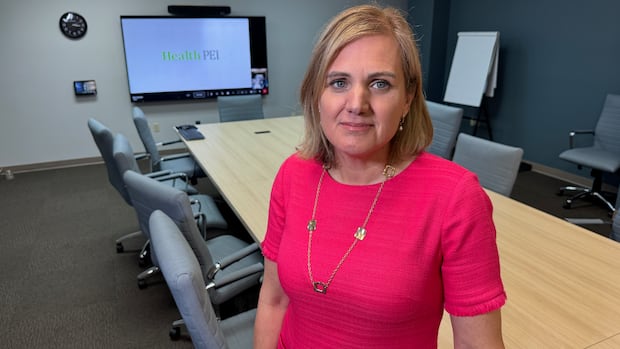
Health P.E.I. chief executive officer Melanie Fraser is leaving the role, effective immediately, the provincial government said in a news release Wednesday.
“Melanie helped advance important work within Health P.E.I. and supporting efforts to recruit more health-care professionals to our province,” Health Minister Cory Deagle is quoted as saying in the release.
“We thank her for her service during a challenging time in our health-care system.”
In an interview with CBC News, P.E.I. Premier Rob Lantz wouldn’t confirm whether Fraser’s contract was terminated, calling it a “mutual decision in the best interests of moving health care forward.”
“We’ve had a lot of chatter recently about that relationship with health-care providers but I think it’s just a good time to refresh leadership and move forward with a fresh perspective, renew our relationships with health-care providers and try and accomplish some important things for Prince Edward Island,” Lantz said.
WATCH | Full interview: Premier on Health P.E.I. CEO’s departure: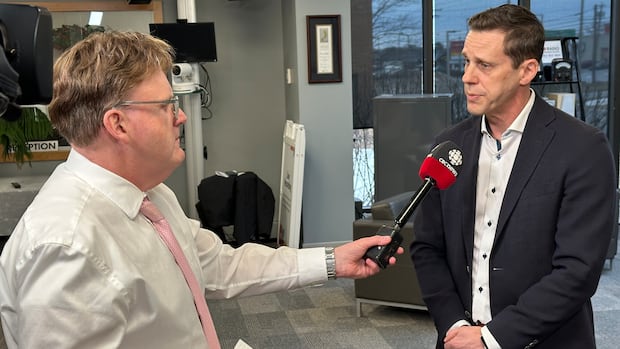
Full interview: Premier on Health P.E.I. CEO’s departure
Melanie Fraser is out as chief executive officer of Health P.E.I. CBC’s Wayne Thibodeau speaks with Premier Rob Lantz to find out what was behind the change.
The news of Fraser’s departure comes after 93 Island physicians signed a letter to Lantz, Deagle, and Health P.E.I. board chair Richard Wedge saying they have lost confidence in Fraser’s leadership.
CBC News obtained a copy of that letter and spoke with five of the doctors who signed it. None wanted to do an interview, but they confirmed the letter is legitimate and their concerns are real.
“Over the past 18+ months, we have experienced a catastrophic deterioration in our relationship with HPEI under Ms. Fraser’s leadership,” the letter reads.
That relationship, the letter goes on to say, suffered “deep damage” that is “beyond repair.”
Lantz called it was “somewhat coincidental” that Fraser’s departure was announced the same day that letter was circulating, saying his government’s priority is improving access to care and supporting the health-care professionals that provide that care.
When asked about whether Fraser will be receiving severance pay or compensation, Lantz said that was an HR issue and personnel matter and that he couldn’t provide details.
Laurae Kloschinsky, who is currently the assistant deputy minister of mental health and addictions with the Department of Health and Wellness, will serve as interim CEO. Lantz said Kloschinsky will provide continuity and stability, ensuring the transition is “as smooth as it can be.”
The province said it will work closely with Health P.E.I.’s board of directors “on an expedited and competitive process for appointing a permanent CEO.” Lantz called it “one of the toughest jobs in Prince Edward Island,” adding that it’s very much in the spotlight.
 Laurae Kloschinsky, who is currently the assistant deputy minister of mental health and addictions with the Department of Health and Wellness, will serve as interim CEO. (Wayne Thibodeau/CBC)
Lantz also confirmed he plans to meet with the Medical Society of P.E.I. on Thursday evening in an effort to build trust.
This all comes at a time when Prince Edward Island’s health-care system is under significant pressure. Three Island doctors recently informed Health P.E.I. that they are leaving their practices, adding to ongoing concerns about access to primary care.
Fraser was hired as Health P.E.I.’s CEO in 2024 and began the role in March of that year.
She followed Dr. Michael Gardam — who had a public spat with the provincial government over its decision to support a new medical school at UPEI — and interim CEO Corinne Rowswell at the helm of the provincial health authority.
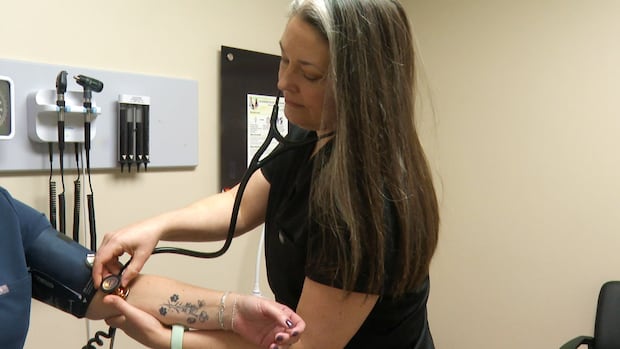
Dr. Heather Austin talks about why she’s leaving her Summerside practice
A family medicine physician on the Island since 2011, Dr. Heather Austin says she has no choice but to close her Summerside practice over what she calls disrespect toward doctors from Health P.E.I. She sat down with CBC’s Taylor O’Brien to discuss what went into her decision
One of the boiling points between doctors and Health P.E.I. has been the implementation of the Physician Services Agreement (PSA), the province’s contract with doctors.
Physicians initially supported the agreement but have since raised concerns about how Health P.E.I. implemented it.
The Medical Society of P.E.I. warned that some of the proposed targets could push family doctors off the Island, and even threatened legal action. The three parties eventually entered mediation.
In December 2025, the provincial government, Health P.E.I., and the Medical Society announced another agreement aimed at addressing physician workloads and patient targets. The agreement allowed some doctors to take on fewer patients.
But in their letter, the physicians said the rollout of the PSA, and the subsequent agreement, also raised concerns about how Health P.E.I. implemented it.
“HPEI leadership, led by Ms. Fraser, appeared to weaponize any ambiguity in the PSA to impose workload demands that family physicians (and our health-care colleagues, and many members of the public) found radically inappropriate. The leadership approach taken with the roll out of the PSA and subsequent MOA has been incredibly damaging to our already fragile health-care system,” the letter reads.
The letter also warns about challenges recruiting new physicians.
“As of writing, not one of our own P.E.I. family medicine residents have taken on longitudinal practices — both from the graduating class last year and those graduating in July 2026.”
Doctors say more resignations could be on the horizon.
“The handful of [Longitudinal Family Medicine] hires over the past year is well outpaced by usual physician attrition to retirement.”
More than 33,000 on patient registry
Despite the challenges facing the province’s health-care system, Fraser said in October 2025 at Health P.E.I.’s annual general meeting that there was “momentum” building to turn around P.E.I.’s fragile health-care system, particularly when it comes to recruiting staff.
During Fraser’s tenure, Health P.E.I. introduced several initiatives aimed at improving Islanders’ access to care. These included efforts to recruit more physicians and the work of team-based patient medical homes.
One such medical home is located at the University of Prince Edward Island’s new medical school. Fraser said last year that the clinic is expected to take on about 10,000 patients within two years.
Health P.E.I. had set a goal to have fewer than 5,000 patients on the registry by 2027. However, officials with the health authority told a legislative standing committee last month that there’s been some roadblocks along the way such as a limited number of health-care graduates in Canada and ongoing challenges recruiting and retaining staff.
Access to primary care remains a major issue in the province. As of Feb. 28, 33,510 Islanders were on the provincial patient registry waiting to be matched with a family doctor or nurse practitioner.
Auditor general flagged spending on travel nurses
Concerns have also recently been raised about Health P.E.I.’s spending on travel nurses.
In a recent report, the province’s auditor general noted the health authority spent $28.5 million on unbudgeted travel nurses in the 2024-25 fiscal year, triple what the province spent the year before.
The report noted that savings from vacant salaried nursing positions did not cover the cost of those travel nurses.