
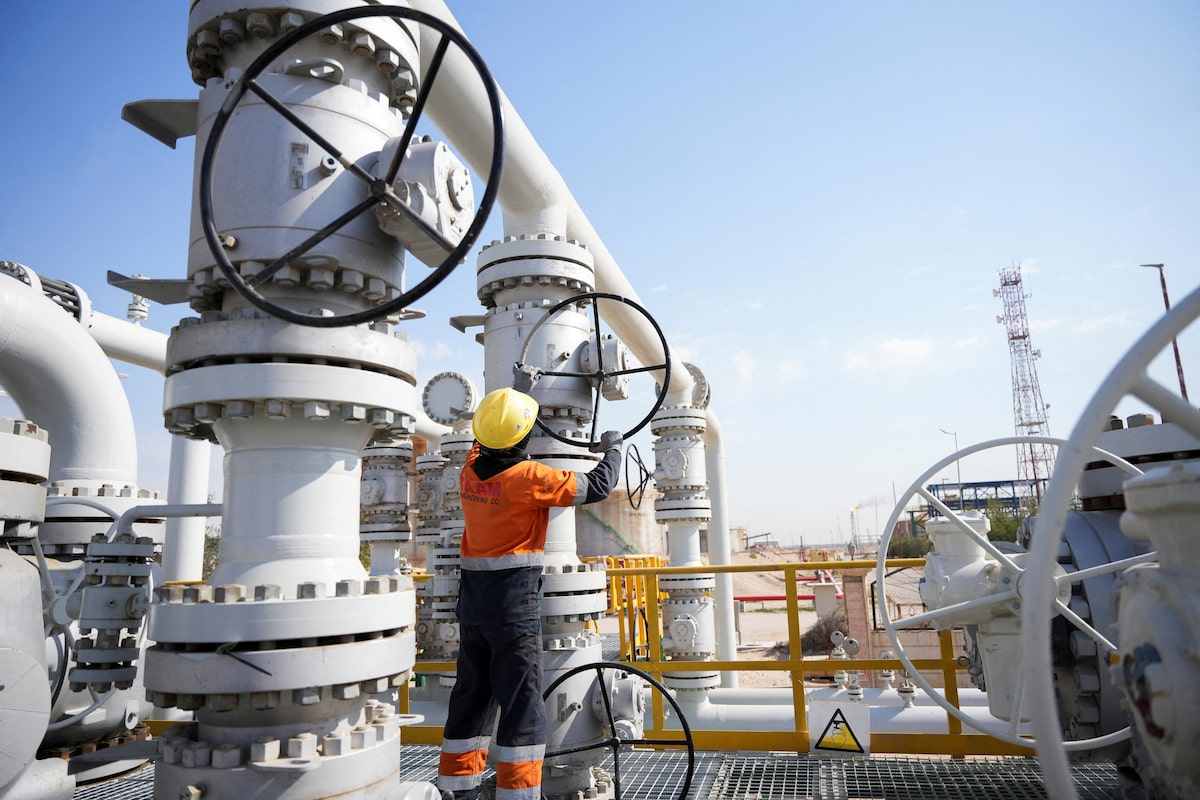
A worker operates valves at the Rumaila oil field in Basra, Iraq, on March 4.Essam Al-Sudani/Reuters
The International Energy Agency’s 32 member countries agreed on Wednesday to release 400 million barrels of oil reserves into the market – the largest-ever move in its history – in a bid to prevent shortages and keep prices in check as the U.S.-Israeli war with Iran drags on.
The IEA’s emergency action is in response to Iran’s effective closing of the Strait of Hormuz in the Persian Gulf. The narrow waterway normally provides a route to market for 15 million barrels a day of the world’s crude oil supply and another five million barrels a day of oil products – roughly a quarter of the world’s oil trade via sea.
Canada, an IEA member and the world’s fourth-largest producer, was already eyeing moves to boost oil supplies to deal with the impact of the global supply shock, though without a national strategic reserve the country is limited in its options.
The U.S. is planning to release 172 million barrels, Energy Secretary Chris Wright said on Wednesday.
Mr. Wright said the release will begin next week and will take approximately 120 days to deliver.
Canadians are more affected by rising prices than concerns about shortages. Still, Ottawa has asked Canadian oil producers to assess how much they could supply as part of the co-ordinated global effort to release oil stocks.
China needs Strait of Hormuz to remain open, but has stayed on the war’s sidelines
What to know about the challenges of reopening the Strait of Hormuz
The Trans Mountain Pipeline, for instance, can move extra barrels to the West Coast, chief executive officer Mark Maki told The Globe and Mail on Wednesday, though it is currently operating at about 90 per cent of its 890,000-barrel-a-day capacity.
While reorganizing oil cargo is complicated, there is enough flexibility in the system for Canada to “help out with global needs,” Mr. Maki said.
Leaders from the Group of Seven industrialized countries, including Prime Minister Mark Carney, supported the IEA’s action during a meeting Wednesday to discuss the escalating Middle East conflict. They underscored the importance of opening secure access through the Strait of Hormuz, according to a readout from Mr. Carney’s office.
With routes to markets squeezed and storage close to full, Persian Gulf oil producers have started to reduce production, putting extreme pressure on supplies – particularly to Asia, which relies on crude from the region.
Silos at the Depot Petrolier de France and the depot’s burning flare tower at the Marseille-Fos industrial dock in Fos-Sur-Mer, southern France.THIBAUD MORITZ/AFP/Getty Images
Energy infrastructure has also been attacked and refinery operations disrupted during the war, crimping jet fuel and diesel supplies.
Cranking open the taps on emergency stockpiles will go some way to alleviate the immediate effects of the current market disruption, but IEA executive director Fatih Birol said “the most important thing for a return to stable flows of oil and gas is the resumption of transit through the strait.”
Combined, IEA member countries hold more than 1.2 billion barrels of buffer reserves, with a further 600 million barrels of industry stocks held under government obligation.
Oil prices have surged to near four-year highs since U.S. and Israeli forces began bombing Iran on Feb. 28. International benchmark Brent oil was up 5 per cent at US$91.98 a barrel in after-hours trade on Wednesday. It’s down from a high of almost US$120 early in Monday’s session. West Texas Intermediate sold for US$87.25 a barrel, also up about 5 per cent in after-hours trade.
Analysis: Should Canada have a strategic oil reserve? It’s complicated
The rise in prices shows that the market had been anticipating such a move from the IEA members after days of talks, and that it is no long-term substitute for resuming shipping from the Gulf, said Hamad Hussain, climate and commodities economist at London-based Capital Economics.
The strait remains effectively blocked, and the resumption of traffic through the key waterway appears no closer. Iran has been reported to have laid mines, and it struck three commercial ships in the region, according to reports on Wednesday. The U.S. military said on Tuesday it had destroyed 16 Iranian minelayers.
Important aspects of the release of stockpiles are still unknown, Mr. Hussain said. “One of the key details is over what time frame the barrels will be released. We’ll get a sense then of exactly how much oil on a daily basis will be brought to the market,” he said.
“My sense is that you’re not going to see enough oil provided to the market by the IEA and its members to be able to offset the daily losses of supply from the Middle East as this conflict drags on.”
The IEA said it plans to release such details soon.
The Paris-based energy watchdog has undertaken five similar releases in the past: during the First Gulf War, Hurricane Katrina, the Libyan Civil War, and twice in the months after Russia’s invasion of Ukraine.
Canada is an IEA member, but as a net exporter of oil, it is not obligated to keep strategic stockpiles. Refiners and marketers keep buffer supplies on hand in case of emergencies or plant outages, however.
Energy Minister Tim Hodgson on Wednesday repeated on social media comments he made to The Globe and Mail a day earlier that the government is consulting with the oil industry to determine the “pace and scale” of action to bolster domestic supplies. He promised more details in the coming days.
He has said maintenance could be delayed at oil sands or conventional sites to keep production as high as possible, for example. The government may also ask companies to release some of their inventories, tweak production or ask refineries that normally process imported crude to switch to domestic supplies for now.
Trans Mountain has plans in place to boost capacity, including introducing drag-reducing agents into the pipeline to reduce friction between the oil and the line itself. It will launch an “open season” to solicit binding commitments for long-term volumes in July, Mr. Maki said.
For now, the spare capacity totals around 89,000 barrels a day.
“I would be of the mind that anything helps – that it buys you some time and it releases some of the pressure in the markets,” Mr. Maki said. “I imagine people will be looking at that in the very near future.”
with files from Reuters