
The country’s four main power companies have signed an agreement to stockpile coal and to extend the life of the coal-fired Huntly power station.
Genesis, Mercury, Contact, and Meridian control 85% of electricity supply and customers in New Zealand, and have sought Commerce Commission approval to make this market-dominating coal move together.
They want to stockpile up to 1.1 million tonnes of brown Indonesian coal and burn up to 10,000 tonnes of it a day whenever they deem it necessary.
Commerce Commission chair John Small must deny this outrageous cartel stitch-up. Only yesterday Commissioner Small said that if electricity suppliers were found to be misusing their market power to deter competition, it would take action.
Auckland Business Chamber chief executive Simon Bridges has said his members were uneasy or scared about raising complaints about their energy bills with their providers because they worried about retaliation.
Small said of this that “I contacted Simon because that’s really concerning. He got a group of his members together, the Major Electricity Users Group, people like that. I got the Electricity Authority and we had a couple of hours talking about it in a group,” he said.
When Prime Minister Luxon was asked if the government would break up the gentailers, he said that the single biggest issue was a supply problem because New Zealand didn’t have access to gas, “which we desperately need when we don’t have enough wind, rain or sun. We are the only country I know of, Corin, in the whole world that is making the rather unique transition from domestic gas to imported coal.” This is in the same week that his Minister of Energy congratulated the Big 4 on this stitch up for coal.
Just a reminder, Prime Minister Luxon runs the government that owns a controlling stake in three of the companies that have decided to make that transition to coal. They could easily have invested more in distributed storage and more solar and wind farms, to accelerate the decline of coal and secure electricity supply, and would not have needed to collude to extend the asset life of Genesis’ Huntly plant.
We should not lose hope about electricity generation as a whole.
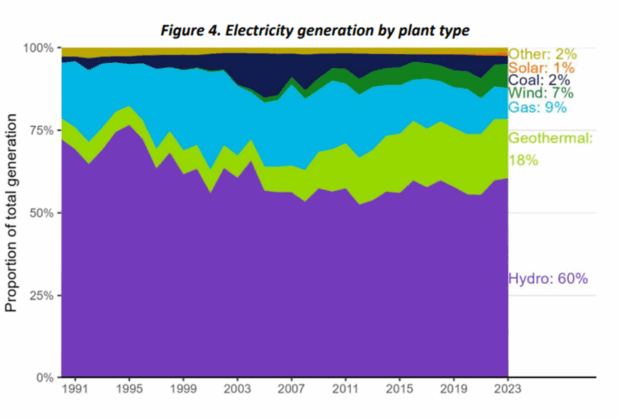
Coal use is down to 2% by generator plant type, wind is up to 7%, and geothermal is up to 18%, according to the MBIE energy report of 2024. New Zealand is moving in the right direction, despite this market collusion.
The problem of dominance over us by Genesis, Mercury, Meridian and Contact is however getting worse not better. That dominance is clear by the Commerce Commission’s move to make complaints about the Big 4 anonymous for fear of retaliation.
Commissioner Small commented that complaint anonymity was vital: “That works for us in other areas like cartels and groceries where there’s the same kind of problem … People can tell you stuff absolutely securely, knowing their name is never going to be published or found out. It might be that it doesn’t get used, it might be all this goes away, sometimes a shot across the bows is all it takes to sharpen up behaviour.”
Prime Minister Luxon, while not specifying the class of asset, is clear that he will be seeking a mandate from the 2026 election to sell remaining state assets:
We would take it to the election and it would be part of our programme that we’d want to talk about and be upfront with New Zealanders about,” he said in January.
If the Auckland Chamber of Commerce and the head of the Commerce Commission are having to act to protect anyone who complains about the Big 4 now, just wait until they have no public constraint upon them whatsoever once they are sold off totally.
They are describing power not only over companies that use electricity, but also power over actual New Zealanders.
This is measured by the fact that last winter, over 360,000 households had difficulty paying their power bills, and 2% or about 100,000 of our 2 million households had their power disconnected at least once because they couldn’t pay a bill. The Big 4 made dumptrucks of money while they did so.
The alternative to base energy supply as burnt coal, is energy storage of other kinds such as a battery dam or a complex disaggregated storage system. Labour leader Chris Hipkins didn’t commit to anything on Morning Report on August 5th when interviewed on it, despite working on the battery storage system for two terms.
The current government doesn’t want to act. The regulator is cowed. The consumer is being ripped off.
This is no longer just a question of electricity.
It is a question of power and it is slowly killing us as an environment, as consumers and as a country.
Related Posts