

Listen to this article
Estimated 3 minutes
The audio version of this article is generated by AI-based technology. Mispronunciations can occur. We are working with our partners to continually review and improve the results.
A growing number of scammers and fraudsters are using artificial intelligence (AI) to quickly gather personal information that they later “weaponize” in targeted scams, Toronto police are warning.
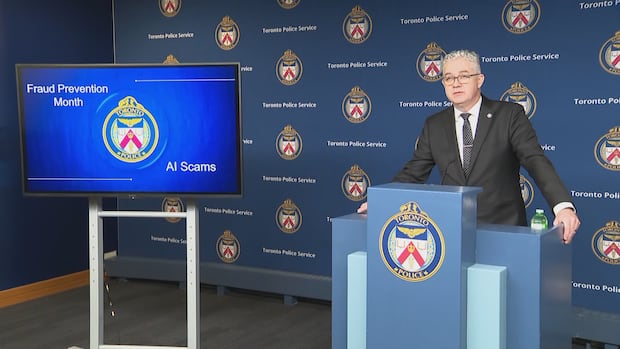
“Criminals are now able to gather information faster, personalize their approach, and impersonate trusted individuals or organizations like banks, government agencies and even the police with far greater credibility,” Det. David Coffey, who’s with the Toronto Police Service’s financial crimes unit, said at a news conference Wednesday marking fraud prevention month.
Coffey said that while the scams themselves aren’t changing, AI tools are being used to scan social media and online profiles to tailor them to each individual with “remarkable precision.”
“What is now being weaponized is our own information against us,” he said.
“When they’re calling us, they’re calling us by name. They know where we live, they know where we bank.”
Reported losses from confidence scams — where scammers gain a victims’ trust to steal assets or money from them — neared $50 million in Toronto last year, said Coffey.
‘Everybody is a target’
Francis Syms, associate dean of the faculty of applied sciences and technology at Humber Polytechnic, said AI scams make “everybody a target” because scammers can automate them and do them “en masse.”
“Now that it’s automated and it can be done through scripts and computer programs, they can go to bed at night [having] sent out 500 scam emails that are hyper-personal, and then just look at their bank account the next morning,” he said.
During the news conference, Coffey also mentioned that previous advice against getting scammed — which focused on protecting your identity — is no longer valid because people’s personal information is “already out there,” whether it’s from their digital footprint or from data breaches on platforms that they’re registered with like online banking.
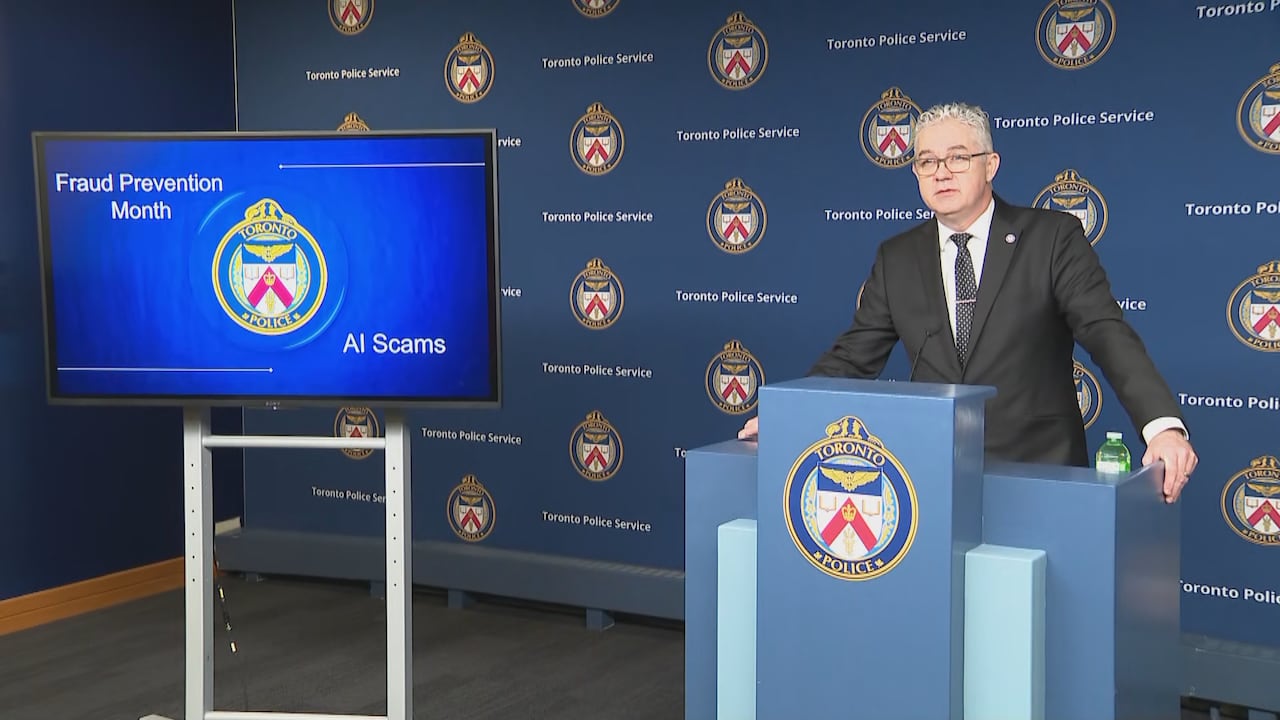 Toronto police Det. David Coffey says a rising number of fraud scams are now being done with the help of artificial intelligence. (CBC News)
Syms said that while Canada has protections on preventing that information from being sold, the rules are weaker in the United States, which is also where a lot of online platforms are based.
“When you’re signing up to new platforms, you have to assume that this concept of privacy is disappearing fast. Anything you put into those platforms, that information may go somewhere else, whether you intend for that to happen [or not],” he said.
‘Don’t panic,’ says expert
Coffey said that scammers will usually try to convey a sense of urgency and panic by relaying very personal details in a call or email, and it’s important to “slow down” if that happens.
“The awareness has to be on the fact that your information is out there and that these callers are going to call you and they’re going to use that information,” said Coffey.
Syms said that measures like safe words for family members to authenticate a call can help identify a scammer, and to also keep in mind what information is absolutely necessary to accurately share when signing up for a new site.
“If you sign up for a new site and it asks for information such as your birthday, if that information is not really required to do business with that site, put in other information,” he said.
“The bottom line is, people shouldn’t panic.”