
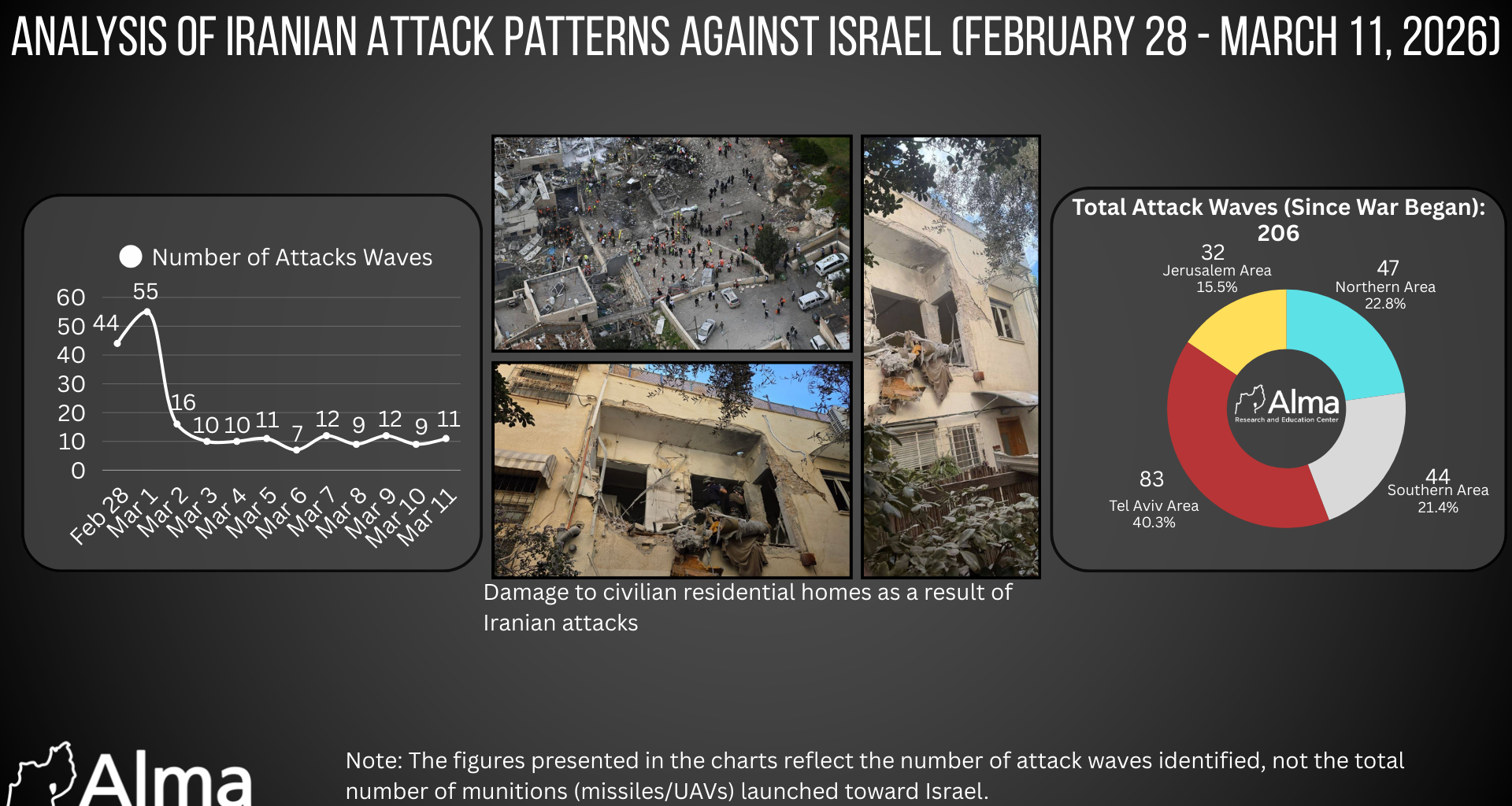
A review of the data accumulated on Iranian attacks against Israel since the commencement of the campaign within Operation “Roar of the Lion” (February 28) reveals identifiable operational trends, target selection patterns, and the strategic rationale guiding Iran’s conduct in the current campaign.
As of March 11, a total of 206 attack waves involving ballistic missiles and unmanned aerial vehicles have been recognised. It should be emphasized that these figures refer to the number of attack waves rather than the total number of munitions launched.
Quantitative Dynamics of the Attacks
Analysis of the attack waves timeline reveals two principal phases in the evolution of Iranian operational behaviour:
The first phase took place during the opening days of the campaign (February 28 – March 1) and was marked by exceptionally high firing intensity. On the first day, 44 attack waves were recorded, while on the second day the number of attacks reached a peak of 55 waves.
The high level of activity during these initial days may suggest that Iran sought to quickly employ a substantial share of its available launch platforms and munitions before potential damage to its infrastructure and launch capabilities. It is possible that Iran aimed to take advantage of the early phase of the campaign, when its launch, command, and munitions systems were still fully operational and readily accessible.
The second phase (March 2–11) is characterized by a sharp decline in the scope of the attacks. The number of daily attack waves first dropped to 16 waves and later stabilized around 7–11 attack waves per day.
This decline likely reflects operational and logistical limitations affecting the launch rate, stemming from damage to Iran’s missile and UAV launch systems and infrastructure. This damage results, among other things, from interception and counter-action operations carried out by Israel and the United States, which operate against launch sites, missile arrays, and UAV capabilities.
In addition, the elimination of senior officials and damage to the command-and-control chain may also affect the operational capabilities of the forces operating the launch systems, impairing coordination, decision-making, and the pace of fire activation. The combination of these factors may limit the rate of launches and directly influence the scope of the attacks in the later stages of the campaign.
Geographical Analysis of Attack Targets
The distribution of the attacks by region indicates a clear focus on central Israel. Out of the 206 attack waves, 83 were directed at the Tel Aviv metropolitan area, constituting approximately 40% of all attacks. The northern region absorbed 47 waves (22.8%), the south 44 waves (22.8%), and the Jerusalem area 32 waves (15.5%).
This focus is not coincidental. The Tel Aviv metropolitan area is the largest population center in Israel (home to approximately 4 million Israeli citizens) and constitutes a central economic, technological, and infrastructural hub.
Despite the focus on the Tel Aviv metropolitan area, there is also a complementary geographic distribution of the attacks. Alongside the concentration on the central region, attacks continue to target the north, the south, and the Jerusalem area.
Operational Patterns and Iranian Strategy
Creating a broad psychological effect on the Israeli public – a sustained sense of threat, attrition, and fatigue.
Influencing Israeli domestic public opinion in order to generate pressure to end the war.
Disrupting the economic functioning of the state.
Operational attrition of Israel’s air defense systems.
A complementary geographic dispersion of attacks expands the threat environment, intensifies the economic strain, and increases military operational attrition.
