
 Play Brightcove video
The war in the Middle East is creating the largest supply disruption in the history of the global oil market, according to the International Energy Agency. Economics Editor Joel Hills reports on the latest spike in oil prices
Iran’s new Supreme Leader, Ayatollah Mojtaba Khamenei, issued his first statement on the war, saying that the leverage of closing the Strait of Hormuz should be used
Oil prices have risen back over the $100 a barrel mark after a series of attacks on energy infrastructure across the Gulf region
It comes after the International Energy Agency agreed to release 400 million barrels of oil into the market to soften the economic blow of the Middle East war
Prime Minister Sir Keir Starmer has vowed that the government will “step in” if companies exploit rising heating oil prices
More than 1,300 people have been killed in Iran since the war began, while 12 people have been killed in Israel. The US has lost seven soldiers, while 634 people have been killed in Lebanon
The UN Refugee agency (UNHRC) says up to 3.2 million people in Iran have been temporarily displaced as a result of the war. The agency previously said 700,000 people had been displaced in a week in Lebanon
Search efforts are continuing for three crew members of a Thai cargo ship attacked in the Strait of Hormuz
Iran’s new Supreme Leader, Ayatollah Mojtaba Khamenei, has said the regime will continue to target the Strait of Hormuz and attack Gulf Arab neighbours in his first statement since his appointment.
He did not appear on camera, fuelling speculation over his health. An Israeli assessment has indicated he was injured in the war’s opening attack.
Khamenei’s comments were instead read on state television on Thursday by a news anchor.
Unrelenting attacks by Iran on energy infrastructure and fuel tankers have pushed oil above the $100 a barrel milestone once again, with no end to the war in the Middle East in sight.
IEA orders largest-ever release of stockpiled oil
Oil prices crossed the $100 mark this week – for the first time since July 2022 – before falling again later in the week after Donald Trump suggested the war is “pretty much complete”.
The president said on Thursday that as the world’s largest oil producer, the US makes “a lot of money” when prices spike, but that was not his primary concern.
“Of far greater interest and importance to me, as President, is stoping (sic) an evil Empire, Iran, from having Nuclear Weapons, and destroying the Middle East and, indeed, the World. I won’t ever let that happen!,” he wrote on Truth Social.
On Wednesday, the International Energy Agency (IEA) agreed to release 400 million barrels of oil into global markets from reserves to soften the economic shock of the war.
This is the sixth time in history this has happened.
The release far surpasses the 182 million barrels of oil put out into the market in two tranches in 2022 in response to Russia’s war in Ukraine, but the announcement does not appear to have calmed markets.
Iran has a stranglehold on the Strait of Hormuz, the strategic waterway leading from the Persian Gulf toward the Indian Ocean through which a fifth of the world’s oil is transported.
In response to the effective shutting of the Strait of Hormuz, Saudi Arabia, the world’s largest oil exporter, has to redirect its maritime trade to its western Red Sea ports to avoid the Strait.
Watch: Aerial footage shows US airstrikes on grounded planes in Iran
More attacks in the Gulf
Iran hit a container ship off the coast of Dubai, caused a blaze near Bahrain’s international airport, targeted a major Saudi oil field with a drone attack, and forced Iraq to halt operations at all the country’s oil terminals after an attack on its port of Basra on the Persian Gulf.
Iran flouted a United Nations Security Council resolution from the previous day demanding that it halt strikes on its Gulf neighbours, with new attacks also reported in Kuwait and the United Arab Emirates.
Many other Gulf nations have also seen their energy infrastructure attacked and have reduced their output.
This comes a day after the UN Security Council voted to approve a resolution demanding a halt to Iran’s “egregious attacks” on its neighbours, who are allied with the US.
But Tehran has shown no signs of backing down.
Ships line up outside the Strait of Hormuz, as seen from the United Arab Emirates, earlier this week. Credit: AP
In Bahrain, an Iranian attack sparked a major fire on Muharraq Island, home to the country’s international airport. The airport has jet fuel tanks, and other tanks in the area serve the kingdom’s oil industry.
Kuwait’s Defence Ministry said an Iranian drone smashed into a residential building, injuring two people. Later on Thursday, authorities said drones hit the country’s international airport, adding that no one was injured.
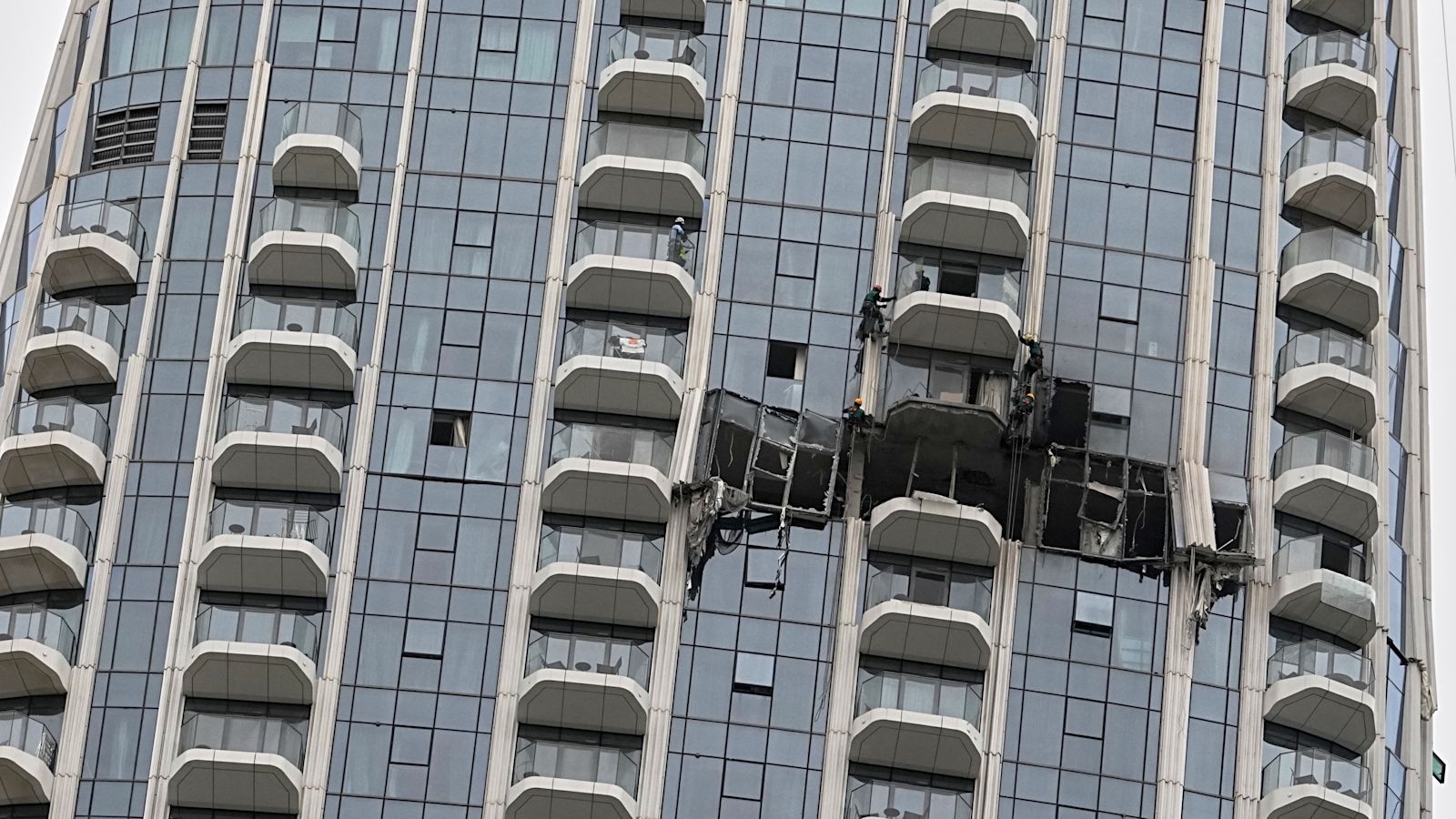
The UAE said it had activated air defences twice to protect Dubai from attacks, and firefighters extinguished a blaze at a tower in Dubai Creek Harbour after a drone hit.
Saudi Arabia said it shot down a drone targeting the diplomatic quarter of the capital, Riyadh, and also reported downing drones in the kingdom’s east, including at least one trying to target its Shaybah oil field.
The Thai vessel Mayuree Naree on fire after an attack in the Strait of Hormuz on Wednesday. Credit: CNN
UK response
UK Prime Minister Sir Keir Starmer said the government will “step in” if companies exploit rising heating oil prices amid the Middle East conflict, and the Treasury is already set to work with the Northern Ireland Executive to reduce home heating oil bills.
Prices jumped after Iran launched retaliatory strikes following attacks by the US and Israel, pushing up energy costs and sending home heating oil bills soaring.
On Thursday ahead of a visit to Northern Ireland, where the majority of people rely on heating oil to warm their homes, Starmer acknowledged that “global instability has real impacts on the lives of working people across the UK”.
Workers inspect damage caused by a drone strike overnight at the Address Creek Harbour hotel in Dubai. Credit: AP
He said: “Let me be clear, we will not tolerate profiteering or unfair practices.
“If companies fleece customers or rip them off, we will not hesitate to step in, and that includes on regulation.”
It comes after Rachel Reeves admitted it was “certainly not good for the British economy to have trade disrupted” and signalled the government may be willing to move on energy prices if the conflict worsens.
Possible Russian involvement
Meanwhile, the defence secretary has suggested Vladimir Putin’s “hidden hand” could be behind some of Iran’s tactics in the Middle East conflict.
When asked if there was evidence of links between Russia and Iran, John Healey said the UK is “analysing the drone that struck the hangar at Akrotiri for any evidence of Russian or any other foreign components and parts”.
“I think no one will be surprised to believe that Putin’s hidden hand is behind some of the Iranian tactics, potentially some of their capabilities as well, not least because one world leader that is benefiting from the sky-high oil prices at the moment is Putin.”
Subscribe free to our weekly newsletter for exclusive and original coverage from ITV News. Direct to your inbox every Friday morning.
Israel preparing for military ‘expansion’
Sirens wailed before dawn in Jerusalem after Israel said it was working to intercept missiles launched from Iran.
The country also announced it had begun a “wide-scale wave of strikes” on Tehran.
In Lebanon, where Israel says it is targeting Iran-linked Hezbollah militants, 11 people were killed in two early morning strikes.
The latest round of conflict between Israel, the US, and Iran has reignited attacks by Tehran-backed Hezbollah militants in southern Lebanon.
Hundreds of thousands of people have been displaced amid a series of airstrikes, including in downtown Beirut, and military action in the country could be expanded, according to remarks by Israel’s defence minister.
During a security assessment with military officials on Thursday, Israel Katz warned Lebanon that if its government does not prevent Hezbollah from attacking, Israel “will take the territory and do it ourselves.”
In a video statement released by his office, Katz said he and Prime Minister Benjamin Netanyahu instructed the military to prepare for “an expansion” of its activity in Lebanon and “to restore calm and security to the northern communities.”
From Westminster to Washington DC – our political experts are across all the latest key talking points. Listen to the latest episode below…