
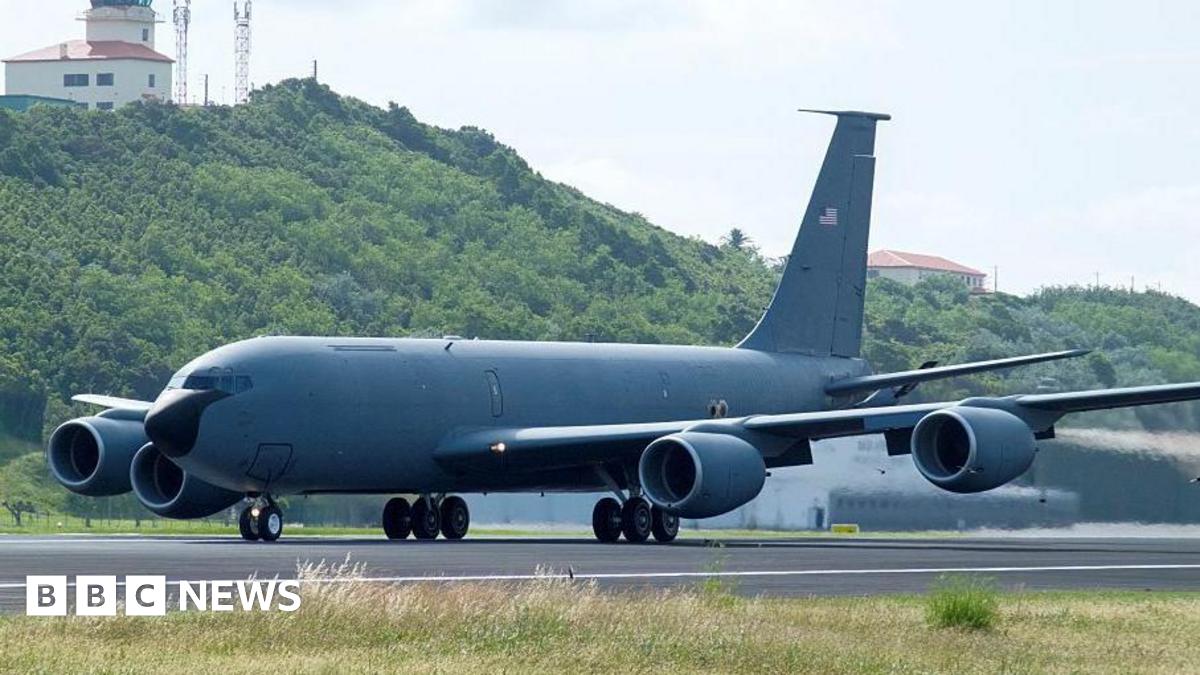
US refuelling planes play crucial role in powering bombing raidspublished at 22:43 GMT 12 March
22:43 GMT 12 March
Chris Partridge
BBC News weapons analyst
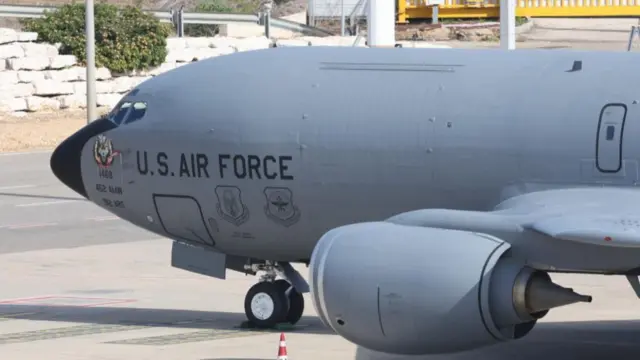 Image source, EPAImage caption,
A US Air Force Boeing KC-135 Stratotanker aerial refueling tanker aircraft is seen in Ben Gurion international airport near Tel Aviv, Israel, in February
We do not know what brought down this KC-135 refuelling aircraft but one possibility is a mid-air collision.
These tankers play a major role in wars, keeping fighter jets and bombers properly fuelled for combat when such aircraft have to fly long distances to get to target.
It’s a huge logistical operation, with many jets in the air at the same time, each requiring fuel.
Refuelling involves flying very close to the tanker, before a probe from the tanker is extended and lowered.
The receiving aircraft pilot flies up to the probe and, using a system of lights under the tanker, re-positions themselves so the probe can literally “plug in” to the jet.
Once contact is made, fuel is transferred in a process that can take several minutes.
All this time the aircraft is literally feet from the larger tanker – in operations that often happen at night.
It requires considerable skill for the pilot to maintain contact with the probe, or in some cases a shuttlecock-shaped drogue, in an environment where there may be many other planes close by.
And during refuelling missions, lights on aircraft may be out completely to avoid detection by the enemy.
US Central Command said this happened over Iraq but we don’t know how far it was from neighbouring Iran.
The KC-135 typically has a crew of three – a pilot, a co-pilot and a boom operator.
The Air Mobility Command, according to the USAF, has nearly 400 tankers in its fleet.