
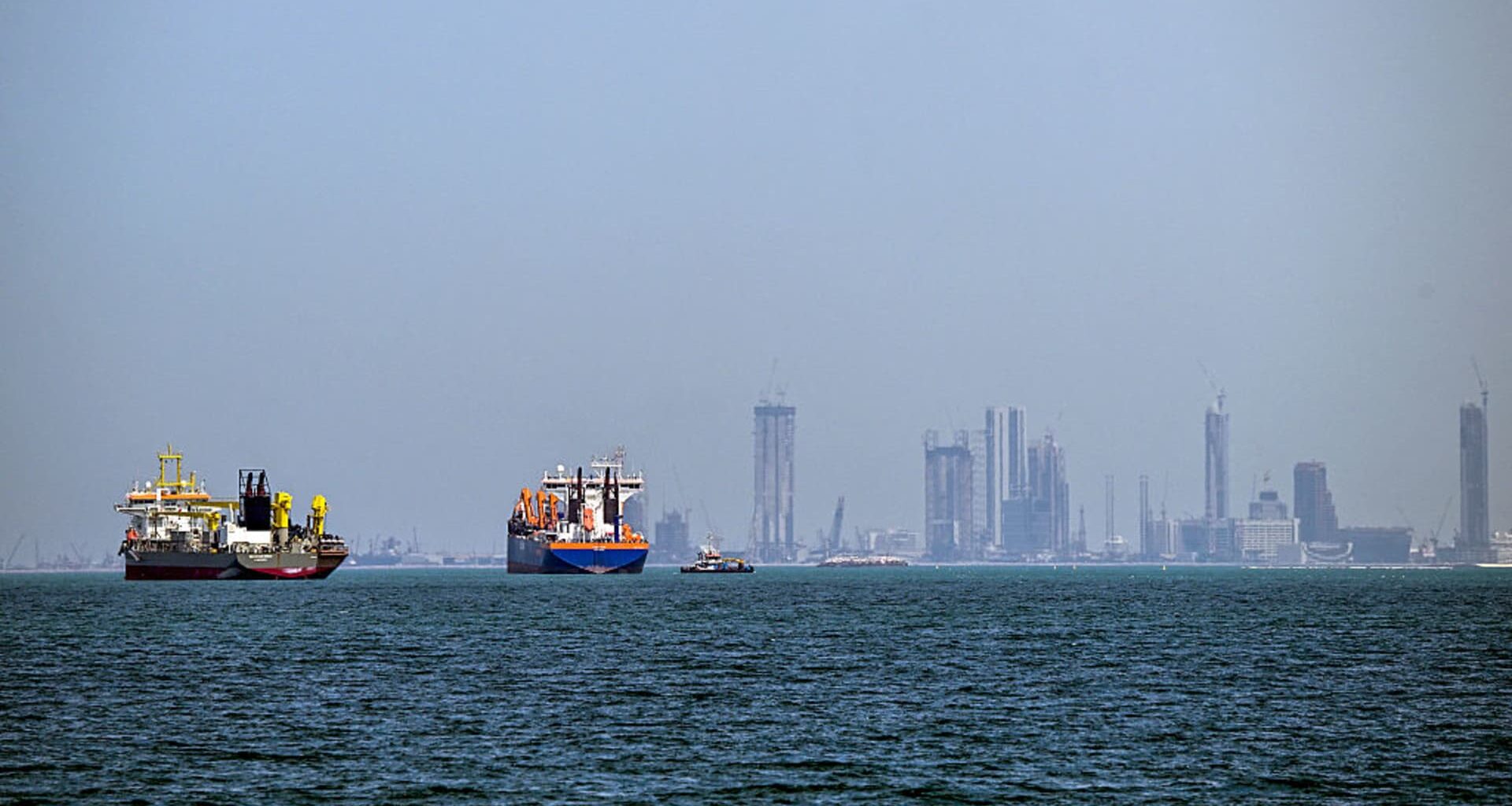
Commercial vessels are pictured offshore in Dubai on March 11, 2026.
– | Afp | Getty Images
Asia-Pacific markets opened lower Friday as oil prices soared on renewed fears that a prolonged conflict in the Middle East could further crimp energy supplies, stoking fears of a global economic downturn.
Iran’s new Supreme Leader Mojtaba Khamenei said in a late Thursday speech that the Strait of Hormuz, a vital artery for global oil trade, should remain shut and that Tehran could open other fronts in the war if the conflict persists.
Commander of the Iranian Revolutionary Guard Corps Navy, Alireza Tangsiri, also doubled down on the threat in a social media post, warning of “the harshest blows to the aggressor enemy.”
Bettors on prediction market Kalshi raised their wagers that the U.S. economy may enter a recession this year, with the likelihood climbing to 32% — highest level this year.
International benchmark Brent crude jumped 9.22% to close at $100.46 per barrel on Thursday. It was the first time Brent closed above $100 since August 2022. U.S. West Texas Intermediate futures rose 9.72% to settle at $95.73.
Oil prices are likely to remain elevated in the near term as investors price in the risk of a prolonged Middle East conflict, Rob Thummel, senior portfolio manager at Tortoise Capital, told CNBC’s “Squawk Box Asia” on Friday.
But he expects prices to ease towards the end of the year as oil flows through the Strait of Hormuz are likely to resume. “By December, that [oil] supply will be better, will be higher so if you can make it in December, you will be able to buy oil much cheaper.”
Stock Chart IconStock chart icon
Goldman Sachs analysts forecast Brent to average $98 per barrel in March and April — up 40% from the 2025 average — before falling to $71 by the fourth quarter. In the event that oil flows through the strait are disrupted for one month, Brent will likely average higher at $110 in March before gradually falling to $76 by year-end, according to Goldman.
U.S. President Donald Trump has sought to downplay the rise in oil prices, saying that the U.S., as the world’s largest oil producer, stands to benefit from higher oil prices, while stressing that his priority would be blocking Iran from obtaining nuclear weapons.
Treasury Secretary Scott Bessent said Thursday night that the U.S. would temporarily allow the purchase of sanctioned Russian crude that is already at sea to stabilize energy markets, while framing the price spike as a “temporary disruption.”
Australia’s S&P/ASX 200 tumbled 0.3% in early Asia trade.
Japan’s Nikkei 225 dropped 2% while the broad-based Topix fell 1.4%. Honda Motor plunged over 6%, the biggest drag on Nikkei, after the automaker forecast its first annual loss in almost 70 years.
South Korea’s blue chip Kospi slumped almost 3% and the small-cap Kosdaq shed nearly 2%.
Hong Kong’s Hang Seng index tumbled 0.2% while mainland China’s CSI 300 index inched 0.3% higher.
Overnight in the U.S., major stock indexes notched closing lows for 2026, with the Dow Jones Industrial Average falling nearly 740 points to settle below 47,000 for the first time this year.
The S&P 500 shed 1.5% to end the session at 6,672.62, while the Nasdaq Composite lost 1.8% to close at 22,311.98.
Futures tied to the 30-stock Dow inched down 0.03%. S&P 500 futures advanced 0.21%, while Nasdaq 100 futures added 0.12%.
Investors await key U.S. inflation data. Economists polled by Reuters forecast the personal consumption expenditures price index, due to be released on Friday, to have risen 2.9% year on year in January, and the core index is expected to have accelerated to 3.1%.