
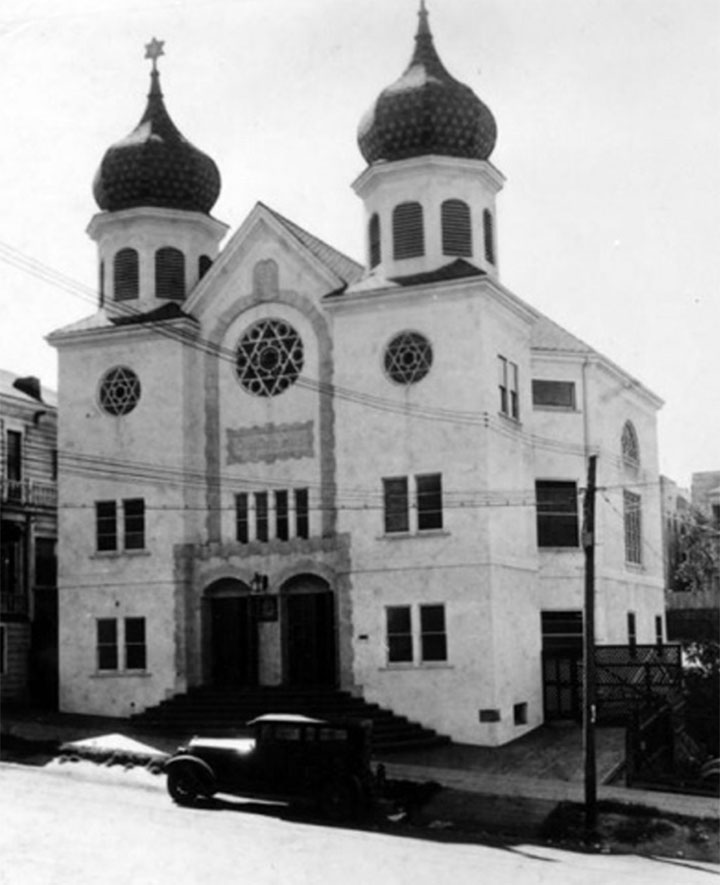
“A shul has nothing to do with wood, bricks and concrete. It’s only about the people who congregate.” — Cantor Hershel Walfish, Z”L, Congregation Beth Israel (1922-2012)
It’s been many years since I took a Google Map “tour” of my old neighborhood in the Fairfax District of Los Angeles. Most such tours left me feeling melancholy. This time, however, it turned out to be a joyous and inspirational experience. My parents (Harold and Edith), my younger brother Gary, and I moved to the predominantly Jewish Fairfax neighborhood in 1955, just in time for me to begin first grade at Hancock Park Elementary School. I was fortunate to have a marvelous, renaissance woman as my teacher: Mrs. Edith Shain, who was also the nurse in the iconic “Kiss” photograph, taken a decade earlier on V-J Day in Times Square.
On these virtual travels, I typically “drove” down South Laurel Ave., to see my childhood home, which has since been transformed into a canonical McMansion. This time, I ventured north a few blocks to Beverly Blvd. to pass by Congregation Beth Israel, where my father took me for Shabbat morning services throughout my youth, beginning years before my Bar Mitzvah.
Congregation Beth Israel is the oldest traditional Orthodox shul in Los Angeles, which was dedicated in 1902 and originally located in the Bunker Hill District in Downtown LA. The shul was relocated to its present location in the Fairfax District in 1953, where Holocaust survivor Cantor Hershel Walfish, Z”L, became its spiritual leader and chazzan for over 55 years. After his passing, his son, Cantor Steven Walfish, assumed his father’s leadership and cantorial roles, and continues to serve the community to this day.
On this particular journey through my childhood neighborhood, my laptop revealed a totally different structure where Beth Israel once stood. The original shul, that served the community for over a half-century, had been replaced by a six-story building, extending the entire block, along the south side of Beverly Blvd., from Laurel Ave. to Crescent Heights Blvd.
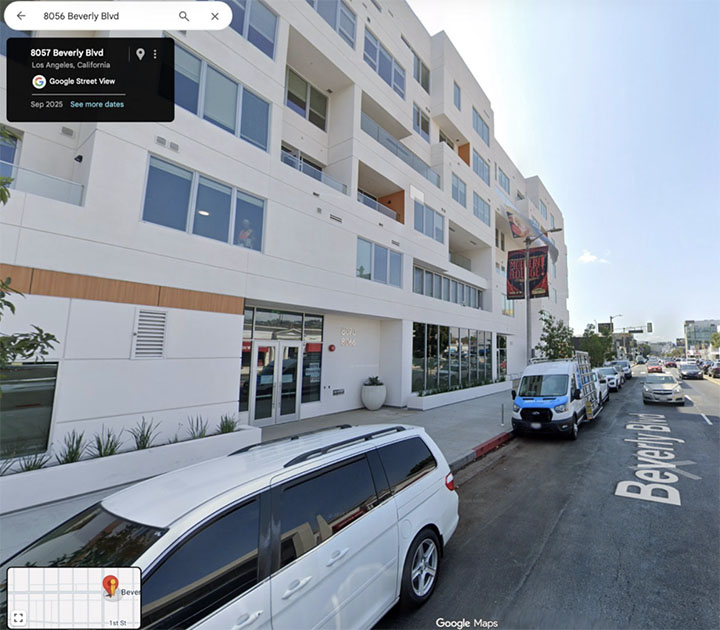 The new facility, a vision of Cantor Steven Walfish, partnered with Black Equities, is located on the south side of Beverly Blvd (viewing west), between Laurel Avenue and Crescent Heights Blvd. Photo: Google Maps, 2025
My curiosity led me to contact Cantor Steven Walfish to resolve this conundrum. He had uplifting news: “The new structure is a soon-to-be-open, state-of-the-art, senior housing building, with assisted living and memory care facilities. And, a newly designed Congregation Beth Israel synagogue will be on the ground floor!”
This 10-year project, a vision by Cantor Walfish and partnered with Black Equities, will enhance the aging Fairfax community and preserve the oldest traditional Orthodox synagogue in our city. As Walfish shared with me, the reality is that many Los Angeles shuls have closed their doors, owing to changing demographics, including congregants who have relocated, passed away, joined other shuls with schools, etc. It is therefore a tribute to Walfish and Black Equities to combine a much-needed residential facility for our local, aging population with a house of worship located on the same campus. Walfish’s father would be so proud of his son’s efforts and commitment to enhance the community as it enters into the 21st century.
During my formative years in the ‘50s and ‘60s, I was fortunate to be raised by wonderful, dedicated and supportive parents. They settled in a sprawling Jewish community in LA, populated by newly arrived Holocaust survivors (including Cantor Walfish, my father Harold, and my mother Edith), who were eager to begin a new life in America. They appreciated the opportunities that were previously denied to them during the war, including the freedom to embrace their religious beliefs and to pursue education. They were excited to be in a new country, free of tyranny and oppressive government control.
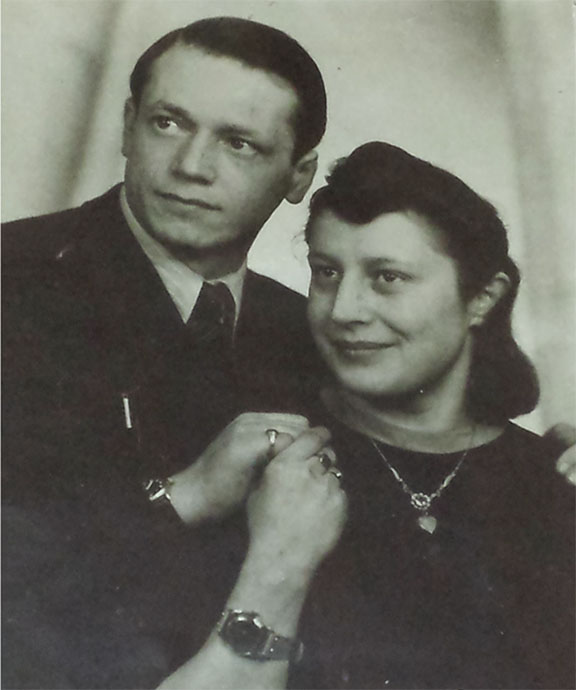 Harold, Z”L, and Edith, Z”L, Pepper (formerly, Pieprz), were married after the war, in Oct., 1946 in a displaced persons camp in Amberg, Germany and immigrated to America in 1947.
Photo: Pepper family
Some of my earliest childhood memories revolve around shuls and schools: Judaism and Torah. We first lived in the West Adams area of the city. I remember, as a three-year-old, accompanying my parents, as we walked from our small home on Sycamore Avenue to the Agudath Achim shul, located on West View Street and Adams Blvd, for Yom Kippur services.
The following year, my dear parents enrolled me in a Hebrew parochial nursery school/shul, located in the Fairfax neighborhood, near the Farmers Market, along Third Street, and spanning an entire block, from Laurel to Edinburgh Avenues. The school also had a very small Orthodox shul, where my father would take me to daven several years later.
As Cantor Walfish noted, time has taken its toll in our Jewish community, as the demographics have evolved. In my experience, Agudath Achim is now the Metropolitan AME Zion Church, and the Hebrew parochial nursery school/shul on Third Street has become a car wash.
Several years later in 1955 we moved to a home on Laurel Ave., in the up-and-coming Fairfax Jewish community. It was delightful to hear Yiddish spoken routinely during a stroll along Fairfax Avenue and to see posters on telephone poles announcing the upcoming High Holydays, with photos of the chazzans and rabbis who would officiate the services. At this time, Fairfax High School was not in session on Yom Kippur, as most of its student body were Jewish and would be davening in the neighborhood shuls on the holiest of days.
Since we lived on Laurel Ave., just a few blocks south of Beverly Blvde, Congregation Beth Israel became our synagogue. Many of my fondest memories relate to my experiences at that most wonderful shul, which I carry to this day when I reminisce about my Judaic roots.
Many of my fondest memories relate to my experiences at that most wonderful shul, which I carry to this day when I reminisce about my Judaic roots.
Congregation Beth Israel was originally located in the Bunker Hill district of LA, dedicated in 1902. In 1953, it was relocated to the Fairfax neighborhood. Over the next 50+ years, Holocaust survivors would primarily fill the traditional Orthodox synagogue regularly, and melodious Yiddish conversation would permeate throughout the shul. To me, it was akin to a “Fiddler On the Roof” atmosphere just up the street!
The actual building was a former movie theater that opened in 1941. As a kid, I would look at the wall behind our seats and see the outlines of the now-covered array of openings from which motion pictures once emerged during its heyday. Back in the ‘50s, the entrance to the synagogue had an art-deco pattern of frosted-glass, bricklike elements, arranged in an arc on either side of the entry doors, not typical of your religious house of worship.
We sat in the last row, off to the side of the shul. These seats were all that my father could afford, given his meager, hard-earned income derived from a small venetian blind business that he began on his own after immigrating to the U.S. with my mother in 1947 (my father, thank G-d, survived 12 concentration camps during the Holocaust).
As it turned out, our distinguished chazzan, Cantor Hershel Walfish, Z”L, was raised in Chrzanow, a small shtetl in southern Poland. My parents were raised in neighboring Bendzin (Bedzin), also a small shtetl, only 25 miles distant. Tragically, Chrzanow was but 10 miles from the death chambers of Auschwitz. Cantor Walfish and both of my parents were concentration camp survivors. Cantor Walfish was the only surviving member of his family, who were all murdered by the Nazis (80% of my family was murdered). But they persevered through this nightmare and began to reestablish their lives, with alacrity, in the U.S. In spite of the atrocities they experienced, Cantor Walfish, my parents and their fellow lantzmen maintained a wonderful spirit and a zest for life, as they played a role in the emergence of a new, tightly-knit, Jewish community in a new country.
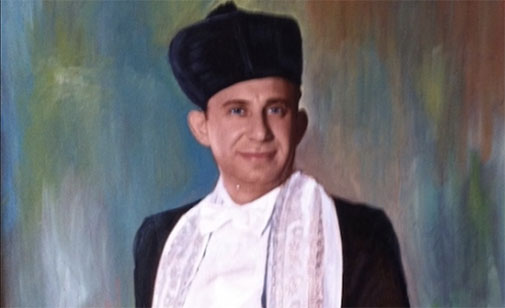 Cantor Hershel Walfish, Z”L, inspired, sang and taught for more than 55 years at Congregation Beth Israel, the oldest traditional Orthodox synagogue in LA. His son, Steven, assumed the cantorial role at Beth Israel after his father’s passing.
Photo: Walfish family
After the war, Hershel Walfish and my parents immigrated to America, eventually settling in LA, unaware of the journeys of each other. By sheer coincidence, both families ended up living on the very same block on Laurel Ave. Subsequently, my father met Chazzan Walfish at Beth Israel. What a wonderful reunion that must have been!
It’s unbelievable that, after being raised in neighboring shtetls in southern Poland (only 25 miles apart), they would survive the Holocaust and eventually become neighbors once again, halfway around the globe in LA, just a few homes from one another. It was beshert. Of course, both families spoke Yiddish and became close friends. I loved to wish Cantor Walfish “Ah Gutten Shabbos” every Shabbat, and to hear his operatic-voice in response, with kindness, a smile on his punim and a gleam in his eyes.
We attended Shabbos services at Beth Israel almost every Shabbat. It became a tradition that, following the services, my father taught me about Judaism and Divrei Torah, the teachings of the Torah. He would read the weekly Parsha (the Torah portion) in Hebrew and then translate it into Yiddish for me to understand. Over the years, my parents instilled in me ethical values, as well as to be respectful of others and to appreciate the virtues of pursuing higher education and achievement.
In the synagogue, I vividly recall the chanting of the Torah portion by the Baal Keriah every Shabbos, hearing the resonant sounds of the shofar echoing throughout the shul on Rosh HaShanah, and remembering my mother weeping softly as tears streamed down her face during the very emotional delivery of Kol Nidre, on the eve of Yom Kippur. I also remember being asked by my parents to temporarily leave the shul during the Yizkor memorial service on Yom Kippur, as adult worshippers would recite solemn prayers in honor of the souls of their departed, loved ones.
I will never forget when I was offered the mitzvah and honor of opening the ark prior to the chanting of the somber U’netaneh Tokef. It is one of the most powerful and central liturgical poems (piyyut) recited during the Rosh HaShanah and Yom Kippur morning services, in which the prophetic phrase, “who shall live and who shall die” is chanted, reflecting on the themes of judgment and mortality. It brought me to tears as I stood by the open ark, revealing the Torah scrolls, with Cantor Walfish alongside, chanting this emotional prayer with his supporting choir.
It brought me to tears as I stood by the open ark, revealing the Torah scrolls, with Cantor Walfish alongside, chanting this emotional prayer with his supporting choir.
One of my most wonderful memories occurred during the chanting of V’chol Ma’aminim by Cantor Walfish and his then not-too-tall, young son Steven, “Stevie,” about eight years old at the time, standing alongside his father, and accompanying him in this contemplative prayer. As a teenager, I fondly remember hearing Steven’s beautiful, young voice in unison with his father’s operatic voice, with the harmonizing choir in the background. Steven’s voice was obviously high-pitched at the time, but his melodic rendition was perfect, and his command of the Hebrew language impeccable. It was a very inspirational moment, indeed. One could hear the congregation davening, but could also detect the din of the congregants quietly whispering about “Stevie” in awe. It was clear that a future chazzan was chanting before us.
On a more festive note, my father’s favorite Jewish holiday was Hoshana Rabbah, held on the morning of the seventh day of Sukkot. During this service, about 20 congregants would chant prayers as they circled the interior of the synagogue seven times, each holding a ceremonial lulav and etrog in hand, comprised of palm branches, myrtle, willow and a citron, to symbolize differences in people possessing good deeds and Torah knowledge. My father would allow me to hold the lulav and etrog as we both circled the synagogue. It was a highlight for us both. Ironically, in 1999 he passed away on his favorite holiday.
The holiday of Simchat Torah, when all the Torahs were removed from the ark and distributed to the congregants to hold and to proudly carry in a procession around the congregation seven times (seven Hakafot), was equally memorable. The children would accompany their elders, waving colorful flags with bright red apples attached to the tops of the small wooden flagpoles.
It was rumored over the years that the synagogue attracted celebrities during the High Holyday services. After all, Joseph Max Wapner was the president of the shul at one time (father of the well-known “People’s Court” Judge Joseph A. Wapner). As a pre-teen, I recall hearing rumors from adults that Tony Curtis was in the shul. And in 1965, when Sandy Koufax didn’t pitch in Game 1 of the World Series, rumors spread that he was in attendance. I was told to focus my attention instead to the liturgy in my Machzor.
After the Shabbat morning services, my father and I would stroll to the Aquarium Stock Company, a tropical fish store located at the corner of Beverly and Crescent Heights Blvds., just a two-minute walk from the shul. He loved to show me the small, tropical fish, especially the red-fluorescent-striped neon tetras, as they meandered in small schools, tracing zig-zag paths in their five-gallon abodes, darting past the bubbling, rotating paddle wheels and the flora, nestled in the gravel at the aquarium’s base.
My father also had a very small aquarium in our home, as far back as I can remember, stocked with those gorgeous neons, as well as a small catfish, who I swear outlived our pet dog. To this day, I make it a memorable destination to stop at a local PetSmart with Denise to view these fascinating little fishes, as tender images of my father appear in my mind.
An absolutely hilarious moment occurred during a Shalosh Seudos service at the shul on Shabbos afternoon, prior to the conclusion of Shabbat. Zemirot (song) and Divrei Torah (teachings of the Torah) are the order of the day, all in Yiddish, of course. Light food and drink are served, such as challah and matzah, with a sprinkling of zaltz (salt), some Gefilte fish, hard-boiled eggs, etc. I was typically the only boy there, accompanying my father and enjoying every moment. At one Shalosh Seudos service, a man pointed across the table and said, “ah bisl alte shnayder.” I asked my father, “Did he mean that a person across the table was a little, aging tailor?” “No,” my father chuckled. “He was asking for a shot of Old Taylor shnaps!”
In the mid-1970s, Beth Israel underwent a major remodel. The rectangular lights along the walls, which were originally in place when the building was a movie house, were upgraded to artful clusters of lights in gold-colored holders. The rear wall that revealed the patched openings, through which movies were once projected, was overlayed with beautiful wood paneling. Gorgeous, hand-painted pastel murals of Judaica artifacts and biblical figures adorned the walls leading up to the bimah. Artistic, stained-glass windows were installed along the side walls and back-lit to reveal their colorful elegance during the services. And, of course, the bimah was completely redesigned to enhance the Judaic nature of the shul, replacing the stage that served theater-goers years earlier. Finally, a new ark was placed at the eastern wall (to face Jerusalem), at the back of the bimah, housing the Torah scrolls.
Enthusiastically, I performed an extensive web search to locate photographs of the shul. I was able to find a pair of historic pictures of Beth Israel, both taken in 1937, before its move to the Fairfax area: an exterior photo and an interior image of a wedding held there. A unique, elegant, two-level-high, domed glass structure stood within the synagogue’s interior on its bimah. Apparently, a small orchestra sat above to entertain the guests below.
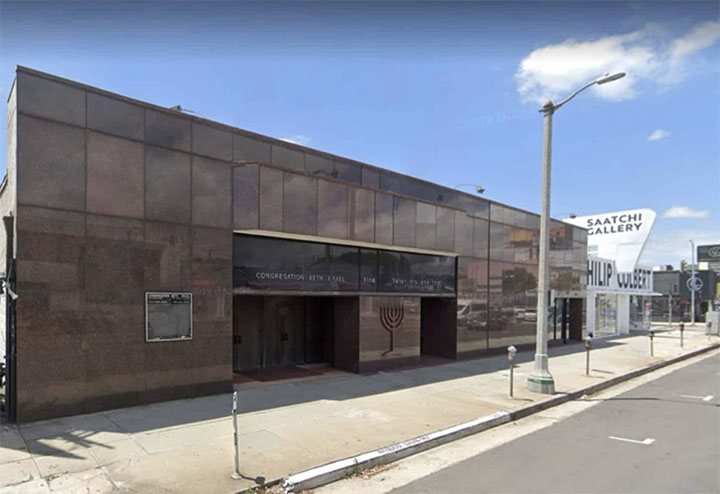 Congregation Beth Israel (viewing west along 8056 Beverly Blvd.), the oldest traditional Orthodox Synagogue in LA. The shul was relocated, in 1953, from its original home in the Bunker Hill District of LA, to its present location, in the Fairfax neighborhood. The “Saatchi Gallery” sign is that of the former Aquarium Stock Co., located at the west end of the block, at Crescent Heights Blvd.
Photo: Google Maps, circa 2019
A relatively recent photo that I found of Beth Israel was taken in circa 2019, shortly before construction commenced on the state-of-the-art synagogue/residential-housing building along Beverly Blvd. My attention was drawn to a glass-encased, outdoor display board, located to the left of the entrance to the original synagogue, which had been there for over 40 years. The signage was not typical of what I would have seen back in the day. It read in part: “Kehillat Ahavat Israel presents a Megilah Reading.” As Cantor Walfish shared with me, “In addition to the traditional Orthodox, Eastern-European Ashkenazi community, the synagogue now also serves those of a strictly Orthodox, Israeli heritage.”
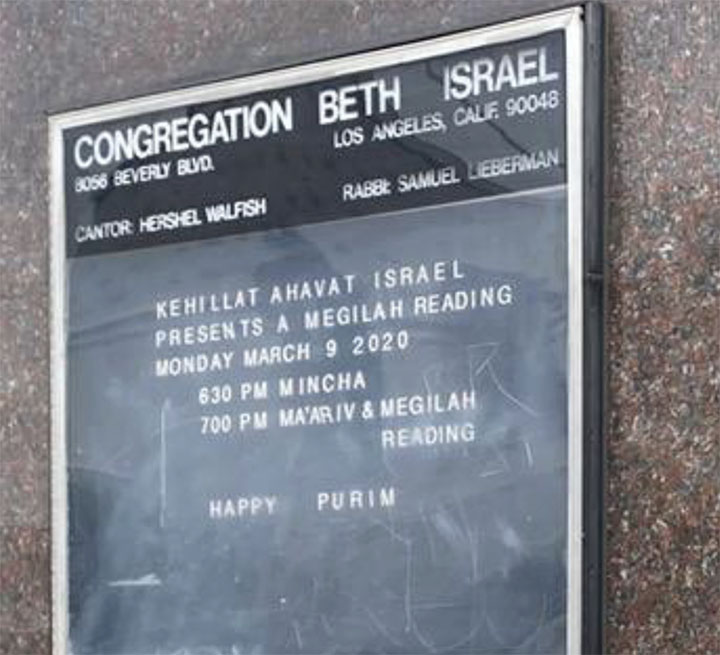 Close-up of the outdoor bulletin board, located to the left of the main entrance, highlighting Cantor Walfish and Rabbi Leiberman, the spiritual leaders of the shul for decades.
Photo: Google Maps, circa 2019
A silver lining, reflecting back to my earlier years, revealed itself when I zoomed in closer to that outdoor display board. Its heading read: “Cantor Hershel Walfish” and “Rabbi Samuel Leiberman”—a tribute to the synagogue’s spiritual leaders who served the community when my father and I attended the shul some 30 years prior. As a pinch of frosting on the cake, the signage wished all a “Happy Purim,” which is the festive holiday on which Denise and I were married, back in the early ‘90s. It also displayed the actual Purim date of 2020: “March 9,” which turns out to be the date of my birth, back in the late ‘40s. Perhaps the spirits of the Walfish meshpacha and of my parents came through to call to my wife Denise and me.
David M. Pepper holds a PhD and MS in Applied Physics from Caltech, and a BS in Physics (Summa Cum Laude) from UCLA. He was a laser physicist at HRL Laboratories (formerly Hughes Research Labs), in Malibu, CA, over his entire 31-year career. He was also an Adjunct Professor in the Natural Science Department at Pepperdine University. He owns Malibu Scientific, a technical consulting company. Dr. Pepper is an inventor on 72 issued U.S. Patents, and has published extensively in myriad archival technical journals, including “Scientific American” and “American Scientist.” He lives in Camarillo, C.A. with his wife and dogs