
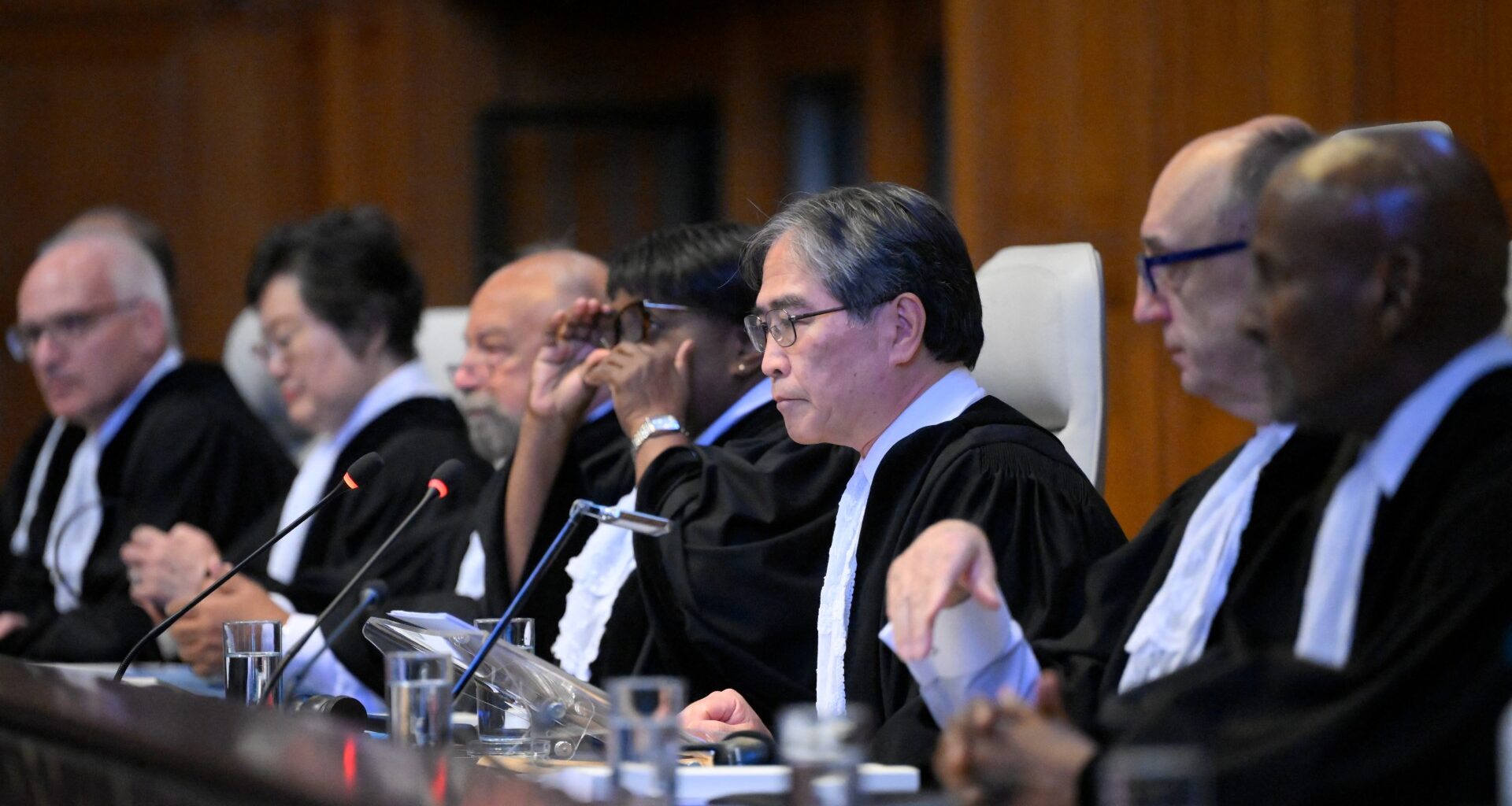
Iceland and the Netherlands filed declarations to intervene in South Africa’s genocide case against Israel at the International Court of Justice (ICJ) on Thursday, bringing the number of countries seeking to participate in the proceedings to 18.
Both states filed declarations under Article 63 of the court’s statute, which allows countries that are parties to a treaty at issue in a case to intervene in order to present their interpretation of that treaty.
The case, brought by South Africa in December 2023, accuses Israel of violating the 1948 Genocide Convention through its military campaign in Gaza since October 2023.
During its devastating onslaught, Israel has so far killed over 70,000 Palestinians in Gaza, most of them women and children. It has also destroyed most of the enclave’s homes, hospitals, schools and infrastructure, rendering it largely uninhabitable for its 2.3 million civilians.
South Africa argues that Israel’s actions in Gaza amount to genocide, including through killing Palestinians, causing serious bodily or mental harm and imposing conditions of life calculated to bring about the group’s destruction. Israel denies committing genocide.
New MEE newsletter: Jerusalem Dispatch
Sign up to get the latest insights and analysis on
Israel-Palestine, alongside Turkey Unpacked and other MEE newsletters
But a UN commission of inquiry concluded last September that Israel has committed genocide (the gravest crime under international law) in Gaza since 7 October 2023.
The UN report’s authors, including legal experts Navi Pillay and Chris Sidoti, told Middle East Eye that the report used evidence and a similar methodology in its analysis to that which will be used by the ICJ.
On Thursday, Israel was scheduled to submit its counter-memorial, or arguments in response to South Africa’s accusations, after several deadline extensions by the court. The court has yet to announce that Israel has filed its evidence, however.
Mass interventions
The new interventions by Iceland and the Netherlands come as a growing number of states seek to weigh in on the interpretation of the Genocide Convention in the case.
Under Article 63, interventions have already been filed by Colombia, Libya, Mexico, Palestine, Spain, Turkey, Chile, the Maldives, Bolivia, Ireland, Cuba, Belize, Brazil, the Comoros, Belgium and Paraguay.
Palestine and Belize have also sought to intervene under Article 62 of the ICJ statute, which allows states to apply to join proceedings if they believe they have a legal interest that could be affected by the court’s decision.
Article 63 interventions do not make intervening states parties to the dispute. Instead, they allow them to submit observations on how the relevant treaty – in this case the Genocide Convention – should be interpreted.
Genocide in Gaza: How many Palestinians did Israel kill?
In its declaration, Iceland said the Convention must be interpreted in a way that supports its fundamental aim of preventing and punishing genocide. It argued that genocidal intent can often be inferred from patterns of conduct rather than direct evidence.
Iceland also said the court should consider whether actions such as deprivation of food, shelter or medical care could constitute conditions of life intended to destroy a protected group, and emphasised the particular vulnerability of children in assessing serious bodily or mental harm.
The Netherlands, in its filing, said the court should take into account patterns of conduct and circumstantial evidence when determining genocidal intent. It also argued that forced displacement and the withholding of humanitarian aid could, depending on the circumstances, contribute to acts prohibited under the Convention.
Both countries stressed that their interventions were limited to questions of treaty interpretation and did not address the factual allegations in the case.
The proceedings are one of the most closely watched disputes ever heard by the ICJ and have drawn an unusually large number of third-state interventions.
The court has already ordered Israel in binding provisional measures to take steps to prevent acts that breach the Convention and to allow humanitarian aid into Gaza, while stopping short of ordering a ceasefire. Israel has been accused of repeatedly violating the court’s orders.
A final ruling on whether Israel has breached the Genocide Convention could take until 2028, experts have previously told Middle East Eye.