
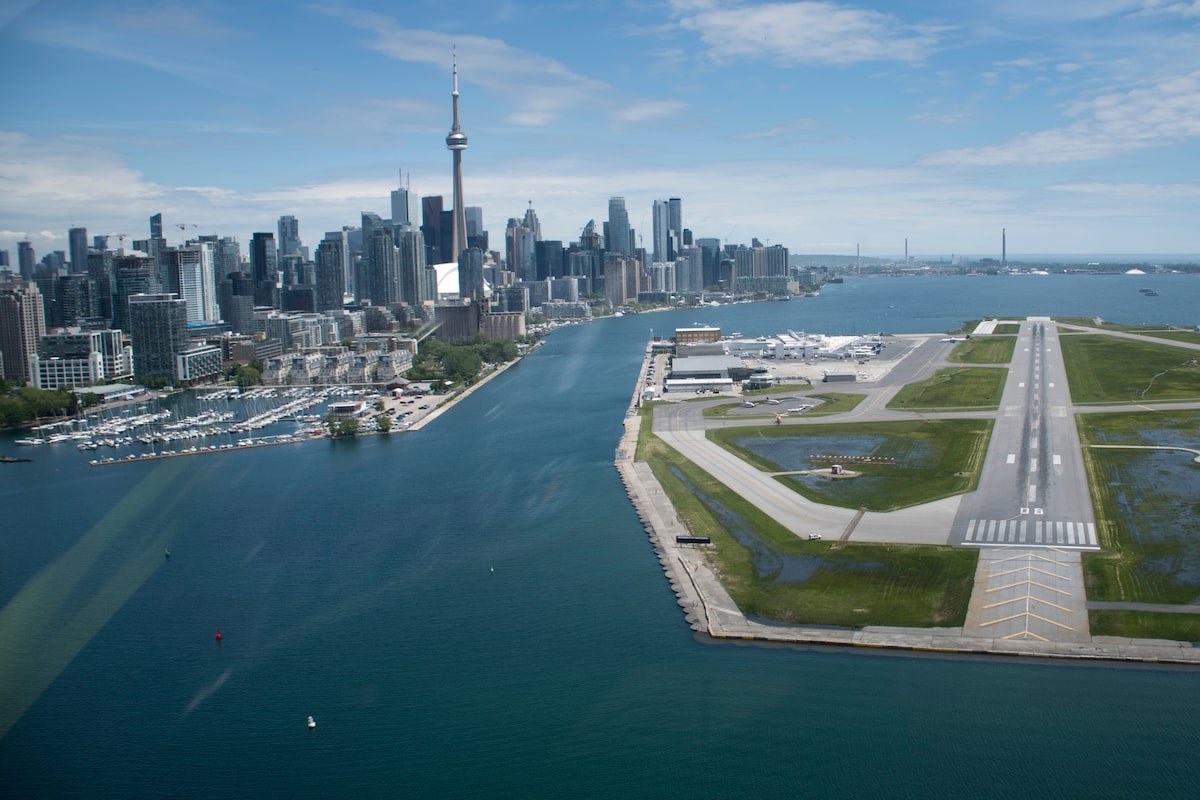
Ontario Premier Doug Ford plans to seize land from Toronto to expand runways at Billy Bishop Airport and allow jets.Fred Lum/The Globe and Mail
Doug Ford’s push for jets at Billy Bishop Airport wouldn’t just wreck Toronto’s waterfront. It would be economic vandalism.
The Ontario Premier is indulging an old obsession with the Toronto harbour, and last week, he reopened an old debate about expanding its small airport. That idea has been dismissed in the past for good reasons: It would make the waterfront uglier, noisier and more polluted, at the expense of tourism, real estate and locals’ quality of life.
Mr. Ford claims this would somehow be great for the economy of the city and the province.
But he’s wrong. In fact, it would be money poorly spent. Expanding Billy Bishop would undermine the federal government’s trade policy and ignore economic research that shows the value of one large, well-connected airport – in this case, Pearson.
Opinion: If Toronto can’t imagine its future, Doug Ford will
That’s the view of the urbanist and futurist Greg Lindsay, co-author of the book Aerotropolis. The case for a Billy Bishop expansion “is based on vibes,” he said in an interview this week. “Decades of research and demonstrated effects show that government spending would be better spent increasing the route networks and ground accessibility of Pearson.”
Where is Mr. Ford getting this idea? It comes ultimately from the airport itself and from the Toronto Port Authority, the federal agency that controls the city‘s port and Billy Bishop.
Their arguments don’t land. The airport, wedged between downtown and the Toronto Island Park, is a little brother to Pearson, moving less than 5 per cent of Toronto air passengers. Yet Billy Bishop claims $2.1-billion in “economic output” each year. They expect Canadians to believe that, if the airport closed tomorrow, none of its flights would move to Pearson, all its jobs would disappear and its visitors would choose not to come to Toronto. Which is absurd.
There are more subtle arguments at play. In short, airports bring in trade and investment. Billy Bishop hired the consultant Richard Florida to make that case in 2023. His report reads like a marketing brochure, and it cites “the ‘aerotropolis model’ of urban development,” in which “airport connectivity is essential to global cities.”
Ford looking to fill in part of Lake Ontario to build Toronto convention centre
One problem: Mr. Lindsay, who introduced that idea, says they’ve got it all wrong. The economic benefits of airports accrue heavily to hubs, the airports that provide many seamless connections to faraway places and markets.
“I can point to any number of papers that show concentrating your traffic in a single hub is better than dividing it into two,” he said. And since Toronto’s Pearson Airport is that hub, “anything that dilutes Pearson’s hub function risks real economic harm.”
In short, Mr. Ford is operating on vibes.
To be fair, those vibes are shared by many members of downtown Toronto’s business and political elites. The few people who use the airport, including local Liberal MPs and their staff, benefit from its tiny scale and small crowds.
“I like flying Billy Bishop,” says Mr. Lindsay, who is based in Montreal. “It is convenient, it is nice, and this is a mistake that we make: People are mistaking their personal preferences for what is the best policy choice.”
The bulk of new flights would also be to the U.S. This is “puzzling,” Mr. Lindsay said. “I would think [an expansion] runs counter to the stated goals of the Carney government to increase its trading partnerships overseas versus the United States.”
So, what would be best? For that we need to determine the real negatives of a jet expansion: filling of the harbour, pollution and noise. Not to mention the continuing multibillion-dollar development of the port lands led by Waterfront Toronto. Airport flight paths are already limiting development potential there, and jets could add to that burden. The city has spent 50 years trying to clean up its lakefront. Mr. Ford’s whims could prove ruinously expensive.