

Listen to this article
Estimated 5 minutes
The audio version of this article is generated by AI-based technology. Mispronunciations can occur. We are working with our partners to continually review and improve the results.
An Edmonton judge has ruled against a bid for an injunction seeking to pause provincial legislation that forced thousands of striking Alberta school teachers back to work last year.
On Friday, Court of King’s Bench Justice Douglas Mah said his decision is not the end of the road for the Alberta Teachers’ Association’s (ATA) challenge, and should not be understood as an endorsement of the Alberta government’s Back to School Act.
ATA president Jason Schilling said he appreciated the thoughtfulness of Mah’s decision but was “deeply disappointed” by the outcome.
“We knew that this was a high bar to achieve in order to get the injunction, but you still have an element of hope with that as well,” Schilling said Friday.
The legislation, passed in October following a three-week strike, forced more than 51,000 teachers back to work and imposed a four-year collective agreement on educators. In passing the bill, the Alberta government invoked the notwithstanding clause of the Charter in an attempt to shield the legislation from legal challenges.
In response, the ATA launched a constitutional challenge, which included the request for the injunction.
Three legal tests
Mah explained that granting an interlocutory injunction requires three legal tests to be proven: that it is a serious issue to be tried; that the applicant will suffer irreparable harm until the case is heard in full; and that the balance of convenience favours the applicant.
Mah told court that the ATA successfully established the first part, finding there is a serious issue to be tried as to whether the notwithstanding clause was appropriately invoked by the province.
He also found that, while the ATA did suffer harm, it does not reach the threshold of irreparable harm and that granting an injunction would not reverse the harm as it has already been manifested.
Schilling said that gives him hope for the ATA’s constitutional challenge of the back-to-work legislation, which is expected to be heard in September.
“The justice had indicated that he recognized that the harm has been done, and then we can further talk about the harm around this case when we get to the merits case in September,” he said.
In the third test, Mah said the balance of convenience favours the province, noting the ATA did not show that granting the injunction would benefit the public interest more than not.
On this point, Mah said, strike consequences would adversely affect students, their families and the public at large.
Education minister pleased
Alberta’s education minister said Friday he was pleased with the decision.
“I’m glad students will be able to stay in the classroom. That’s where they need to be. That’s where they belong. They’re the ones who are going to pay the price if there’s continued labour disruption,” Demetrios Nicolaides said in an interview with CBC.
“That doesn’t mean we cannot continue to have conversations, as we have, about improving our education system, investing more to build more schools, address complexity. We’ve already been doing that work.”
A spokesperson for Alberta’s justice minister said the government is “encouraged” by the decision, which is seen as supporting the use of the notwithstanding clause.
“This decision reaffirms that the notwithstanding clause is a legitimate constitutional tool — one that allows elected governments to act swiftly in the public interest,” said a statement from Heather Jenkins, press secretary to Justice Minister Mickey Amery.
The Opposition NDP said conditions that led to the strike, including classroom complexity, still exist.
“All Albertans had their rights affected when the government used the notwithstanding clause to trample teachers’ constitutional rights,” said a statement from education critic Amanda Chapman. “Today’s court decision has not changed that reality.”
The Back to School Act mandates educator salary increases of three per cent a year, and commits the government to hiring 3,000 teachers and 1,500 educational assistants over three years.
The act also prohibits teachers from taking job action, such as strikes, until 2028.
Lawyers for the ATA argued the act violates teachers’ constitutional rights, and that the government did not properly invoke the notwithstanding clause. The union contended that the clause was used retroactively to institute a contract that teachers had already rejected.
The provincial government’s legal team said the ATA’s case does not meet the legal grounds for an injunction, and that lifting the notwithstanding clause — and putting teachers back in a legal strike position — would not be in the public interest.
“While disappointing, [the decision] does not signal the end of our fight to restore the fundamental freedoms that Bill 2 stripped from Alberta’s teachers in the fall,” Schilling said Friday.
“We see the government’s use of the notwithstanding clause for what it is, a means to silence teachers and sidestep the Charter. This is not normal governance and it’s an affront to all Albertans.”
WATCH | Injunction hearing unfolds: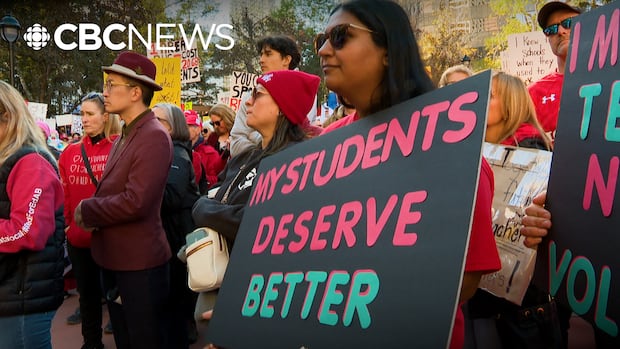
Court hears province’s arguments in ATA injunction hearing
On the second day of the Alberta Teachers’ Association’s injunction hearing, the court heard the province’s arguments. A decision on the injunction is expected by March 13.