
US air defence systems and troops have been withdrawn from East Asia. Pleas for missile interceptors in the oil-rich Gulf have been “stonewalled“. Even an air base in Romania has been roped into the US-Israeli war on Iran.
What US President Donald Trump has characterised as a “little excursion” is fast becoming the biggest drain on the security architecture of the world’s foremost superpower since the end of the Cold War.
The US is taking a lot from its partners across the globe to wage war on the Islamic Republic, even as lawmakers and world leaders question what the purpose of the conflict is.
To make matters worse, the Trump administration has yet to provide answers to tactical questions about how it will break Iran’s closure of the Strait of Hormuz or tame energy prices that have skyrocketed as a result.
“The problem the US will need to recover from is the loss of credibility as it opened a Pandora’s box without thinking through what would happen next. Lack of competence is a terrible thing to display in public,” Peter Frankopan, a professor of global history at Oxford University, told Middle East Eye.
New MEE newsletter: Jerusalem Dispatch
Sign up to get the latest insights and analysis on
Israel-Palestine, alongside Turkey Unpacked and other MEE newsletters
Now in its third week, the US-Israeli war has shown that Iran can be pummelled from afar. The 86-year-old supreme leader, Ayatollah Ali Khamenei, was killed in the war’s opening salvo. The US boasted on Friday that it has hit a staggering 6,000 targets in Iran.
But the takeover of government institutions by ordinary Iranians that Trump has called for has yet to materialise, and Khamenei’s son, Mojtaba, has been named as the next supreme leader. The US was even rebuffed by Kurdish partners, whom it hoped would rise up in rebellion. There is no sign pointing to the Iranian government’s collapse.
‘Lack of competence is a terrible thing to display in public’
– Peter Frankopan, Oxford University
Instead, on Friday, Iranian President Masoud Pezeshkian and top security official Ali Larijani felt confident enough to stroll through downtown Tehran among thousands of people even as Israeli air strikes targeted the area.
Iran’s ability to torment Doha, Manama and Dubai with cheap Shahed drones continues as expensive American missile interceptors are exhausted.
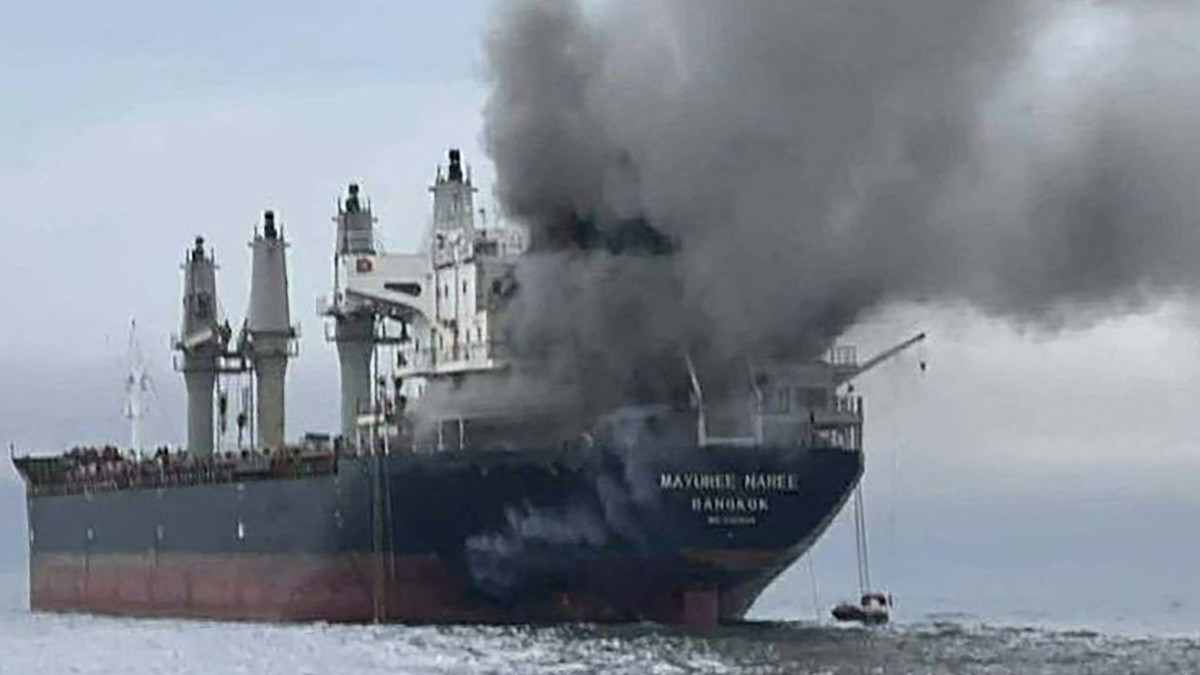
An Iranian strike rocked Tel Aviv on Friday. Meanwhile, the Strait of Hormuz, through which 20 percent of the world’s energy passes, was aflame this week with at least six vessels attacked by Iran.
All of these attacks have been carried out by a country currently under relentless air strikes, and which has also been under crippling sanctions by the US for four decades.
“I think we are witnessing a Suez Crisis moment for the US,” Fawaz Gerges, a professor of international relations and expert on the Middle East at the London School of Economics, told MEE.
In 1956, Britain and France joined forces with Israel to attack Egypt after President Gamal Abdel Nasser nationalised the Suez Canal. The US, under President Dwight D Eisenhower, smacked Israel and the Europeans into submission.
Suez has gone down in history as a textbook case of late imperial overreach.
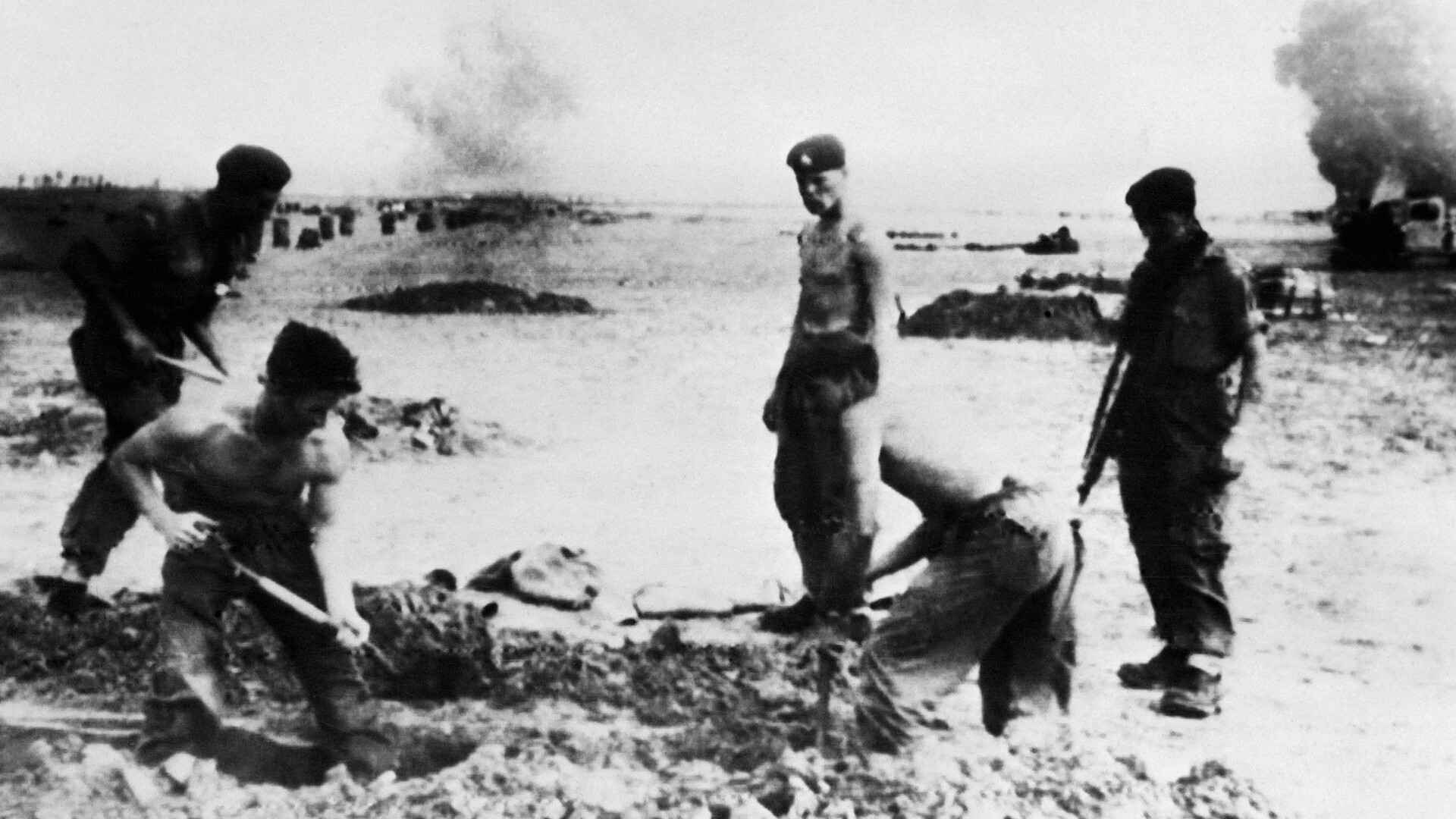
A picture released on 8 November 1956 shows British troops digging trenches, near Port Said, Egypt, during the Suez crisis (STR/Files/Intercontinentale/AFP)

But there are key differences between the war on Iran and the Suez crisis.
Few predict that a battered Iran will emerge victorious from the war, offering an alternative security system to the US.
According to Trump’s own admission, Russia is aiding Iranian attacks against the US. MEE was the first to reveal that China has sent air defence systems and offensive weapons to Tehran. An Arab official told MEE that further weapons supplies are continuing uninterrupted. But China and Russia are confined to playing the role of spoilers in the region, experts say.
“There is no superpower to replace the Americans, unlike how the French and British were sidelined,” Gerges said.
One lesson to take from Suez, of course, is that even after they are embarrassed, imperial powers can endure for decades. Britain continued to meddle in Yemen and the Gulf for twenty years after Suez. The last British troops left the Trucial States – modern UAE – in 1971. Even today, the UK is helping the UAE shoot down Iranian drones and missiles.
Ships in Strait of Hormuz to be ‘set ablaze’, IRGC official says, as insurers cancel coverage
The US’s climax in surpassing the old British Empire in the Middle East came after the 1991 Persian Gulf War, when US military bases sprang up in Kuwait, Saudi Arabia, Bahrain and Qatar.
Energy-rich Gulf states assumed those bases would give them security. Now, MEE has reported, some are questioning the value of hosting the US.
The Gulf states are facing pressure from Washington to join the war on Iran, and have become targets because of their ties to the US.
The Gulf states were already on guard over the US’s failure to respond to a 2019 Iranian attack on Saudi oil installations and, more recently, Washington’s inability to rein in Israel, which bombed Doha last year.
In response, they started to hedge their bets. Saudi Arabia signed a mutual defence agreement with Pakistan and was exploring joint weapons production with Turkey. The UAE has hosted the Chinese military.
“When the dust settles from this war, the diversification that was taking place will speed up,” Gerges said.
Frankopan said it would take time for those attitudes to mature.
“Across the Gulf, I am hearing lots of threats to turn to China and elsewhere for weapons systems, security and defence and even for investment more broadly. I think that reflects the heat and difficulties of the moment,” he said.
“[But] the US is an enormous economy, with lots of highly innovative and exciting opportunities. That does not change overnight. But… in football terms, this looks like an own goal,” Gerges added.
The crisis of confidence in US power is not just stirring in the Gulf.
Missiles and troops out of East Asia
The concept of reducing US entanglements in the Middle East to focus on rivalry with China has become so stale in Washington that it’s almost a platitude. But East Asian countries now have reason to be alarmed.
The US has reportedly begun moving a Terminal High-Altitude Area Defence (Thaad) missile-defence system from South Korea to the Middle East. South Korea’s foreign minister, Cho Hyun, said on Friday that the US was also weighing the redeployment of some US Patriot missile defence systems.
This carries deep symbolic weight in South Korea, a key US ally and economic partner, Andrew Yeo, a senior fellow and the Korea chair at the Brookings Institution’s Center for East Asia Policy Studies, told MEE.
A decade ago, China and South Korea got into a nasty spat over the deployment of the Thaad system. South Korea endured a Chinese economic boycott that cost it billions of dollars to defend the placement.
“The mission of US forces there is to deter and defend against a North Korean invasion,” Yeo said.
“If US forces are just going to go in and out, then what does that mean for the US commitment to South Korea’s defence? Those questions are being raised,” he said.
On Friday, reporting emerged that the Pentagon is sending the USS Tripoli, a Marine amphibious ready group, and 2,500 US Marines from Japan to the Middle East.
‘There is no superpower to replace the Americans, unlike how the French and British were sidelined’
– Fawaz Gerges, London School of Economics
“By some thinking, anything that keeps US forces outside the Indo-Pacific region is good for China,” Yeo said.
Experts say that you can add European countries to the list of US partners bearing the price for the US-Israeli war on Iran.
A Patriot air defence system had to be moved from Germany to defend a Nato radar base in Malatya, Turkey. Romanian President Nicusor Dan said on Wednesday that his country will host US refuelling planes, surveillance and satellite communications gear. Greece has also deployed a Patriot missile system on an Aegean island.
The military reshuffle occurs against the backdrop of Russia’s war on Ukraine.
The Trump administration has long been in a tussle with European allies about the cost of supporting Ukraine. One of the key wins European leaders were able to chalk up was tougher sanctions on Russian oil.
Now, in response to rising energy prices, the Trump administration is walking those sanctions back.
Europe pays the price
“In some ways, it’s Suez in reverse because you have a transatlantic crisis of different shared stakes and policies. Then it was Europe pursuing an assertive policy, and the US not liking it. Now, it’s the opposite,” Ian Lesser, the vice president of the German Marshall Fund of the United States, told MEE.
“Suez is a good example.”
“Already most of Nato’s integrated air defence capacity is afloat in the Mediterranean,” added Lesser.
European countries are deeply exposed to the closure of Hormuz. They pivoted to purchasing jet fuel and diesel from refineries in the Gulf after sanctioning Russia.
Trump has shown little sympathy for their pain, bragging this week that the US – as a net energy exporter – benefited from the rising prices.
“There is a fundamental question of what is the American stake in international stability: security and economic. It goes to the question of trust in the US,” Lesser said.
“The very fact that there is a debate over whether ties with the US are an asset or liability is disturbing,” he added.
For those looking for a sign that the US has already lost some prestige and power, one can look to the Strait of Hormuz. The power to guarantee the safe passage of sea lanes and the flow of trade is a hallmark of being a superpower. But with the US unable to open the strait, France and Italy are now reaching out to Iran to secure passage for tankers carrying energy, The Financial Times reported.
Reuters also reported that India has done the same.
“It’s going to be a much more chaotic, multipolar world,” Gerges said.