
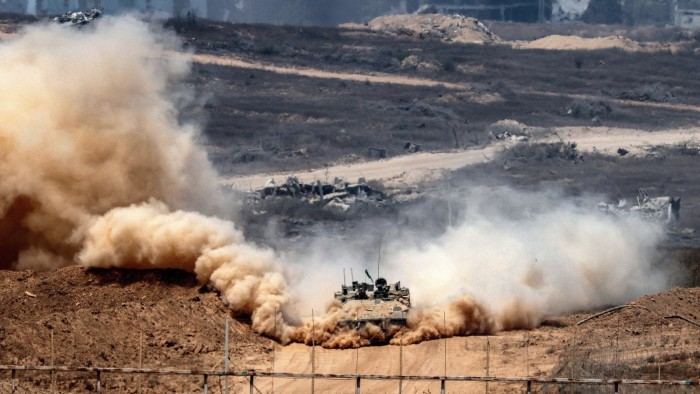
Prime Minister Benjamin Netanyahu’s allies are pressing the Israeli army to launch a new offensive in Gaza, potentially to reconquer the entire territory, as big disagreements emerge between the government and military leadership.
Cabinet ministers have even taken the unusual step of insisting publicly that the army would obey all orders they are given by the government, including for seizing the remaining parts of Gaza not already under Israeli control.
Netanyahu held a three-hour consultation with a few of his top commanders on Tuesday, including Eyal Zamir, chief of staff of the Israel Defense Forces, ahead of an official meeting of the full security cabinet set for Thursday.
Israel has threatened to expand its military offensive into additional areas of Gaza in a bid to increase pressure on Hamas and force the militant group to release the remaining Israeli hostages it still holds.
Several of Netanyahu’s ministers have demanded a full reoccupation of the shattered territory, a move the Israeli military is known to oppose as it could imperil hostages’ lives, overstretch already war-weary ground forces, and shift the full burden of administering the territory on to the IDF.
 IDF chief of staff Eyal Zamir has been pressed by Israel’s national security minister ‘to state clearly that he will fully comply with the directives of the political echelon’ © Ohad Zwigenberg/AP
“The IDF is prepared to carry out any decision made by the security cabinet,” Netanyahu’s office said in a laconic statement on Tuesday night, as anonymous reports in the Israeli media depicted severe disagreement between the prime minister and Zamir. Netanyahu appointed Zamir in March, after his predecessor Herzi Halevi — on whose watch Hamas’s October 7 2023 attack took place — was pushed out amid differences with the government over war strategy.
Zamir was touted at the time by the Netanyahu government as an “offensive” general who would be more aggressive in prosecuting the military campaign against Hamas.
Itamar Ben-Gvir, Netanyahu’s hardline national security minister, said on X on Tuesday: “The Chief of Staff is required to state clearly that he will fully comply with the directives of the political echelon, even if a decision is made for conquering [all of Gaza] and defeat [of Hamas].”
Defence minister Israel Katz said of Zamir on Wednesday that the IDF chief of staff had a “right and duty . . . to express his position in the appropriate forums”, but he warned that “after the decisions are made by the political echelon, the IDF will resolutely and professionally implement what is decided . . . until the war goals are achieved”.
Talks over a partial 60-day ceasefire between Israel and Hamas collapsed last month amid mutual recriminations, with the militant group hardening some of its demands and Netanyahu refusing to guarantee that any deal would lead to a full end of the conflict. The Israeli premier had previously broken a shortlived truce in March and restarted the military offensive in Gaza in an effort to achieve “total victory” over Hamas.
US and Israeli officials have now said that Hamas is not interested in reaching an agreement, and that “alternative options” for releasing the remaining 50 hostages — 20 of whom are believed to be alive — were being considered.
Netanyahu, with apparent backing by the US administration of President Donald Trump, has refused to end the war until all the hostages are returned and Hamas disarms — either through a full deal where the Palestinian group capitulates or via increased military action.
Trump has been non-committal about the prospect of Israel expanding its offensive into the remaining 25 per cent of Gaza not yet controlled by the IDF, including Gaza City, Deir al-Balah and the central camps of the strip. The vast majority of the territory’s 2.1mn people have been concentrated in these areas, with humanitarian conditions dire and international aid groups warning of famine.
Trump told reporters on Tuesday that he was focused on “trying to get people fed” in Gaza, but said it was “pretty much up to Israel” whether it decided to fully reoccupy the entirety of the territory.
Amid growing international condemnation of Israel over the Gaza war, the Netanyahu government late last month reversed its policy on the entry of aid into the territory, easing restrictions, opening new crossing points and creating secure corridors to improve distribution.
However, even this flow of aid, condemned as inadequate by Palestinians and by aid groups, could be imperilled in any new IDF offensive and the further forced evacuation of hundreds of thousands of civilians, with Netanyahu on Sunday saying that aid was likely to be funnelled to “areas outside the fighting zones and, to the extent possible, to areas outside Hamas control”.
The IDF, according to a person with knowledge of the matter, also opposes the establishment of so-called “humanitarian cities” mooted by Katz and other ministers for southern Gaza, where much of the Gazan population could be moved.
However, an Israeli official cautioned that the recent statements and public disagreements between the government and IDF — including the threat of full reoccupation — were also meant to heap pressure on Hamas to return to the negotiations.
“They will expand [the offensive],” the official added, referring to the government. “But it’s about expanding [militarily] and pressure [on Hamas].”
Recommended

Military analysts speculated that short of full reoccupation, the IDF top brass will recommend a more limited expansion of the campaign into Gaza City and central Gaza, to include targeted ground raids and precision air strikes.
Analysts estimate that seeking to fully take over the Gaza Strip will require the deployment of several infantry and tank divisions, including the call-up of additional reservist units, many of whom have been fighting for hundreds of days since the start of the war 22 months ago.
In recent days, Zamir has actually drawn down the IDF force presence inside Gaza, curtailed the length of service for the conscript army after a public outcry and officially stated his intention for the military to rest and rehabilitate over the coming year.
In the face of these public disagreements with the Netanyahu government, the premier’s son and adviser, Yair Netanyahu, wrote on X on Monday that it was akin to a “rebellion and attempted military coup that is fit for a banana republic in Central America in the 70s”, adding falsely that it was defence minister Katz — and not his father — who appointed Zamir.
Additional reporting by Steff Chávez in Washington