
I remember chicken schnitzel and near beer printed on restaurant menus alongside ghormeh sabzi and zereshk polo.
The ruins of Persepolis, horse-drawn carriages and a desolate pair of large bronze riding boots severed from its owner — a colossus statue of Reza Shah Pahlavi — also remain etched in my mind.
The exquisite silk rugs are the hardest to forget since the few my parents purchased ended up in my childhood home, where my mom has them unfurled whenever she wants to make an impression.
My vivid memories of Iran pale in comparison to Negar Mortazavi’s recollections of the country’s resplendent architecture, ancient culture and often mischaracterized population.
The Tehran native, who immigrated to the United States to study in Massachusetts a year after my family’s unforgettable 2001 trip, immediately thought of her loved ones when U.S. and Israeli forces started bombing Iran a little over a week into Ramadan, assassinating Iranian Supreme Leader Ayatollah Ali Khamenei.
Then, as more grim news of the initial strikes unfolded, she started having flashbacks to the 1980s, when she and her classmates rushed to take cover as sirens blared during the Iran-Iraq War.
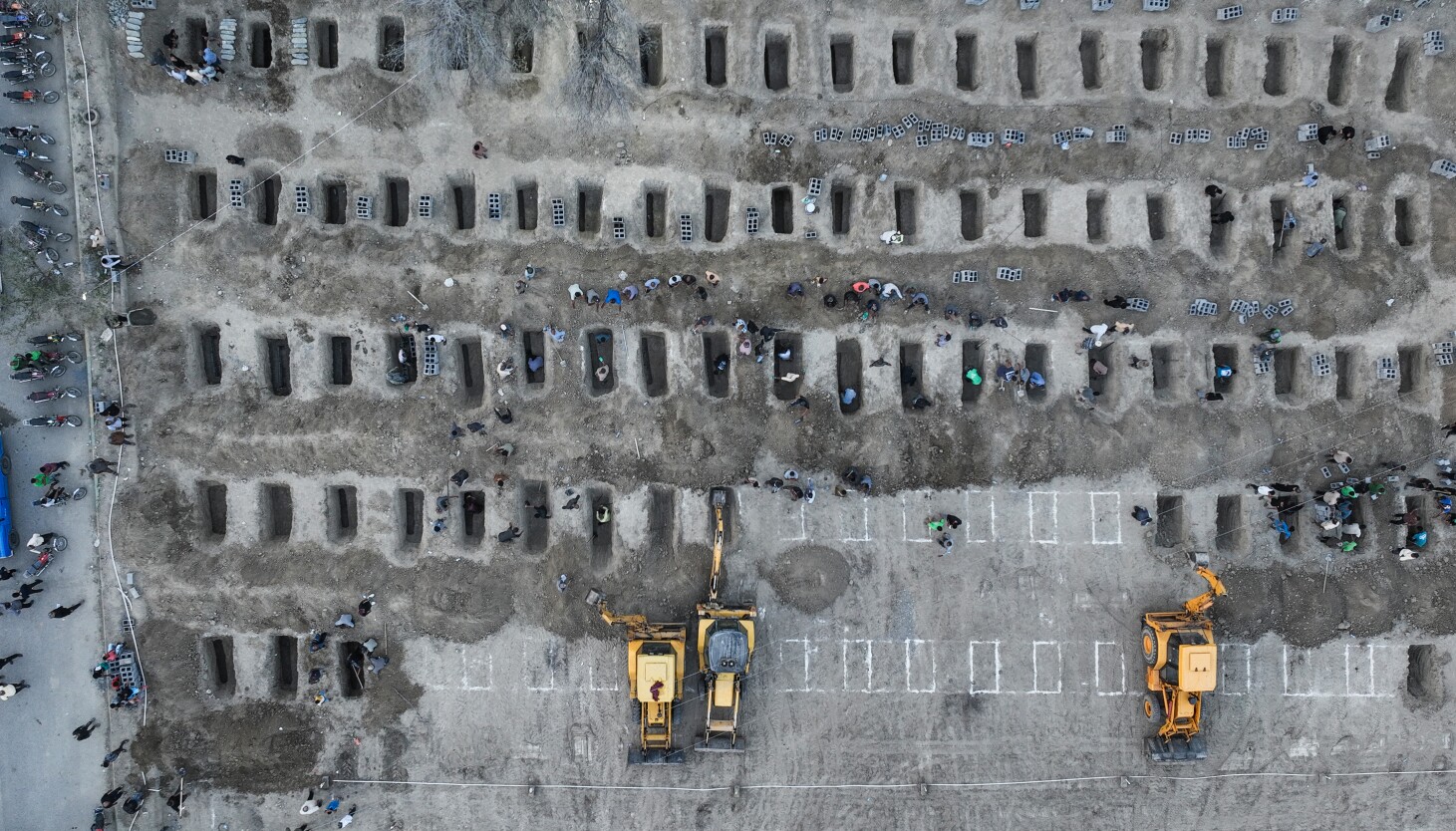
“This could have been me,” Mortazavi said of the 175 people, mostly children, who were killed when a missile, likely belonging to the U.S., struck the Shajareh Tayyebeh elementary school in Minab, a rural city in Southern Iran known for its date palm groves and citrus trees.
The timing of the Feb. 28 attack — well before Iran started its retaliatory campaign on U.S. and Israeli military bases in the Gulf region — is just another example of how little the West and its key Middle East ally care about protecting civilians when they bomb Muslim-populations, Mortazavi said.
“Not all people matter,” said Mortazavi, a senior fellow of the Washington, D.C.–based Center for International Policy and co-host of the “Iran Podcast.”
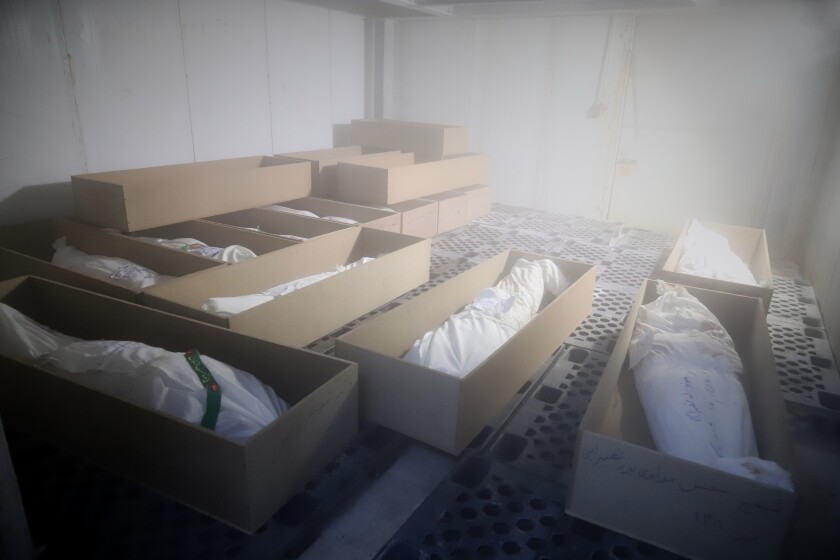
Coffins holding the bodies of mostly children killed in strike at the Shajareh Tayyebeh elementary school sit in a room in Minab, Iran. A preliminary U.S. military investigation has found that the U.S. was likely responsible for the Feb. 28 attack.
Mortazavi compared the deadly strike on the girls school, where some boys also studied, to the Vietnam War’s My Lai Massacre.
At best, the strike on the school was a grave, negligent mistake: A preliminary U.S. military investigation recently revealed outdated intelligence likely led the U.S. to strike the two-story facility, which used to be housed on a military compound nearly a decade ago.
Still, questions linger when you have a Defense secretary who boasts about a “mission delivered with overwhelming and unrelenting precision” and end up with a bombed-out school that is labeled on online maps and satellite imagery.
While Donald Trump deflects on the plausibility of U.S. involvement, many Iranians, including those vehemently opposed to their authoritarian, theocratic government, are mourning.
“The killings of schoolkids have been, and still are, and I think, will remain one of the main images of the current aggression on the country,” Hassan Ahmadian, a political scientist who teaches at University of Tehran, told me.
The graphic pictures of the children killed in “cold blood by the U.S.” have “stirred anger among the people like never before,” inspiring many to “rally around the flag” against “indiscriminate bombing seen elsewhere in the country,” he said.
A few days ago, The Tehran Times printed portraits of the youngest victims on its front page, demanding, “Trump, Look Them in the Eyes.”
That’s a challenging feat when the president chooses not to see and perpetuates and facilitates more death and destruction.
Previous Republican and Democrat-led administrations have also used democracy, security and women’s rights as a pretext to unleash violence in parts of the world they view through a jaundiced, one-dimensional lens.
The Iran war is no different.
“These attacks, the Israeli-U.S. attacks on Iran, are doing nothing to protect the Iranian protesters and those who have been at the forefront of fighting the government,” Agnes Callamard, the secretary general of Amnesty International and a former United Nations special rapporteur, said in a recent interview with the news program “Democracy Now!”
Among the most vocal Iranians who have taken to the streets are thousands of girls and women, who ramped up their calls for a regime change after 22-year-old Mahsa Amini suspiciously died in police custody following her arrest for wearing her hijab too loosely in 2022.
Shrinking violet is not a term I would use for the outspoken and educated women I encountered in Iran 25 years ago.
I probably wouldn’t describe them that way today, either.
Iran has a high female literacy rate — 96.1%, according to a report submitted to the U.N. General Assembly last summer. Seventy percent of the Islamic Republic’s university graduates in science, technology, engineering and mathematics are women, the report also shows.
A plane ticket isn’t required to absorb the complexities of Iran’s history and its people.
There’s always the option to crack open a book and learn, which is all the Shajareh Tayyebeh elementary school students were trying to do that Saturday morning before they were killed.
Rummana Hussain is a columnist and leads the opinion coverage at the Sun-Times.