
The latest:
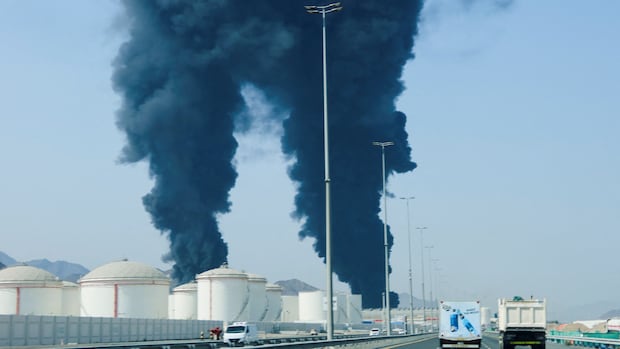
U.S. forces executed a large-scale precision strike on Iran’s Kharg Island oil hub on Friday night local time, hitting military targets but preserving oil infrastructure. The strikes follow threats by U.S. President Donald Trump, who warned on Friday that he would target Kharg Island if Iran doesn’t reopen the Strait of Hormuz.Iran is maintaining its defiant response, threatening to use more dangerous weapons and specifically warning that the U.A.E. is a legitimate target.Debris from a drone interception over the U.A.E.’s Fujairah oil industry zone resulted in a fire and billows of smoke. The U.S. Embassy in Baghdad was struck, but so far the embassy hasn’t commented publicly on the matter.
American forces executed a large-scale precision strike on Kharg Island in Iran on Friday night local time, the U.S. Central Command said on Saturday, as the war enters its third week with no end in sight.
“U.S. forces successfully struck more than 90 Iranian military targets on Kharg Island, while preserving the oil infrastructure,” CENTCOM said.
The strike destroyed naval mine storage facilities, missile storage bunkers and multiple other military sites, the U.S. military said in a post on social media platform X.
U.S. President Donald Trump threatened on Friday to strike the oil infrastructure on Kharg Island unless Tehran stopped attacking vessels in the Strait of Hormuz.
Oil exports from Kharg Island were continuing normally despite the U.S. attack, according to an Iranian official quoted by state TV.
WATCH | Trump says U.S. ‘obliterated’ targets on Kharg Island: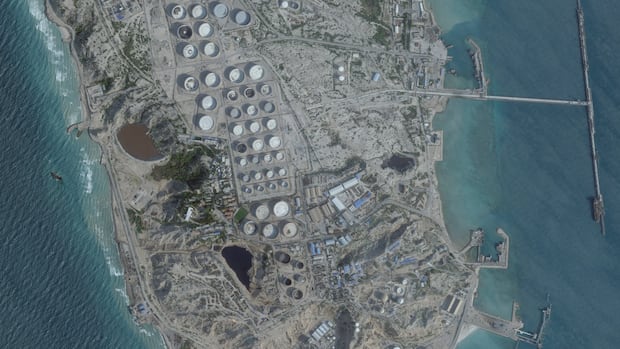
Trump says U.S. ‘obliterated’ military targets on Iran’s key oil export island | Hanomansing Tonight
U.S. President Donald Trump says American forces conducted strikes on Iran’s Kharg Island, ramping up attacks between the two countries. Robert Huish, a Dalhousie University professor, explains how this latest development affects Iran’s oil exports to China.
As the war entered its third week, Iran continued to exchange strikes with the U.S. and Israel while striking a defiant note. The country has been playing down the extent of the damage on Kharg while threatening to step up its use of more powerful weapons and warning that parts of the United Arab Emirates were a legitimate target.
“We declare to the leaders of the U.A.E. that Iran considers it a legitimate right to defend its national sovereignty and territory by targeting the origin of American enemy missile launches in the shipping ports, docks, and military shelters of the U.S. hidden in some cities of the U.A.E.,” a spokesperson for Iran’s Islamic Revolutionary Guard Corps (IRGC) said.
In a statement, the IRGC urged residents in the U.A.E. to evacuate ports, docks and U.S. military shelters to avoid civilian casualties.
Nine ballistic missiles and 33 drones were launched from Iran toward the U.A.E. on Saturday, the Ministry of Defence said, bringing a total of 294 ballistic missiles, 15 cruise missiles and 1,600 drones launched from Iran since the war started.
Behind the scenes, resentment had already been mounting in Gulf Arab capitals at being drawn into a war they neither initiated nor endorsed but are now paying for economically and militarily, regional sources have told Reuters.
European countries have also been increasingly implicated in the war, even as a former NATO chief said he doesn’t believe allies will be pulled into the conflict further. On Saturday, France’s president said Paris was ready to host direct Israel-Lebanon talks. Meanwhile, Iran threatened Ukraine, saying that the country — already under siege by Russia — is a legitimate target because it has provided Israel with drone support.
Battle continues over Strait of Hormuz
Iran also vowed to increase its usage of upgraded weapons, particularly ballistic missiles and other missiles with greater destructive power, a Defence Ministry spokesperson was quoted as saying in state media.
Trump told reporters on Friday that the U.S. navy will “soon” start escorting tankers through the Strait of Hormuz, a conduit for 20 per cent of the world’s fossil energy supplies.
Iranian Supreme Leader Mojtaba Khamenei, who replaced his slain father, has said the strategic waterway should remain closed as a tool of pressure.
Iran’s armed forces responded to the Kharg attack by saying any strike on the country’s oil and energy infrastructure would lead to strikes on facilities owned by oil companies co-operating with the U.S. in the region, Iranian media reported.
Some oil loading operations have been suspended in the U.A.E.’s Fujairah emirate, a major bunkering hub, industry and trade sources said, after a fire broke out there on Saturday.
The fire occurred after debris fell during the interception of a drone, but no injuries were reported, the emirate’s media office said.
WATCH | Why reopening the Strait of Hormuz won’t be easy: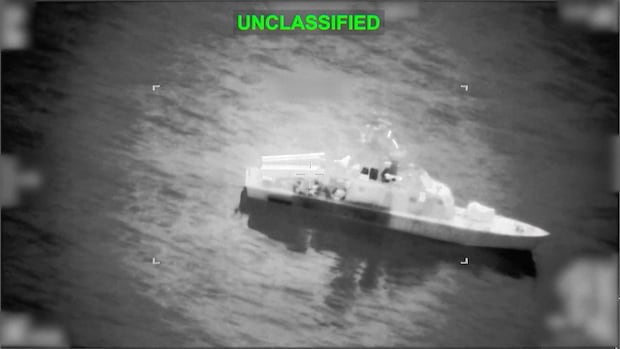
Securing the Strait of Hormuz: Why it’s harder than the U.S. suggests
As Iran escalates attacks in the Strait of Hormuz, the U.S. says it’s confident it will be able to get ships moving again. For The National, CBC’s Lyndsay Duncombe breaks down why re-opening the vital waterway likely won’t be as simple, fast or as safe as the White House wants.
Iran, which ramped up oil output in the run-up to the Feb. 28 launch of the war by Israel and the U.S., has continued to ship oil at a rate of 1.1 million to 1.5 million barrels per day, according to TankerTracker.com and Kpler data.
Much of the oil shipped from Iran via Kharg Island goes to China, the top global crude importer.
Oil prices have swung sharply on Trump’s changing comments about the likely duration of the war, which began with massive U.S. and Israeli bombardments of Iran and quickly spread into a regional conflict with broad consequences for worldwide energy and stock markets.
U.S. Embassy struck in Baghdad
The U.S. Embassy in the Iraqi capital Baghdad was hit in a missile attack on Saturday, causing smoke to rise from the building, Iraqi security sources said. They did not have further details on the strike.
The embassy has not yet commented on the reported strike.
In other attacks across the region, Iran’s Revolutionary Guard said it had carried out additional attacks on Israel with Lebanon’s Hezbollah militia, Iran’s Tasnim news agency reported.
At least 12 medical personnel were killed in an Israeli strike on a health-care centre in the town of Borj Qalaouiya in southern Lebanon, the Lebanese state news agency reported on Saturday, citing the Health Ministry.
Reports from Iranian media said at least 12 people were killed and several others wounded in attacks on multiple locations across Iran, including in the central and southeastern provinces.
Government spokesperson Fatemeh Mohajerani said U.S. and Israeli strikes have damaged some 43,000 residential and commercial units, including 36,469 residential units and 6,179 commercial facilities, according to the state-run IRNA news agency.
Iran hasn’t provided any information about military losses and damage.
In Dubai, the management team of the ICD Brookfield Place, a business centre in the heart of the Dubai International Financial Centre, said in a message to its tenants seen by Reuters that an incident took place, without elaborating further. Earlier, Dubai’s media office said debris from a successful interception struck a building in central Dubai, but no fire or injuries were recorded. It did not specify the location.
After two weeks of war, 2,000 people have been killed, mostly in Iran but many in Lebanon and a growing number in the Gulf. Several million people have been displaced from their homes.
U.S. forces have suffered casualties, including the deaths of all six crew members aboard a refuelling aircraft that crashed in western Iraq.