
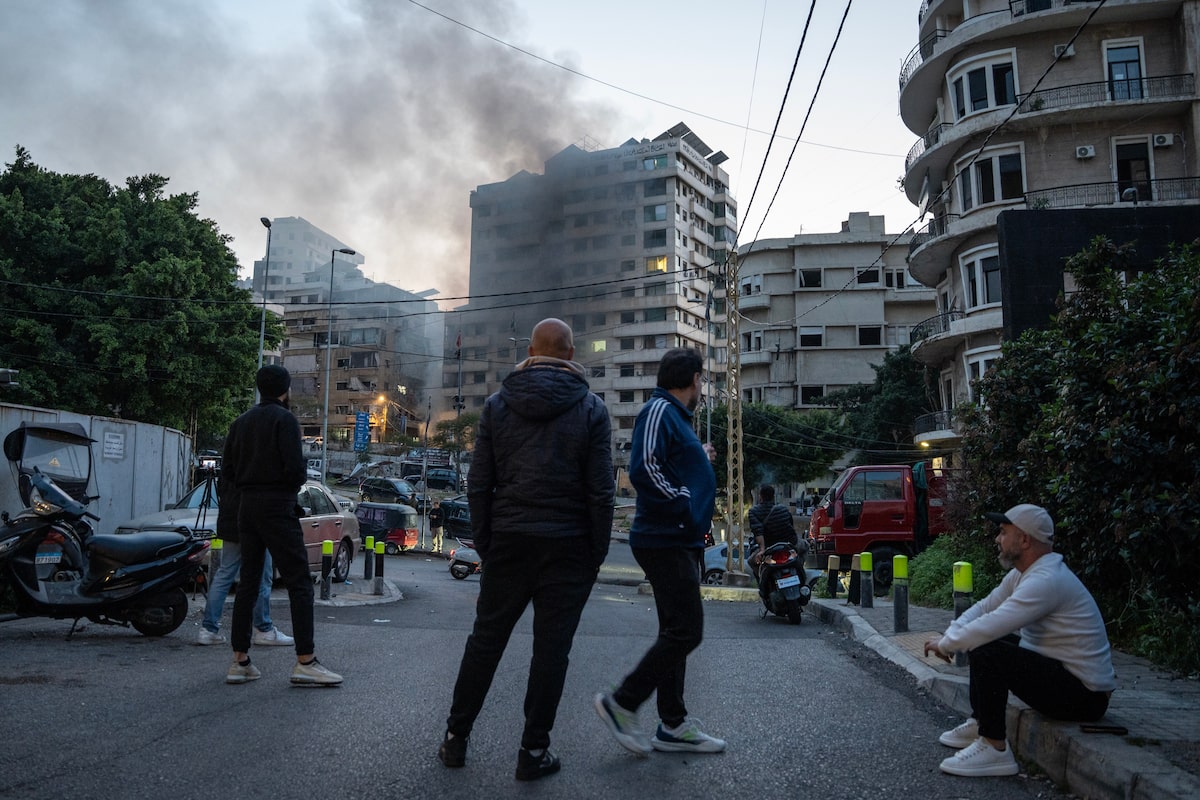
The scenes in Beirut this week were both shocking, and ones the world has seen several times before.
Pillars of smoke rose from the city’s southern suburbs, which are collectively known as the Dahiya, as hundreds of thousands of people fled their homes with whatever they could carry.
Israel’s controversial scorched-earth strategy has been used repeatedly over the past 2½ years in wars against Hamas in Gaza and Hezbollah in Lebanon. The military concept is known as the “Dahiya Doctrine” after its first use, 20 years ago, in another destructive war between Israel and Iranian-backed Hezbollah.
Now the Dahiya Doctrine has come back home, so to speak, since Hezbollah opened a front with Israel after the joint U.S.-Israeli attack on Iran on Feb. 28. Gadi Eisenkot, the Israeli general-turned-opposition politician who initially coined the term, wrote on social media this week that “the Dahiya Doctrine has never been more relevant than it is now.”
The essence of the Dahiya Doctrine is that it’s too difficult to separate guerrilla formations such as Hezbollah and Hamas from the civilians that support them – and that such groups can only be uprooted by making those supporters feel enough pain to turn against the militants.
Human-rights groups say the Dahiya Doctrine amounts to collective punishment and is a clear violation of international humanitarian law.
Targets hit by Israeli warplanes over the first 12 days of war have included a network of banks, as well as a pair of media outlets that have connections to Hezbollah but are not themselves military targets. Entire apartment blocks have been levelled – usually after residents were given a warning to evacuate – because of the alleged presence of a single Hezbollah member.
Beirut residents, warned by an evacuation alert on Thursday, flee before an Israeli air strike on the El Bachoura neighbourhood; later, locals watch the smoke from an apartment block that was hit.
Siegfried Modola/The Globe and Mail
International law arguably matters less now than at any time since the Geneva Conventions were drawn up in the wake of the Second World War. Israeli Prime Minister Benjamin Netanyahu is still in power despite an International Criminal Court arrest warrant, issued in 2024, over alleged war crimes committed in Gaza. It’s notable that none of Israel, the United States, Iran or Lebanon is a party to the Rome Statute that underpins the ICC.
The Geneva Conventions, which prohibit the intentional targeting of civilians, were never a factor in Mr. Eisenkot’s own description of the Dahiya Doctrine. “What happened in the Dahiya quarter of Beirut in 2006 will happen in every village from which Israel is fired on,” Mr. Eisenkot told Israel’s Yedioth Ahronoth newspaper in 2008. “We will apply disproportionate force on [the village] and cause great damage and destruction there. From our standpoint, these are not civilian villages, they are military bases.”
The 2006 war, which was instigated by a cross-border Hezbollah attack, saw entire city blocks of the Dahiya reduced to rubble by intense Israeli bombardment. The conflict left 1,200 Lebanese and 165 Israelis dead, but was later seen as having bought Israel almost two decades of relative calm on its northern border.
Hezbollah supporters in the southern suburbs of Beirut turned out to mourn on March 1, the day after Iran’s Supreme Leader died. The late Ayatollah Ali Khamenei backed Hezbollah and other groups in an ‘Axis of Resistance’ around the Middle East.Hassan Ammar/The Associated Press
Open this photo in gallery:Open this photo in gallery:
Israeli planes dropped leaflets over Beirut on Friday urging people to disarm Hezbollah, whose installations have been bombed extensively in recent weeks.Joseph Eid and Anwar Amro/AFP via Getty Images
Since Oct. 7, 2023 – when Hamas attacked southern Israel, killing more than 1,200 people and taking 200 others as hostages to Gaza – the Dahiya Doctrine has once more become Israel’s main approach to dealing with groups such as Hezbollah and Hamas. The previous strategy – repeated, smaller-scale strikes known as “mowing the grass” – is now seen as having allowed Israel’s enemies to build up too much strength.
It’s the explicit blending of Hezbollah, which is believed to have tens of thousands of fighters, and Lebanon’s Shia Muslim population of roughly 1.5 million people that concerns human-rights advocates.
Most of Lebanon’s Shiites live in either the Dahiya or the southern part of the country, two areas that are under Israeli evacuation orders that have driven more than 800,000 people from their homes.
Ramzi Kaiss, Lebanon researcher for the New York-based Human Rights Watch, said targets such as Al-Qard Al-Hasan, an Islamic bank that Hezbollah uses to disperse payments, and Al-Manar, a television station controlled by the militia, “were not lawful” since they are not military institutions. Ambulances and first-aid stations run by Hezbollah’s civil defence arm have also been targeted.
“There’s a sense of recklessness with regards to the laws of war,” Mr. Kaiss said.
The Lebanese Ministry of Health reported Friday that more than 700 people have been killed since the outbreak of hostilities on March 2, including at least 91 children. The Israeli military says two of its soldiers have died fighting inside Lebanon, while 15 civilians have been killed in missile and drone attacks launched by Iran, occasionally in co-ordination with attacks by Hezbollah.
A mosque in Saida, southern Lebanon, has a Hezbollah flag and a portrait of the movement’s late leader Hassan Nasrallah. He was killed by Israeli air strikes in 2024.Oliver Marsden/The Globe and Mail
Avraham Levine, director of educational programs at the Alma Research and Education Center, an Israeli think tank that studies the security situation on the Israel-Lebanon border, said it is impossible and impractical for Israel to try to differentiate between Hezbollah and the ecosystem that supports it.
“I don’t make that differentiation that is very popular in Europe and the rest of the world, that there’s the civilian wing and there’s the military wing, and they’re separate,” he said.
“The youth wing is a way to draft the youth into Hezbollah, it is the education system; Al-Qard Al-Hasan is the financial side of it; the hospitals, the ambulances, are all part of one effort – and that effort is the ideology that we can’t live with any more.”
Nadim Khoury, who covered the 2006 Israel-Hezbollah conflict for Human Rights Watch, said the Dahiya Doctrine has evolved over the past two decades, aided by new technologies and the overall erosion of international law.
The rise of social media has allowed the Israeli military to panic entire populations, driving people into the streets with evacuation orders issued through a single social media post. Meanwhile, the fact that no one has faced international justice over the war in Gaza – which Israel acknowledges killed more than 70,000 people – has led to a sense that whatever restraints existed in 2006 are gone.
“We’re now seeing the Dahiya Doctrine 2.0 being applied,” said Mr. Khoury, who is executive director of the Paris-based Arab Reform Initiative. Back in 2006, he said, “there was actually a serious discussion of ‘Can you target things like Al-Qard Al-Hasan, gas stations and so forth?’ Now there’s almost no discussion at all internationally.”
Iranian air strikes in the Gulf states, such as this one in Bahrain’s capital of Manama, have taken a toll on civilian infrastructure.AFP via Getty Images
Iran itself appears to have adopted a military strategy similar to the Dahiya Doctrine. Tehran has responded to two weeks of U.S.-Israeli air strikes by targeting civilian infrastructure – banks, airports and even a water desalination plant – in countries that host U.S. military bases (including Saudi Arabia, Qatar, Bahrain and the United Arab Emirates), hoping the economic pain will persuade their leaders to pressure the U.S. to bring the conflict to an end.
“There seems to be an actual convergence in how Iran and Israel fight wars,” said Rob Geist Pinfold, a lecturer in international security at King’s College London. “The key parallel is in Iran’s targeting of people who are not involved in hostilities.” As with the Dahiya Doctrine, he said, “that’s not an accident, that’s by design.”
Mr. Geist Pinfold said the rules of war are eroding “in real time,” a process accelerated by the 2022 Russian invasion of Ukraine and this year’s U.S. military operation to capture Venezuelan leader Nicolás Maduro.
“This is the moment we’re living in,” Mr. Khoury said. “A moment when all the norms have been eroded.”
A man sweeps away leaflets Israel dropped on Beirut on Friday. ‘Lebanon is your decision, not someone else’s,’ some of them read.Answar Amro/AFP via Getty Images