
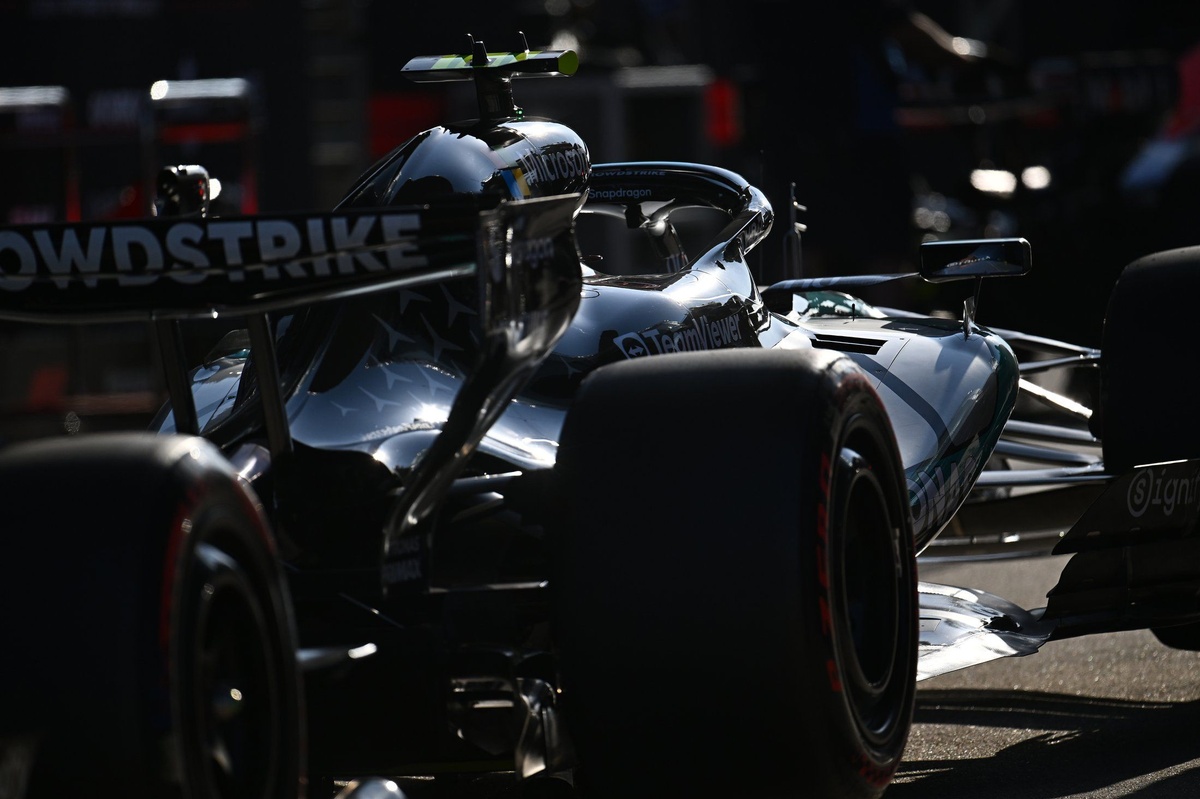
Kimi Antonelli’s Saturday in Shanghai was, to put it mildly, a mixed bag. A terrible start to the sprint race put the 19-year-old as far back as eighth, a situation that snowballed into a clash with Isack Hadjar and a subsequent 10-second penalty. The first-lap coalescence of errors was ultimately damaging to Antonelli’s day, and masks a particularly salient point: his race pace was every bit the equal of George Russell’s laps at the front.
Although armed with this year’s strongest car, Antonelli’s opening weekends haven’t exactly been paragons of serenity. There was the shunt in FP3 last weekend in Melbourne, the difficult start to the Australian Grand Prix, and then the first-lap catalogue of errors that restricted what he could achieve in the sprint. The interlude between sprint and qualifying served as a period of convalescence for Antonelli’s mind, and he duly sprung out of the blocks to grab his first grand prix pole – in the process taking Sebastian Vettel’s record for youngest polesitter.
Of course, Antonelli’s pole was made easier by Russell’s odd gearshift issue that resulted in briefly stopping on-track. It was of some amusement to see a comment in the recesses of social media suggesting that fortune through others’ unreliability meant that Antonelli’s pole was devalued; if that’s what the people who lurk in Twitter replies really think, I’d love to be around when they discover what F1 used to be like.
So, can Antonelli claim his first F1 win on Sunday? It’s certainly possible, but he needs two ingredients: one, to get his grey matter wrapped around the admittedly complex race start routine, and get out of the blocks quickly without bogging down. Two, he simply needs to repeat the pace he’d shown in the sprint race (beyond lap one, anyway) – because it was rather good indeed.
There’s a bit of context to the early laps, in that both were grappling with some degree of traffic or battle for position; Russell was embroiled in a cat-and-mouse lead battle with Lewis Hamilton, while Antonelli was simply trying to make up lost ground. Interestingly, in the laps where Russell and Antonelli had some cleaner air to play with, the Italian was marginally the quicker of the two.
All being well at the first corner, then, we could have a great battle on our hands. Russell and Antonelli have equal opportunities to clinch victory on paper, but those opportunities must be taken; Antonelli can’t afford another lacklustre start.
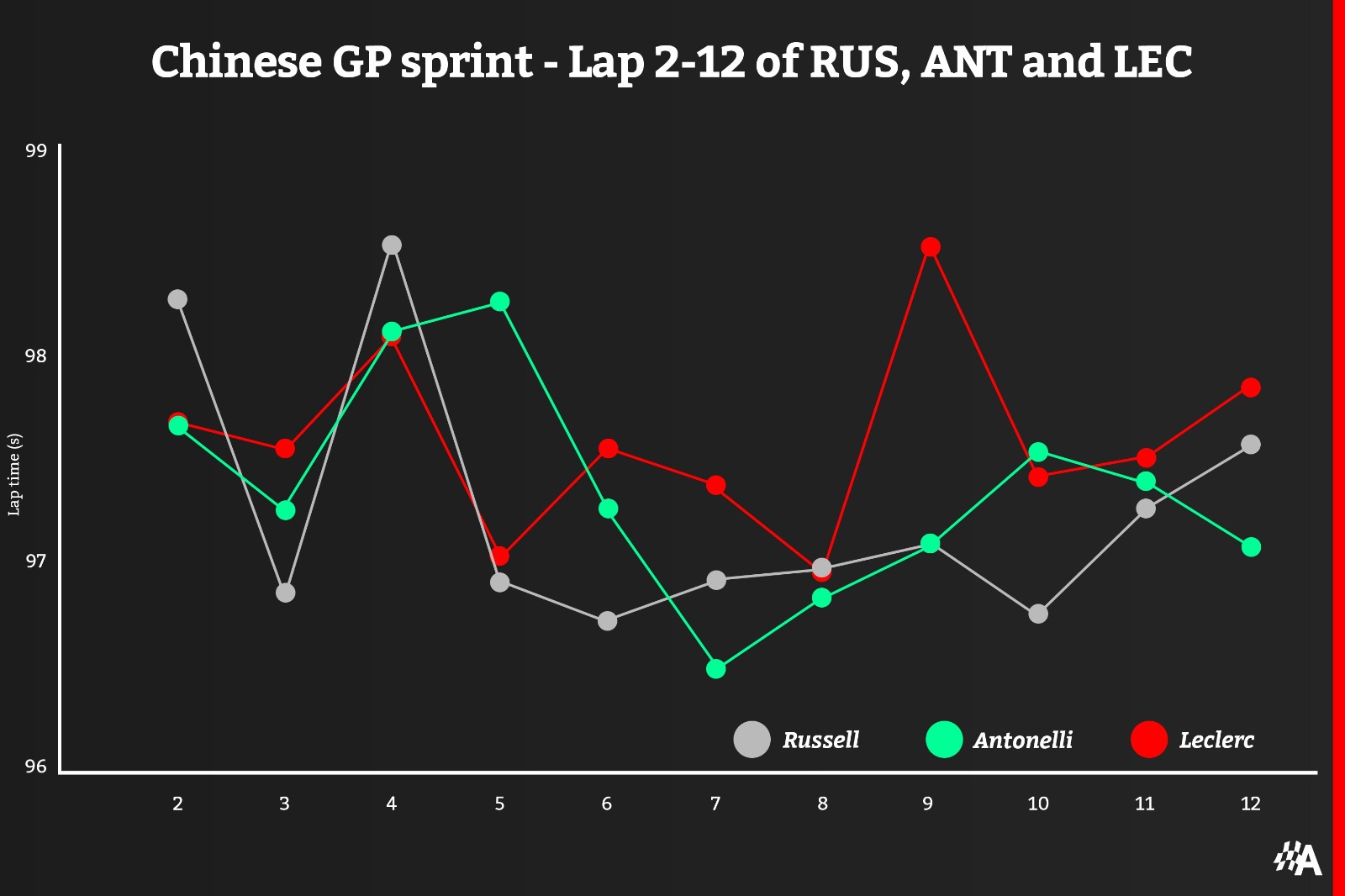
First-stint sprint pace, comparing laps of Russell, Antonelli, and Leclerc
Photo by: Jake Boxall-Legge
But let’s not discount Ferrari. We’re becoming accustomed to the lightning-fast release from the grid, and Hamilton had demonstrated the worth of the Scuderia’s decision to run with a smaller turbocharger by scything up to second place in the opening corners of the China sprint. We don’t see many moves into Turn 9 either, but Hamilton made it work for the lead as he put his first move on Russell into the left-hander.
Ferrari’s efforts petered out slightly when front-left graining began to bite. The front-limited layout of the Shanghai circuit puts the most strain on that tyre, since the load sits on it during Turns 1, 8, and 13. And, since it’s very easy to slide the front axle about if the front end isn’t strong enough, the pills of rubber start to build on the inside shoulder. After sprint qualifying, it had looked as though Ferrari hadn’t dialled its front in quite enough; Charles Leclerc had appeared to struggle to get it to bite through the Friday qualifying session, and one wonders if it hadn’t balanced the forward and rear halves of the car enough after changing rear wings post-practice.
With the reopening of parc ferme, Ferrari would hope that it has managed to cure that feeling and potentially bring the front end into play a bit more with a few waggles of a spanner. We’ll get a sense of that in the opening 10 laps; if the tyres start to grain again, it’ll be problematic but, if Ferrari can keep the tyres in, it can offer Mercedes a more prolonged bout at the front. Leclerc and Hamilton both sit on row two, their visage in occupation of the Silver Arrows’ wing mirrors.
Antonelli’s first-lap coalescence of errors was ultimately damaging to his day and masks a particularly salient point: his race pace was every bit the equal of Russell’s
While one might suggest that Ferrari and Mercedes had a bit more in the tank, McLaren appeared to hit the zenith of what its MCL40 is currently capable of achieving. Lando Norris got the most out of the car in the sprint sessions, outqualifying the Ferraris and benefitting from Antonelli’s sprint race misfortune to grab fourth. It was an impressive effort, underlined by Norris’ average pace over the sprint race: that he was the fifth-quickest on average is unsurprising, but the average deficit of 0.079s per lap to Hamilton is worthy of note.
By comparison, Oscar Piastri had taken a little bit longer to build into the weekend and outqualified his championship-winning team-mate by 0.05s in grand prix qualifying. You’d expect fifth and sixth to be the maximum that McLaren can achieve here; the orange cars will instead cast a lonely vigil over the cars in front and attempt to benefit from any misfortune.
Red Bull, meanwhile, seems to be all at sea. Max Verstappen’s countenance is one of a man trying to keep a lid on his discontent with the RB22 in its current form; the sort of fury that can be contained publicly, but viscerally released in private quarters by a cathartic scream into the nearest pillow. Australia was a greater extreme of energy management and deployment, and it seemed to suit the characteristics of the Red Bull-Ford powertrain a little bit more; on a more level circuit like China, the power unit’s greatest strength is far more muted.
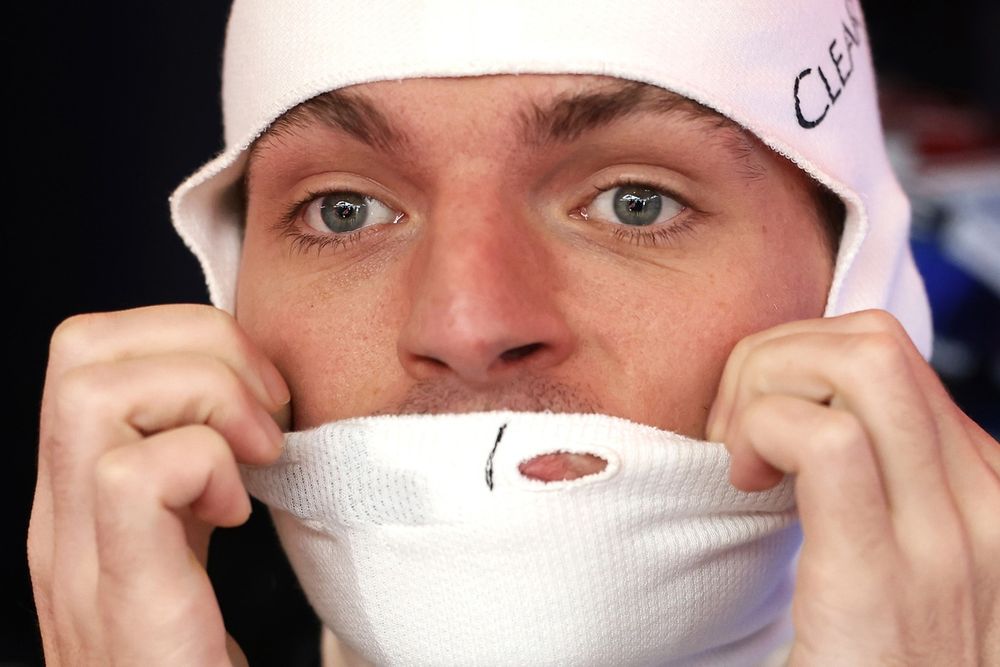
“I prefer not to speak” – Verstappen puts a mask over his frustrations with Red Bull’s 2026 car
Photo by: Mark Thompson / Getty Images
On the chassis side, there are issues here; tyre preservation is not particularly good, and an understeer trait is exposed by Shanghai’s front-limited nature. Verstappen called it “undriveable”, and his sprint pace suggests as much: his average lap of a 1m39.225s across laps two to 12 was 1.2s per lap down on that achieved by Piastri and 1.4s per lap down on Norris.
Most painful for Red Bull was that both cars were outraced by Liam Lawson and Ollie Bearman in the sprint (although Hadjar was nursing floor damage after contact with Antonelli) and then outqualified by Pierre Gasly, driving for 2025’s slowest team. Alpine demonstrated what was expected from it after pre-season testing, very much suggesting that it had rather fluffed its lines Down Under rather than glory-running in Bahrain.
The performances of Gasly, Lawson, and Bearman this weekend demonstrates that we should be in for a thrilling midfield scrap over the year between Alpine, Racing Bulls, and Haas. Audi is in this camp too, and Nico Hulkenberg was just 0.002s away from matching Hadjar in qualifying, but China has been so far less fortunate to the Swiss-German operation compared to the impressive run in Australia.
Lawson also exhibited the benefits of the hard tyre in the sprint race; his run to seventh after choosing not to stop showed that the C2 was slightly more impervious to the effects of graining versus the softer compounds. It’ll be a critical tyre to work with during the race, and getting it deep into the 56-lap run-time of the race will be at the forefront of the strategists’ minds.
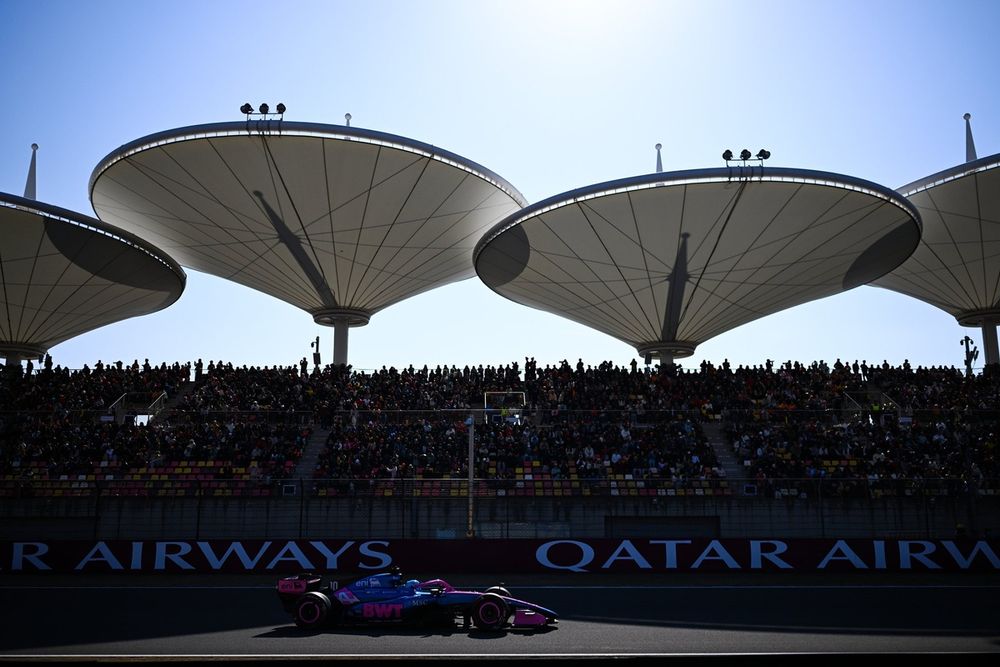
Gasly impressed with seventh on the grid – but can he climb any higher?
Photo by: Guido De Bortoli / LAT Images via Getty Images
We want to hear from you!
Let us know what you would like to see from us in the future.
– The Autosport.com Team