
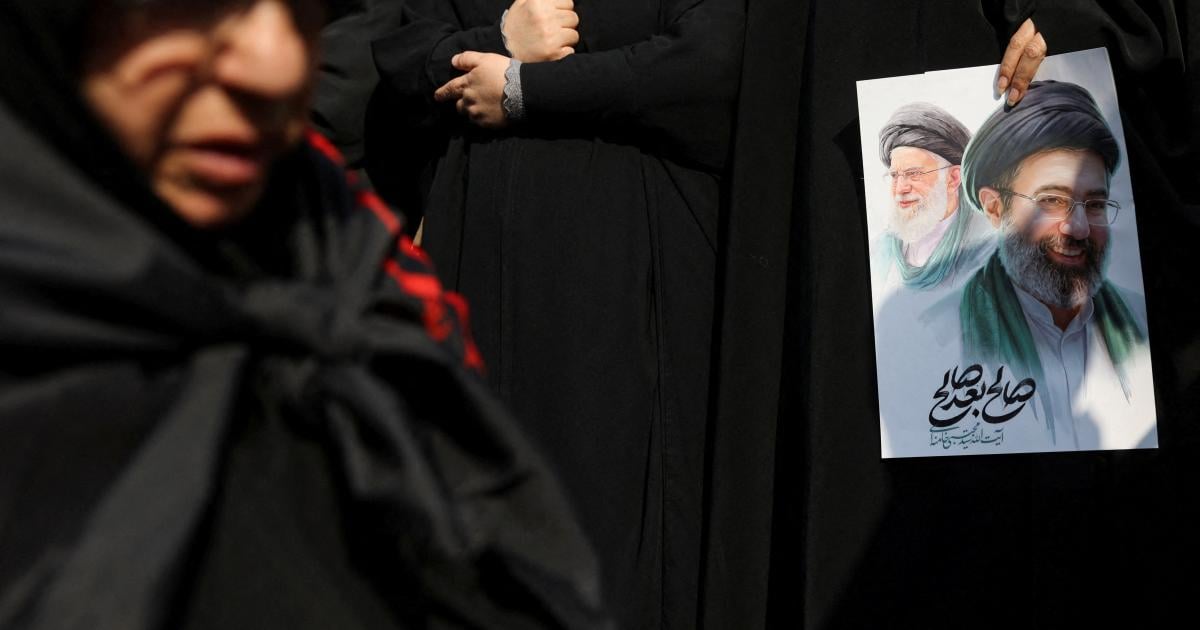
Israel and the United States’ targeted assassination of Iranian Supreme Leader Ali Khamenei—and subsequent strikes on a gathering of the Islamic Republic’s Assembly of Experts—turned long-standing deliberations over who should succeed Khamenei into an opaque emergency process. The assembly’s decision to choose Khamenei’s son Mojtaba was thus made as much out of necessity as it was out of merit. It reflected an effort to preserve a degree of continuity at the top of the regime after the U.S.-Israeli operations killed much of the regime’s military and clerical leadership.
But neither the urgency of the moment nor the desire for continuity fully explains Mojtaba’s rise. The most significant factor in his selection was U.S. President Donald Trump. The president’s expressed desire to help select Iran’s next supreme leader, along with Israeli assassination threats, made Mojtaba the only viable option for regime survival. With its sovereignty undermined and its leadership humiliated, Iran opted to elevate a figure representing resistance to foreign pressure—even as that choice contradicted the regime’s ideological principles and constitutional norms.
Had it not occurred in wartime, Mojtaba’s elevation would not have satisfied ordinary Iranians, who see him as an extension of his brutal father. Nor would it have assuaged the concerns of moderate elites who also want a less extreme figure. But facing U.S. and Israeli bombardment, many Iranians may grudgingly accept Mojtaba as a symbol of national defiance and regime endurance, preferring flawed order to chaos, security to insecurity, and anything to war and foreign domination. Meanwhile, hard-line elites, triumphant in their bid to influence the assembly, will welcome his emphasis on security and ideological purity and his determination to strengthen the IRGC’s power. They expect, and hope, that he will intensify domestic repression and quash dissent, maintain an aggressive posture toward Israel and the United States, and prioritize regime survival over economic or social reforms.
MERITOCRACY OR THEOCRACY?
In ideological regimes, leadership succession is often a critical juncture for survival or collapse. In the Islamic Republic, the process has long been complicated by both external pressures and internal tensions. Inside the country, it has taken place against the backdrop of a fierce competition for influence between hard-liners in the IRGC, Basij militia, and ultraprincipalist clerics on the one hand and an alliance of reformists, protest veterans, and pragmatic moderates on the other.
The succession question is related to debates over the role of the Islamic doctrine of authority of the jurist, or velayat-e faqih, and economic pressures stemming from sanctions and war. Mojtaba’s arrival has further complicated matters, polarizing supporters of the Islamic Republic divided on the relationship between velayat-e faqih and hereditary rule. Before the war, Mojtaba was a low-profile but influential figure operating in the shadows of his father’s office. He maintained close coordination with security and military institutions, particularly the IRGC, but by most accounts did not possess the religious qualifications required of a potential successor. Velayat-e faqih requires that a supreme leader possess deep scholarly religious credentials, and Mojtaba—a midlevel cleric—does not meet these lofty standards. Unlike other supreme leader candidates, who demonstrated their religious authority through published works of Islamic jurisprudence, he has published no scholarly work. No cleric of the highest authority, or marja-al taqlid, confirmed that he possesses the independent juristic reasoning required. Nevertheless, his deep ties to state institutions and symbolic importance as an inheritor of his father’s legacy were enough to position Mojtaba as a leading candidate for succession.
At one point, the elder Khamenei himself seemed opposed to elevating Mojtaba. In 2017, he even condemned hereditary rule as emblematic of monarchical restoration, equating the transfer of power from father to son to the transfer of a copper ablution pot used in the bathroom from one shah to another. He deemed it antithetical to revolutionary rationality and Islamic principles. And he repeatedly forbade his sons from entering the economic sphere, warning that if they took advantage of their proximity to power to engage in such rent-seeking, they would be forced to completely cut ties with him.
But Khamenei’s assassination fulfilled what many analysts suspected was the supreme leader’s long-standing desire for martyrdom, rooted in Shiite ideals of sacrificial resistance, and thus elevated the status of his son. So, too, did Washington’s criticisms. As speculation about Mojtaba mounted, Trump expressed his displeasure at the prospect that the younger Khamenei might take charge. “Khamenei’s son is a lightweight,” he told Fox News, calling him “unacceptable” and contrasting him with Venezuelan President Delcy Rodríguez, who has been willing to comply with Washington’s demands after the capture of former President Nicolás Maduro.
Israel, meanwhile, has openly declared its intent to assassinate any newly selected supreme leader, as well as all current, past, and future Iranian political and military elites. On March 4, Israeli Defense Minister Israel Katz announced that “any leader appointed by the Iranian terror regime … will be an unequivocal target for elimination, no matter his name or where he hides.” Days later, the Israel Defense Forces warned that members of the Assembly of Experts participating in the selection process would be targeted, as well.
The comments backfired. To the Iranian regime, Trump’s and Israel’s remarks were a national humiliation. Instead of caving, it responded with defiance, discarding the former supreme leader’s long-held opposition to hereditary rule by promptly electing Mojtaba.
STATE OF EMERGENCY
Mojtaba’s appointment was not strictly a reaction to perceived indignities at the hands of Israel and the United States. Competition over the succession had been simmering for years. Reformists and moderates, led by former Iranian Presidents Mohammad Khatami and Hassan Rouhani, have long demanded structural reforms in domestic and foreign policy. They viewed Mojtaba as the embodiment of continued hardline policies at home and abroad, incapable of forging national consensus and unwilling to agitate for meaningful change.
But Mojtaba had the support of principalists led by the influential hard-liner Saeed Jalili, IRGC commanders, Basij leaders, and top security officials (though not necessarily their rank and file). And in the chaotic aftermath of Khamenei’s assassination, these hard-liners, particularly the IRGC, had unparalleled access to the Assembly of Experts, many of whose members rely on the Revolutionary Guards for personal protection and security. Their opponents tried to negate this influence; in the days after Khamenei’s death, the Reformist Front, a coalition of reformist parties and groups, issued statements demanding the selection of a supreme leader with broad appeal, and the National Development Party of Islamic Iran argued that “by choosing a comprehensive, all-encompassing figure who is aware of global relations and committed to national interests and the public good, [the Assembly of Experts] can pave the way for national unity and solidarity to overcome the current crisis.” But lacking comparable personal relationships with the assembly’s influential members—and thus direct access to the mechanisms of power—they had no way to more directly convey their views and lobby assembly members.
Had the succession process taken place under normal circumstances, Mojtaba’s selection likely would have provoked widespread protests. Iranian civil society, reformists led by Khatami, and moderates led by Rouhani would have objected that Mojtaba represented a return to monarchy. They would have fought back rather than consigning Iran to continued irrational, repressive, and self-destructive policies. Although protests would likely not have swayed the loyalist-dominated Assembly of Experts or blocked Mojtaba’s ascension, they would have created enormous problems for the regime. If the results of the 2024 presidential election are any indication, the regime would have faced a major crisis by installing a leader who represents a politics opposed by, at a minimum, 75 percent of society.
The strikes and ensuing war, however, have kept moderate elites in check and closed down any space for public dissent. Hard-liners have been able to proceed unimpeded, turning a succession process designed to select for the candidate with the highest jurisprudential qualifications into a desperate (and likely successful) attempt to rally support for a beleaguered regime. The overriding political priority is preserving Iran’s territorial integrity and national existence; all other issues are secondary.
LIKE FATHER, LIKE SON
Mojtaba, who emerged from the Israeli strikes injured, is likely to follow in his father’s footsteps as a leader. With an additional wartime mandate, he may focus on internal security by further empowering the IRGC, tightening the regime’s control over media and the Internet, and redoubling efforts to suppress dissent and stifle efforts at reform. And he will continue Tehran’s aggressive foreign policy. In what was ostensibly his first statement as supreme leader, Mojtaba threatened to continue attacking U.S. bases in the Middle East, vowed to keep the Strait of Hormuz closed, and called on Iran’s proxies to join the war effort.
Trump or Israeli officials, of course, may eventually make good on their threats and attempt to assassinate Mojtaba. But just as killing his father did not spark an uprising against the regime or trigger its collapse, the departure of Mojtaba would do little to accomplish any U.S. or Israeli war aims. If anything, it would likely strengthen the regime’s base of religious support, cause the country’s military leaders to double down on the war, and reverberate in Shiite communities across the Muslim world. Shiites would see it as another example of their persecution by foreign powers—a narrative that dates back to the sixth-century Umayyad dynasty.
Even if the United States and Israel pursue a maximalist strategy of decapitation, hoping that the regime eventually runs out of replacements, detailed succession planning and the IRGC’s decentralized structure provide enough redundancy to prevent the collapse of the Iranian state. A scenario in which the IRGC decides to dispense with velayat-e faqih entirely and assumes total control of the government, transitioning the country to a military dictatorship that discards the clerical façade but retains authoritarian power, is plausible.
However the internal and external power struggles unfold, none of their leading participants are capable of resolving Iran’s problems. Neither Mojtaba’s leadership nor violent U.S. and Israeli attempts at regime change will improve the lives of ordinary Iranians. Only Iranians themselves can lead the transition toward a secular republic committed to freedom, human rights, and justice. In the meantime, they will continue to suffer—under a repressive regime on the one hand and bombardment on the other.
Loading…