
The following hypothetical legal memorandum imagines what the General Counsel for the U.S. Department of Defense would advise the Secretary of Defense immediately following the SecDef’s remarks on March 13, 2026, in which he appeared to suggest that U.S. forces would deny “quarter” to Iranian combatants during Operation Epic Fury. The memorandum presumes that Secretary Hegseth did not know what “no quarter” means under international humanitarian law or knew its legal meaning but intended only to panic and terrify Iranian combatants or knew its legal meaning and intended for “no quarter” to be executed by his subordinates. The memorandum is agnostic as to those conditions; its analysis applies regardless.
FOR: Pete Hegseth, Secretary of War
DATE: Mar. 14, 2026
FROM: General Counsel, Department of War
SUBJECT: The Secretary’s “no quarter, no mercy” remarks during Operation Epic Fury
1. Purpose: to inform you that a public statement you made on Mar. 13, 2026, may be construed as counseling, commanding, encouraging, ordering, or threatening the commission of a war crime. This may expose you to criminal liability under 18 U.S.C. 2441(c)(2), and expose any subordinate servicemembers who carry it out to prosecution under the Uniform Code of Military Justice as well as 18 U.S.C. 2441(c)(2). Your statement may also be used adversely in future unforeseeable incidents. We recommend that you publicly retract this statement immediately and to clarify to all subordinates within the DoW that under no circumstances shall U.S. forces order, threaten, or tolerate “no quarter” with respect to Iranian combatants, under penalty of criminal investigation and potential prosecution.
2. Background:
a. At a Pentagon press briefing on Friday, Mar. 13, 2026, you stated: “the military capabilities of their evil regime are crumbling. They can barely communicate, let alone coordinate; they’re confused and we know it. Our response? We will keep pressing. We will keep pushing, keep advancing, no quarter, no mercy for our enemies.”
b. This statement follows several other remarks you made regarding the use of force, rules of engagement, and the law of armed conflict, including:
In your book, The War on Warriors, you described your service as a junior Army officer in Iraq and ordering your subordinate soldiers to ignore legal advice regarding then-current Rules of Engagement with which you disagreed.
In that book, you wrote: “Our boys should not fight by rules written by dignified men in mahogany rooms eighty years ago. America should fight by its own rules.”
When asked about that sentence in your book during your Senate nomination hearing on Jan. 14, 2025, you replied: “The applications of the Geneva Conventions are incredibly important, but we would all have to acknowledge that the way we fought our wars back when the Geneva Conventions were written are a lot different than the asymmetric, nonconventional environment of counterinsurgency that I confronted in Iraq and Afghanistan.”
In an Oval Office press briefing on Sep. 5, 2025, you stated that the Department of War will conduct its operations with “maximum lethality, not tepid legality.”
On Sep. 30, 2025, you spoke before more than 800 flag officers at Marine Corps Base Quantico, during which you said: “We fight to win. We unleash overwhelming and punishing violence on the enemy. We also don’t fight with stupid rules of engagement. We untie the hands of our warfighters to intimidate, demoralize, hunt and kill the enemies of our country. No more politically correct and overbearing rules of engagement, just common sense, maximum lethality and authority for warfighters.”
Just days into Operation Epic Fury, in a press briefing on Mar. 2, 2026, you said the U.S. military would be bound by “no stupid rules of engagement.”
3. “No quarter” is a war crime:
a. As law of armed conflict experts Michael Schmitt and John Tramazzo have explained, “no quarter” is “an order that there shall be no survivors, a threat to conduct operations on that basis, or fighting in that manner” (emphasis in the original). To command, threaten, or practice that “no quarter” be given to one’s enemies in battle is to simply say to subordinates: “do not accept surrender;” this implies killing every combatant regardless of their expressed desire to surrender and become a prisoner of war.
b. Such orders, threats, and fighting have been long recognized under customary international law (see here and here), the Hague Convention (art. 23, Annex to Convention IV, 1907) and the Geneva Convention’s Additional Protocol I (art. 40) as absolutely prohibited. Though not a signatory to AP I, the U.S. recognizes and affirms this prohibition as reflective of customary international law. The prohibition extends as far back as the Lieber Code issued by President Lincoln during the Civil War; in 1948, a U.S. military court convicted high-ranking German military officers of the crime of no quarter (the so-called High Command Case).
c. The prohibition applies not only to an order to subordinates but also, independently, to a threat of no quarter communicated to enemy forces. The Department of Defense Law of War Manual, Section 5.4.7 cites to Hague IV Regulation article 23(d) as conclusive: “it is especially forbidden . . . [t]o declare that no quarter will be given.” In describing that rule, the Manual further warns “it is also prohibited to conduct hostilities on the basis that there shall be no survivors, or to threaten the adversary with the denial of quarter,” quoting the ICRC’s Commentary to AP I, art. 40 (para. 1595) (emphasis added).
4. War Crime liability under 18 U.S.C. 2441:
a. The U.S. War Crimes statute makes it a federal offense to commit a “war crime,” subject to being “fined … or imprisoned for life or any term of years, or both, and if death results to the victim, shall also be subject to the penalty of death.”
b. The statute defines “war crime” by incorporating those offenses described as “grave breaches” of the Geneva Conventions or its additional protocols and acts specifically “prohibited by Article 23, 25, 27, or 28 of the Annex to the Hague Convention IV.”
c. As stated above, Article 23(d) in that Annex is unambiguous: “it is especially forbidden . . . [t]o declare that no quarter will be given.”
d. In describing ongoing and future combat operations in the current international armed conflict between the United States and Iran, your statement “no quarter, no mercy for our enemies” likely violates Art. 23(d) of the Annex to Hague IV and thereby violates 18 U.S.C. § 2441. This interpretation is reinforced when your remarks are considered alongside your previous public comments about the Rules of Engagement, “maximum lethality, not tepid legality,” and the laws of armed conflict noted above in para. 2.b.
e. An intention to merely cause panic and terror within the Iranian armed forces is not a defense because Article 23(d) prohibits the “declar[ation] that no quarter will be given.” It is a speech offense; under normal principles of criminal law, a command to unlawfully kill another person, even if never performed, is still prohibited (“Whoever commits an offense against the United States or aids, abets, counsels, commands, induces or procures its commission, is punishable as a principal” – see 18 U.S.C. § 2). Whether the order is ever consummated by your subordinates is immaterial to your criminal exposure under 18 U.S.C. § 2441.
f. Any U.S. servicemember who interprets your comments as an order and who subsequently commands, directs, orders, or gives “no quarter” to Iranian forces will be exposed to criminal liability under Article 118, UCMJ, for murder (a premeditated killing of another with no legal justification or excuse). Such an order is “patently” or “manifestly” unlawful; therefore, a servicemember accused of murder for ordering or giving “no quarter” cannot raise an “obedience to orders” defense in their court-martial. Alternatively, servicemembers would also be exposed to prosecution in U.S. district court for violation of 18 U.S.C. § 2441.
5. Recommendations : In your remarks on Mar. 13, 2026, you twice said that the first ten days of Operation Epic Fury has been a military campaign like nothing the “world has never seen before.” In light of your assertion that “[n]ever before has a modern capable military, which Iran used to have, been so quickly destroyed and made combat ineffective, devastated,” there is no discernible strategic, operational, or tactical logic for the proposition that “no quarter” is militarily sound or necessary. Given that “no quarter” is a clear violation of the Hague Convention IV and, as a consequence, U.S. federal law, we recommend the following immediate actions:
a. Publicly retract the comments and disavow any intention to induce, inspire, counsel, encourage, incite, order, threaten, tolerate, or give “no quarter” to Iranian combatants.
b. Communicate through the chain-of-command conducting Operation Epic Fury that “no quarter” is a war crime that will be thoroughly investigated and prosecuted under the Uniform Code of Military Justice or 18 U.S.C. § 2441.
6. The point of contact for this opinion is the General Counsel, Department of War.
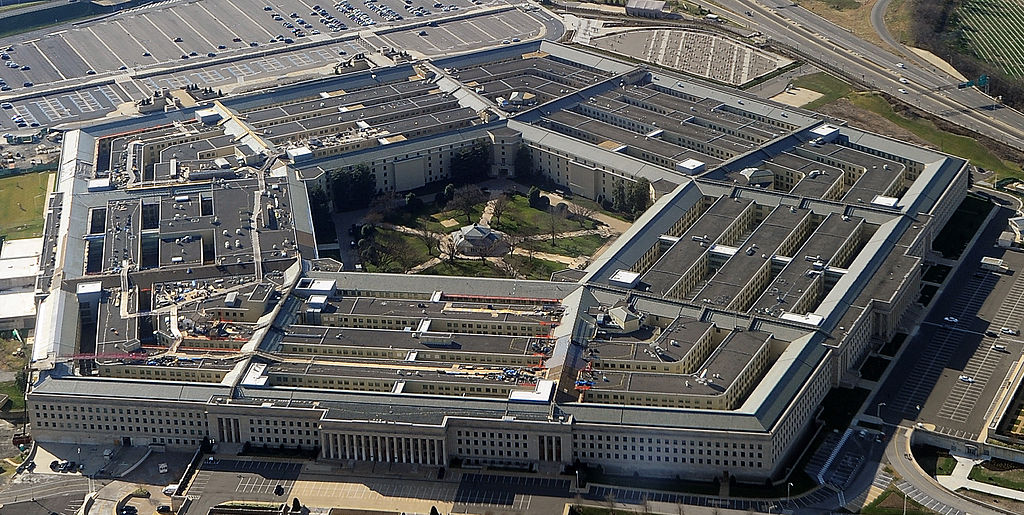
FEATURED IMAGE: This picture taken December 26, 2011 shows the Pentagon building in Washington, DC. Headquarters of the United States Department of Defense (DOD), the Pentagon is the world’s largest office building by floor area, with about 6,500,000 sq ft (600,000 m2), of which 3,700,000 sq ft (340,000 m2) are used as offices. Approximately 23,000 military and civilian employees and about 3,000 non-defense support personnel work in the Pentagon. AFP PHOTO (Photo credit should read -/AFP via Getty Images)