
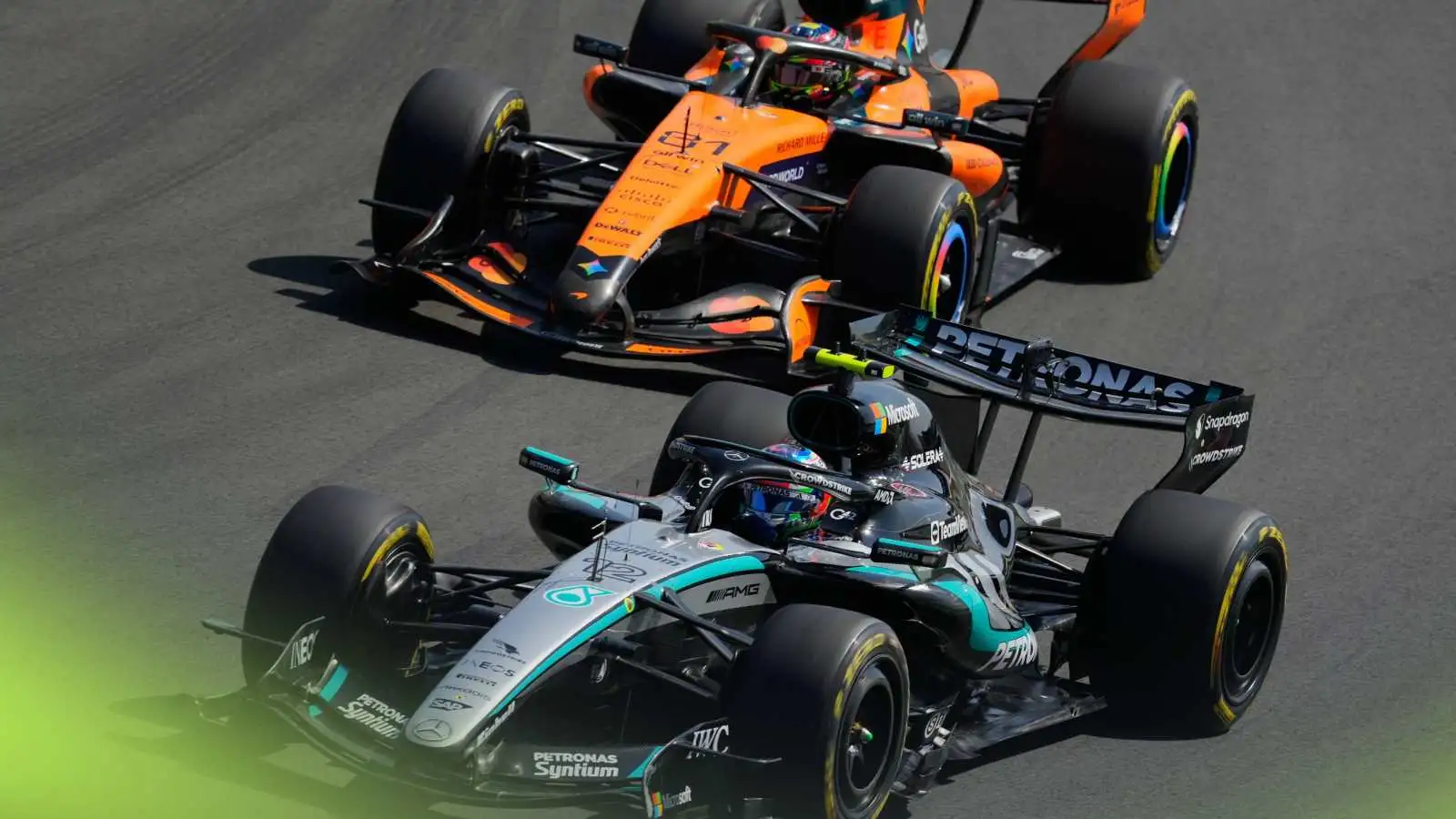
McLaren certainly aren’t enjoying the start to the season they had envisioned. At present, the Woking-based outfit finds itself well behind Mercedes and Ferrari, with lap times that are yet to challenge for top spot.
During Sprint Qualifying, Lando Norris was the quicker of the two, yet he still trailed George Russell’s pole time by over six-tenths. While the much-discussed straight-line speed deficit appears to have been largely rectified, the gap on the timing screens remains stubbornly wide.
Lando Norris telemetry explains McLaren Shanghai qualifying deficit
Want more PlanetF1.com coverage? Add us as a preferred source on Google to your favourites list for news you can trust.
So, how did McLaren solve its top-speed woes, and what exactly stopped them from challenging the frontrunners in qualifying? The telemetry data provides the answers.
The opening stages of this 2026 season have been dominated by “conspiracy theories” regarding the Mercedes power unit bolted into the back of the McLaren. Rumours have been swirling that the British team isn’t receiving the same output as the works Mercedes squad, leaving them at an unfair disadvantage to the Silver Arrows.
However, a deeper dive into the telemetry suggests these theories are wide of the mark. McLaren’s deficit to the front is significantly more nuanced than a simple lack of horsepower. Even still, Mercedes has to supply each of its customer teams with its current power unit – meaning no advantage can be gained this way.
As previously noted, a primary factor behind the massive gap in Sprint Qualifying, despite respectable starting positions, was indeed straight-line speed. At a circuit like Shanghai, with its 1.2km back straight, top-end velocity is critical. But this isn’t necessarily a question of engine “ponies”; it’s about how you manage and deploy your energy.
More on the Chinese Grand Prix
What is the grid for the 2026 Chinese Grand Prix?
F1 2026: Head-to-head qualifying statistics between teammates
China is a fascinating case study in this regard. Teams have several heavy braking zones, a monstrous straight, and a few high-speed sweeps where harvesting electrical energy is far easier than it was last week. This has led to diverging strategies regarding E-boost deployment over a single flying lap.
Comparing Norris’s and Russell’s best laps from Sprint Qualifying reveals clear tactical differences.
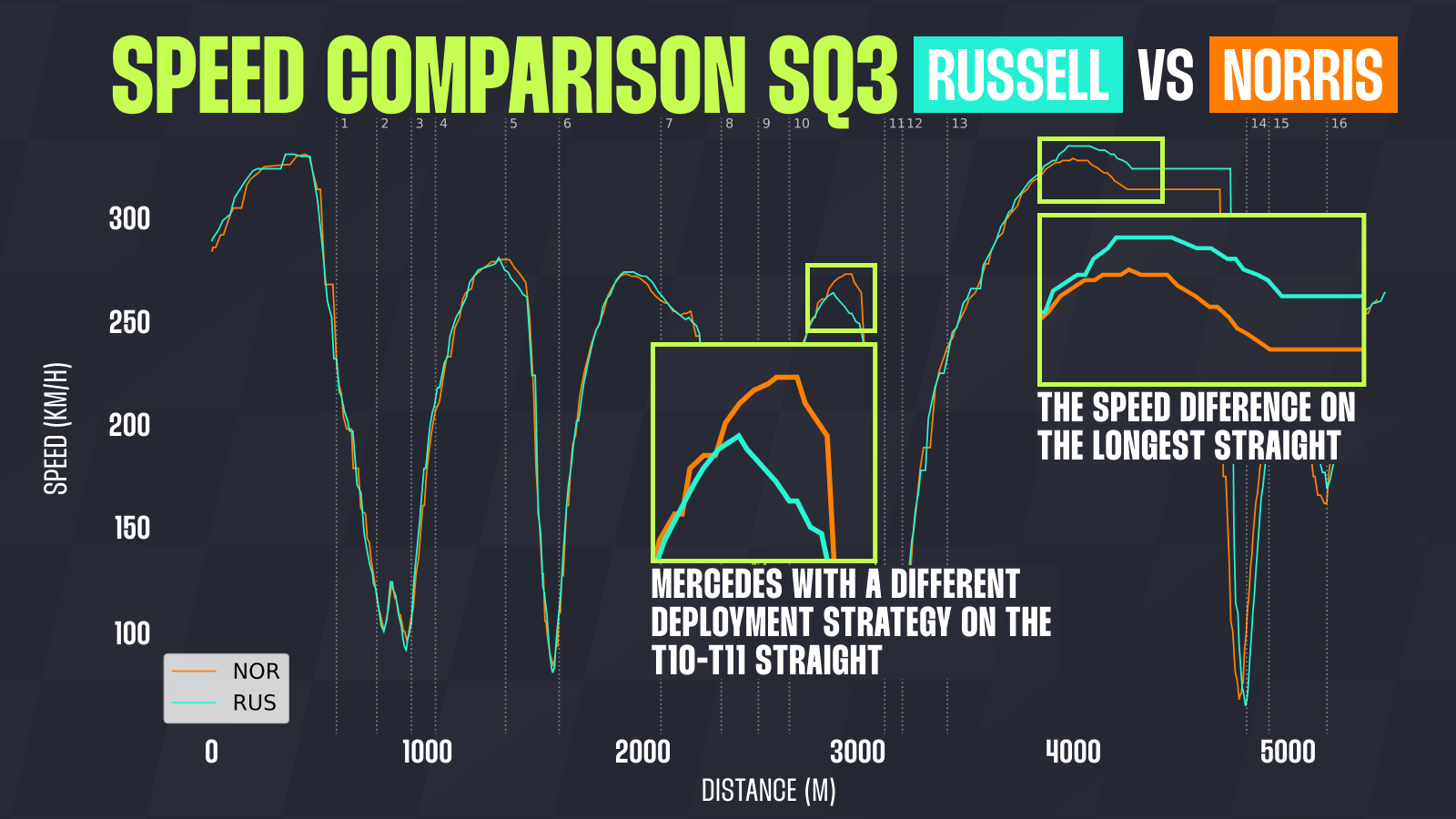
Essentially, Russell was the one carrying significantly less speed through the T10–T11 section to harvest the battery, which he then drained aggressively onto Shanghai’s longest straight. This is precisely where the massive delta between the two drivers was created. Despite a minor data glitch in the second half of the straight, the difference in peak velocity was unmistakable.
What is particularly interesting is how the picture changed for the main Grand Prix qualifying session. Although we are now looking at Oscar Piastri and Kimi Antonelli as the representative benchmarks for their respective teams, the data trends would be identical had we compared Norris and Russell.
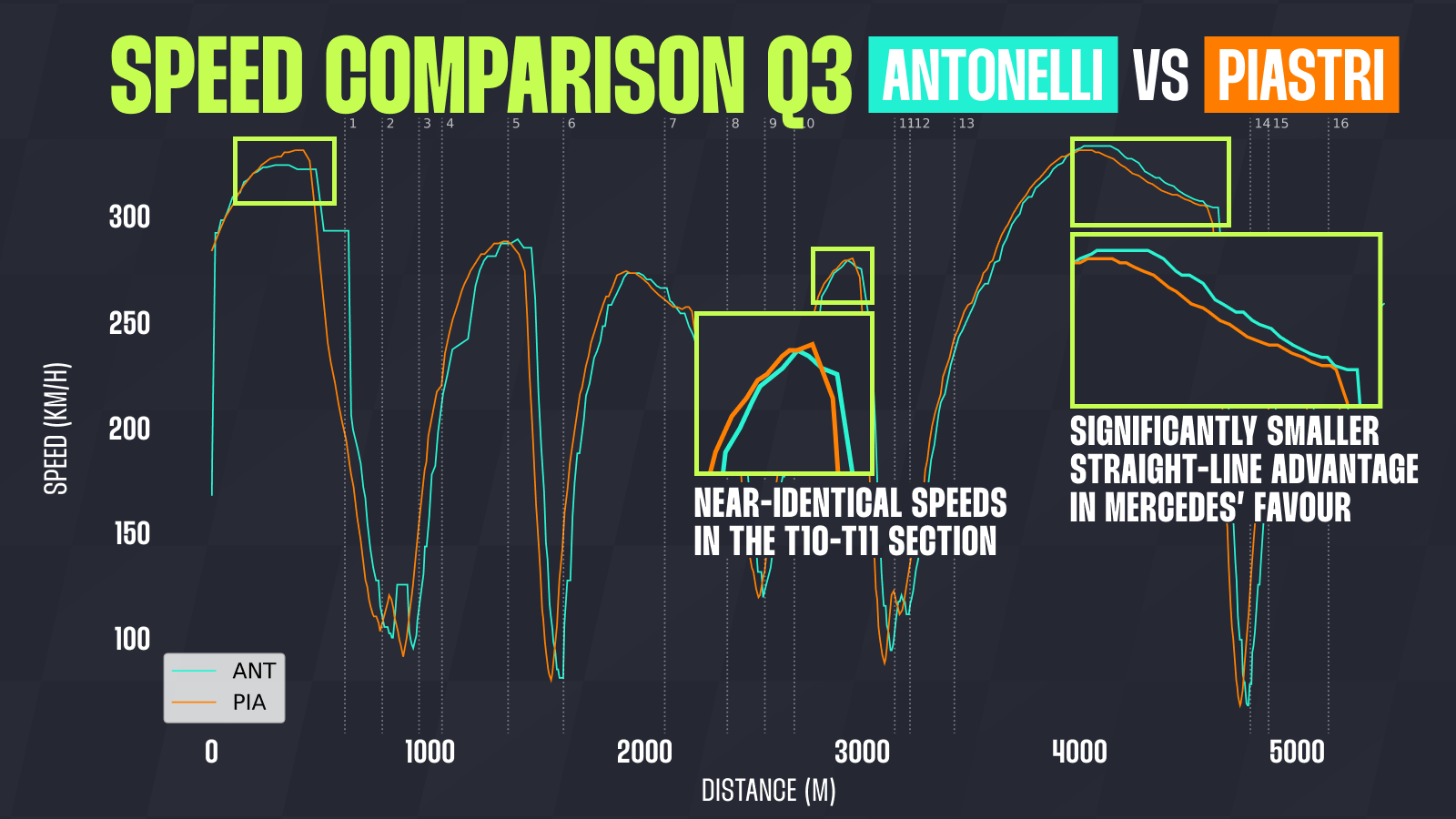
Take a look at the straights: their speeds are now almost identical through the T10–T11 section, while the gap on the main back straight has been slashed significantly. In fact, the data shows that Piastri lost 0.027 seconds to Antonelli between T13 and T14.
Furthermore, another shift appears also on the start-finish straight, where McLaren now holds a noticeable advantage, a complete reversal of the Sprint Qualifying trend.
In other words, McLaren tweaked their tactical approach for qualifying and successfully matched the W17 for top speed. It seems “engine power” can no longer be used as an excuse.
So, why is McLaren still lagging behind?
The telemetry reveals that the “Papaya” drivers are bleeding the most time in the traction zones.
The most glaring disparity is found in T2 and T3, where Piastri lost a chunky 0.2 seconds. A similar story unfolds in T11 and T12 – both long-radius corners. Through T11 and T12 alone, the Australian lost approximately 0.25 seconds.
We can conclude from this that the McLaren isn’t necessarily suffering from a lack of engine grunt, but rather from aerodynamic and mechanical instability. The car appears more difficult to manage on the rear axle, which seems to lack the aerodynamic downforce of its rivals.
McLaren is still losing the most ground in the third sector, but the culprit isn’t the 1.2km straight – it’s the technical challenge of Turns 11 and 12.
When you factor in that Mercedes still boasts the most efficient energy recovery system on the grid, that half-second gap on Saturday becomes a very realistic reflection of the pecking order.
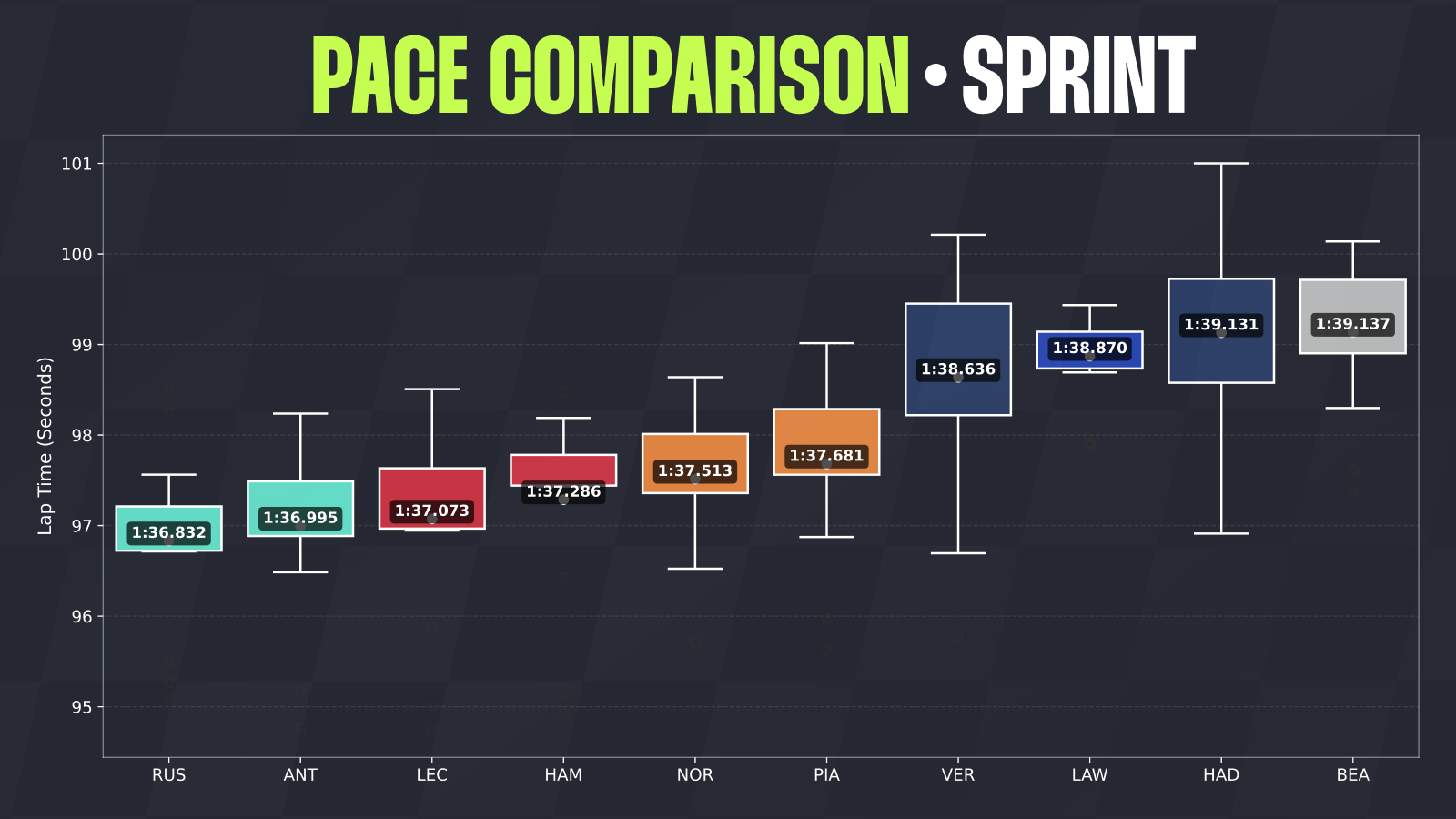
The concern for McLaren deepens when looking at race pace, which remains a country mile behind Mercedes and Ferrari. During the Sprint race, Norris was on average 0.65 seconds per lap slower than Russell, with Piastri’s deficit even greater.
It’s clear that the engineers at Woking have a mountain of work ahead of them.
Want to be the first to know exclusive information from the F1 paddock? Join our broadcast channel on WhatsApp to get the scoop on the latest developments from our team of accredited journalists.
You can also subscribe to the PlanetF1 YouTube channel for exclusive features, hear from our paddock journalists with stories from the heart of Formula 1 and much more!
Read next: Kimi Antonelli explains ‘risk versus reward’ lesson behind breakthrough Chinese GP pole