
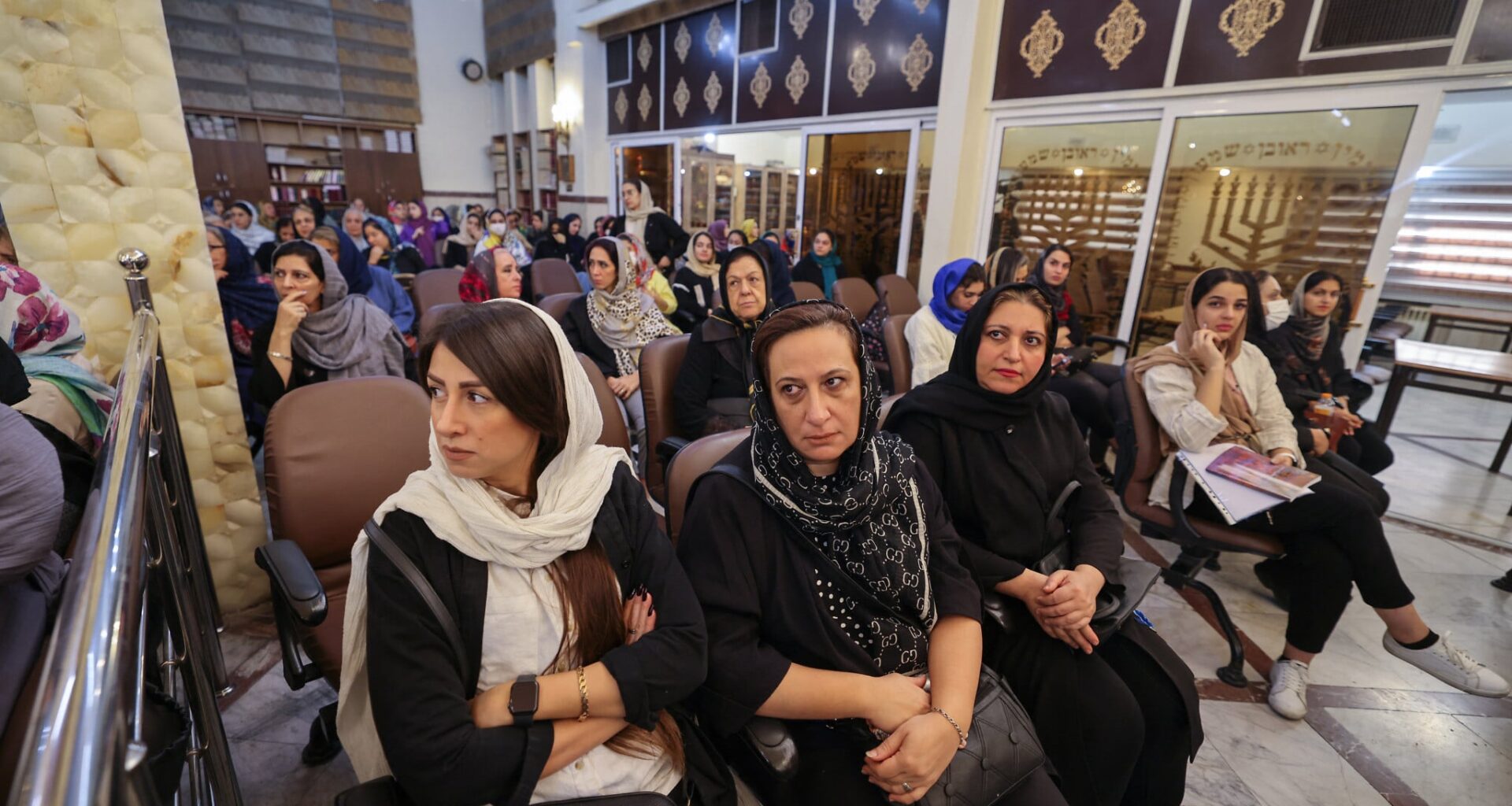
It’s been over a year since Daveed, a pseudonym, spoke to his cousins in Tehran.
While the Iran native, who today sells goods in Jerusalem, is worried for the relatives he left behind years ago, he is also acutely aware of the danger he can put them in merely by making contact.
“Nowadays, it’s safest to keep a low profile,” he said. Of the situation his family is in, he knows nothing beyond “they’re afraid.”
As Israel and the United States begin the third week of their joint aerial assault against the Iranian regime, thousands of Jews living in the Islamic Republic are facing fraught circumstances.
Exactly how fraught is difficult to determine. Since the campaign began, many Jews in Iran, like Daveed’s cousins, have had little or no contact with relatives abroad. Internet blackouts have limited communication, but in many cases the silence is deliberate, as such contact — particularly with those in Israel — risks drawing suspicion from authorities.
Get The Times of Israel’s Daily Edition
by email and never miss our top stories
By signing up, you agree to the terms
Iranian Jewish community leaders and activists warn that attempts from within Israel to contact Jews in Iran could put their lives at risk. For that reason, The Times of Israel did not directly contact Jews in the country.
Interviews have been conducted, however, with relatives, friends, and community figures connected to Iran’s Jews in an effort to understand how the war is affecting them. (This article was approved for publication by Israel’s military censor, which requires the submission of material concerning the status of Jewish communities in “hostile nations.”)
Online estimates put Iran’s Jewish population at between 8,000 and 15,000 people, mostly concentrated in Tehran, with smaller communities in cities such as Isfahan and Shiraz.
Since Israel’s establishment, tens of thousands of Iranian Jews have immigrated to the Jewish State, making up an estimated population of about 200,000 today, mostly Israeli-born.
Daveed told The Times of Israel that he remembers the country fondly and longs to see it “free” one day.
Now middle-aged, Daveed moved to Israel with his wife and children in his early 30s after growing up in Tehran and completing compulsory military service there.
While speaking in Hebrew to the Times of Israel from his small shop, where he sells roasted nuts, seeds, dried fruit and spices, two other Iranian Jewish immigrants working nearby passed, calling out to him in Farsi.
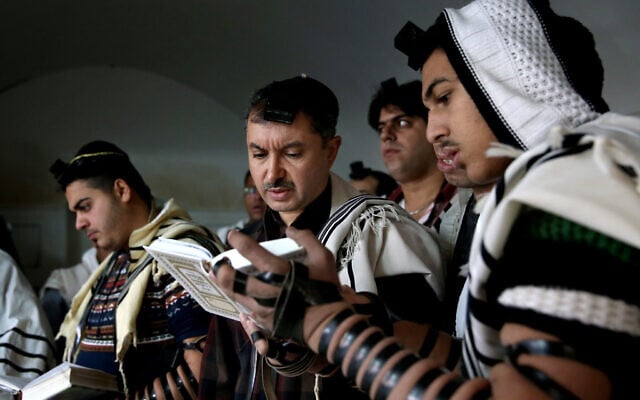
Illustrative: Iranian Jewish men pray at the Molla Agha Baba Synagogue in the city of Yazd, 420 miles south of the capital Tehran, in Iran, November 20, 2014. (AP Photo/Ebrahim Noroozi)
When asked about their relatives in Iran, they declined to comment.
“It all will be okay, I believe,” Daveed said at the end of the conversation. “Please God, this will bring down the regime.”
A tense picture
Iranian-born Jews who have been in contact with relatives in Iran said the Jewish community appeared to be managing under the circumstances, but pointed to past instances in which the regime targeted Jews in times of crisis, stressing that keeping their heads down was the best strategy.
Some also expressed hope that the war would ultimately allow them to visit loved ones in the country.
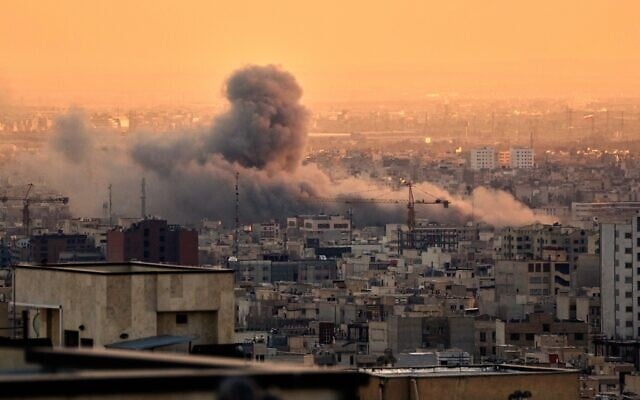
A plume of smoke rises following a military strike in Tehran, Iran, amid the US-Israeli bombing campaign there, March 3, 2026. (AP Photo/Vahid Salemi)
Many of those approached for this article declined to discuss the Jewish community in Iran at all. Some said they had intentionally avoided contacting relatives since the strikes began, fearing that even routine communication might expose them to danger.
Responding to questions forwarded to them in Farsi by a London-based anti-regime activist, one Jewish family in Iran told The Times of Israel, “The conditions are not suitable to speak at the moment. Hoping for better days ahead.”
“From being in touch with members of the Jewish community in Iran, I understand that they are physically well. We pray for their continued safety and well-being,” said Istanbul-based Rabbi Mendy Chitrik, who is the chairman of the Alliance of Rabbis in Islamic States.
Joseph, a pseudonym for a Jewish Iranian who moved from Tehran to Jerusalem in 2005, said that he hasn’t heard from his two aunts in Tehran since a brutal government crackdown against anti-regime protests earlier this year.
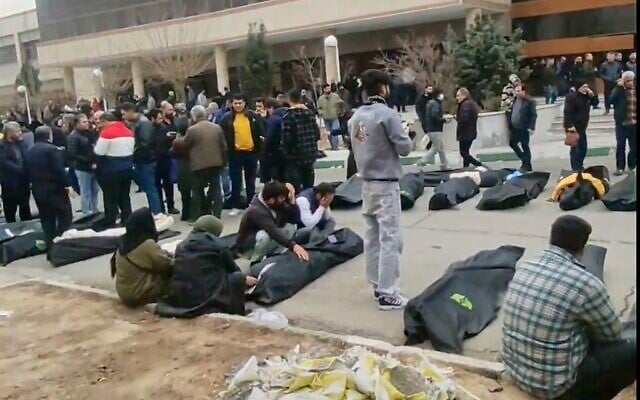
This image from video taken between January 9 and January 11, 2026, and verified by AP, shows bodies and mourners outside a morgue in Iran, following a crackdown on protests in Kahrizak, Tehran province. (UGC via AP, File)
Some estimates say the repression killed as many as 30,000 Iranians, and officials in Israel have cited the violence as a factor accelerating the decision to strike Iran.
Joseph explained that in moments of political or military unrest, suspicion can quickly fall on minorities in Iran: “The regime always blames someone for being connected to the enemy, saying the enemy caused all the disturbances.”
“And of course, the first people they look for there are the Jews. So we’ve learned the lesson. Everyone immediately cuts off contact. We don’t speak. There has been no contact from [when the protests started] until now.”
Reported arrests
During the recent demonstrations, unconfirmed Hebrew media reports alleged that several members of Iran’s Jewish community were arrested on suspicion of involvement in the protests, though community representatives were said to deny any connection, calling the arrests a mistake.
In the aftermath of the 12-day war between Israel and Iran in June, Hebrew media reports also claimed that several Jewish community leaders in Tehran and Shiraz were arrested and accused, without any evidence, of having ties to Israel.
At the same time, the Iranian regime distinguishes between Zionism and Judaism, and Jews are formally granted a degree of religious freedom. Jewish community leaders inside the country have repeatedly condemned Israeli action against Iran or in the Palestinian territories.
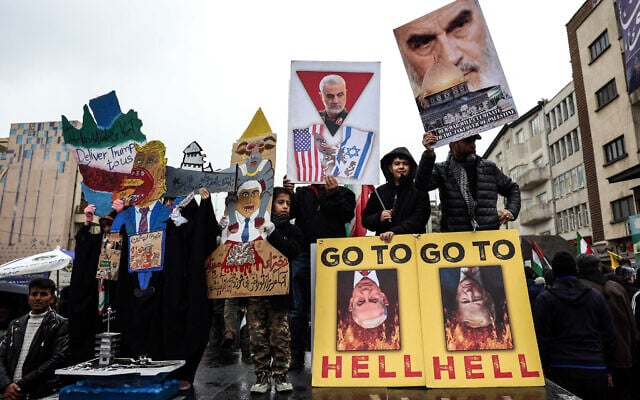
Iranians hold up posters as they take part in a Quds Day, or Jerusalem Day, rally in Tehran, on March 13, 2026 (AFP)
During the June war, several Jewish communities published sharp statements condemning Israel. Similar statements were issued — and anti-Israel gatherings held — soon after the October 7, 2023, Hamas-led massacre in southern Israel that sparked Israel’s two-year war in Gaza with the Iran-backed terror group.
It remains difficult to determine how much these statements reflect genuine sentiment within the community and how much they stem from pressure by the authorities.
“The regime has taken people who had absolutely no connection to Israel, accused them of spying, and put them in prison. So if a Jew speaks directly now — especially in times like these — they’re looking for that,” Joseph said.
Even the use of encrypted messaging apps such as WhatsApp or Telegram can be dangerous.
“Even if they don’t know the content [of the conversation], the fact that they know that a Jewish person there spoke to someone with an Israeli number — that alone is a problem,” he said.
‘I hope to visit my homeland one day’
Joseph said that during the June war, Jewish community leaders “warned very strongly not to speak with people in Israel — and even if they do speak, the conversation should only be about mundane things… Nothing political, or anything that could sound like information transfer.”
Contacting relatives outside of Israel can also be problematic.
An Iranian Jew living in the US told The Times of Israel that they’ve managed on occasion to speak with relatives in Shiraz since the US-Israeli campaign started, but are careful to avoid mentioning Israel over the phone, for fear of them “being accused of spying.”
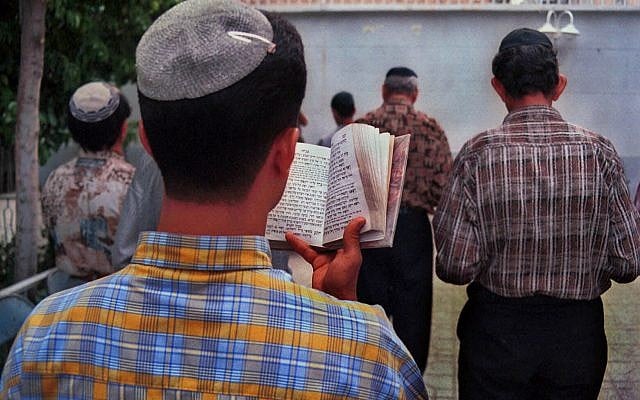
Illustrative: An Iranian Jewish youth group prays at the Rabeezadeh Synagogue in Shiraz in southern Iran, April 12, 2000. (AP Photo/Vahid Salemi)
Joseph recalled that, before the 1979 revolution that put the current regime in power, his grandfather would travel at least twice a year to Israel from Iran, taking a one- to two-hour flight over Iraq.
He hoped the current conflict would result in the regime’s fall, perhaps opening up ties between the countries and allowing him to see his family again: “As someone who lived there, I hope that one day I’ll be able to visit. Just a visit to my homeland.”
“Everything the regime has done in the past 40-something years is one thing. What they did recently, with suppressing the protests, was on another level,” he said sadly. “Simply as a human being, I expect this to end — because as long as they remain in power, it will continue. And I believe that if the war stops halfway without the regime falling, they will oppress the people there even more.”