
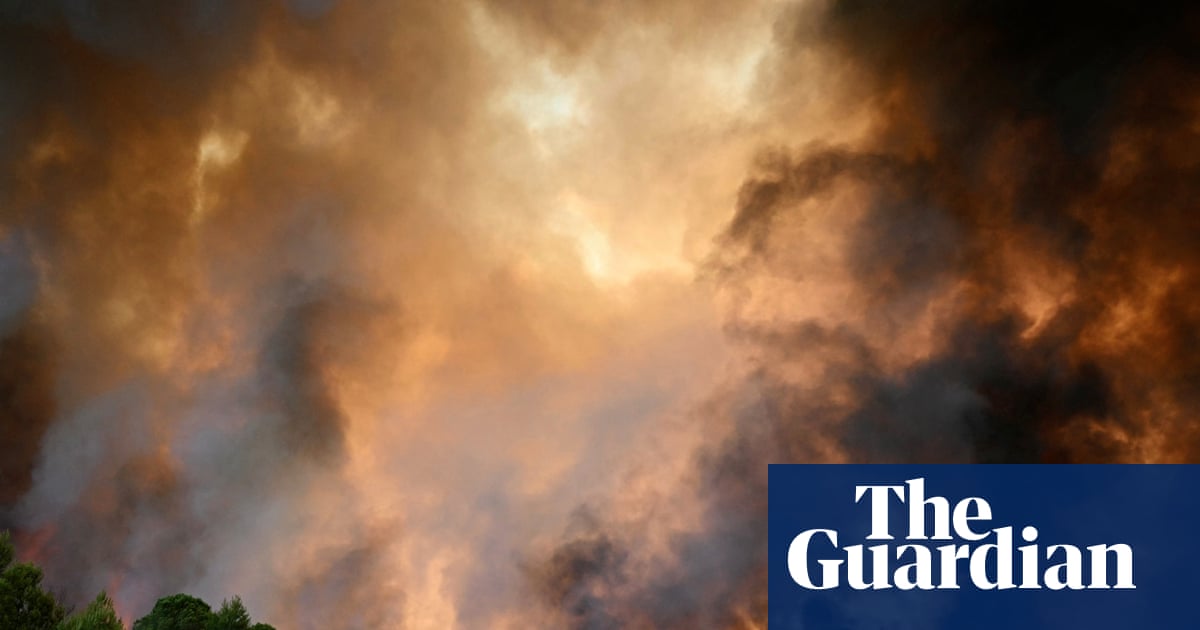
Hundreds of firefighters are battling to stop the spread of a fast-moving wildfire in southern France, after one woman died and nine people were injured as the blaze scorched a vast area of the Corbières hills.
The blaze burned an area the size of Paris over the course of one afternoon and night and was still ongoing on Wednesday evening, making it the second biggest fire in France in 50 years.
The French prime minister, François Bayrou, who visited the area, described the fire as “a catastrophe of unprecedented scale”. “What is happening today is linked to climate change and drought,” he said.
The blaze, which started on Tuesday afternoon, had burned 16,000 hectares inland from the Mediterranean near the Spanish border.
It began in the village of Ribaute in the Aude department, spreading across the rural, wooded area of the Corbières, famous for its vineyards and medieval villages.
A woman died in her home and one person was in a critical condition with severe burns, according to the Aude prefecture. Several firefighters were also injured. At least 25 homes were destroyed or damaged.
Police are investigating the cause of the fire.
The environment ministry said the fire had destroyed the same amount of land in 24 hours that wildfires typically burned across France in a year.
It destroyed double the total surface area that burned in wildfires in France in 2023. “This is an exceptional fire that illustrates the scale of the consequences of the climate crisis,” the ministry said in a statement.
The wildfire remained “very active’’ on Wednesday, local authorities said.
The mayor of the village of Jonquières, Jacques Piraux, said all residents had been evacuated. “It’s a scene of sadness and desolation,” he told the broadcaster BFM TV. “It looks like a lunar landscape, everything is burned. More than half or three-quarters of the village has burned down. It’s hellish.”
Lucie Roesch, the secretary general of the Aude prefecture, said: “The fire is advancing in an area where all the conditions are ripe for it to progress. We are monitoring the edges and the back of the fire to prevent flare-ups.”
Planes were dropping water on the flames but Roesch said: “This fire will keep us busy for several days. It’s a long-term operation.”
Weather conditions were expected to remain unfavourable due to strong winds, rising temperatures and dry vegetation in the area, officials said.
Camping grounds and at least one village were partially evacuated, and several roads were closed. Residents and tourists were asked to remain in their homes unless told to evacuate by firefighters. Some tourists who were evacuated from campsites spent the night in municipal buildings.
skip past newsletter promotion
Sign up to This is Europe
The most pressing stories and debates for Europeans – from identity to economics to the environment
Privacy Notice: Newsletters may contain info about charities, online ads, and content funded by outside parties. For more information see our Privacy Policy. We use Google reCaptcha to protect our website and the Google Privacy Policy and Terms of Service apply.
after newsletter promotion
One local resident told France 2 TV: “I wanted to go back to my house to get my things but I couldn’t go in. We’re waiting to see what the damage was. When I left, there were flames at the foot of the house.”
The French president, Emmanuel Macron, wrote on social media: “All of the nation’s resources are mobilised.” He called on people to exercise “the utmost caution”.
The Aude department, in particular, has experienced an increase in wildfires in recent years, aggravated by low rainfall and the removal of vineyards, which used to help slow their advance.
Aude Damesin, who lives in the town of Fabrezan, told Agence France-Presse that the frequency of wildfires was taking a toll on local residents.
“I find it tragic to see so many fires since the beginning of the summer,” she said. “It’s terrible for the wildlife, the flora and for the people who are losing everything.”
Last month, a wildfire that reached the southern port city of Marseille, , left about 300 people injured.
Southern Europe has experienced large fires this summer. Fires have burned more than 25,700 hectares of Portugal since the beginning of 2025, according to the European Forest Fire Information System (EFFIS), while there have also been wildfires in central Spain, Turkey, Greece and elsewhere in the Balkans.
Scientists say climate change is exacerbating the frequency and intensity of heat and dryness, making the region more vulnerable to wildfires. Europe is the world’s fastest-warming continent, with temperatures increasing at twice the speed of the global average since the 1980s, according to the European Union’s Copernicus Climate Change Service.
Agence France-Presse contributed to this report