
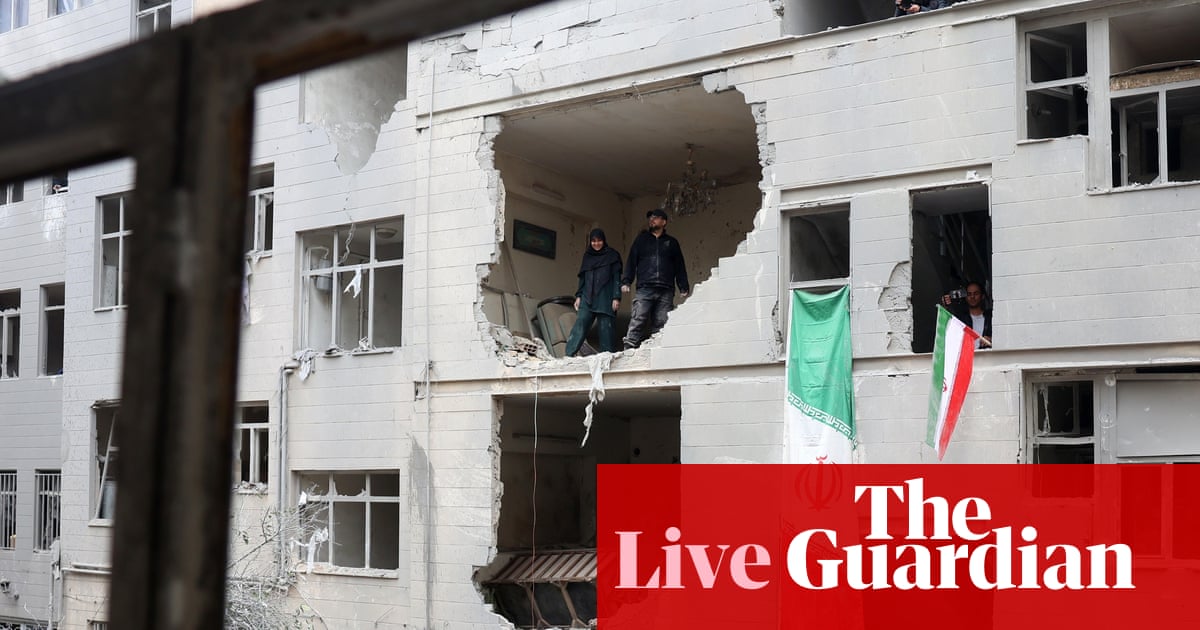
Summary of the day so far…
Iranian foreign minister, Abbas Araghchi, denied Tehran had asked for a ceasefire or even a negotiation to end the war, in comments undermining Donald Trump’s claim that Iran wanted to make a deal.
Araghchi also said that Iran was open to countries who wanted to “talk” about safe passage through the strait of Hormuz, one of the world’s most important shipping channels, which has effectively been closed due to the war.
Iran has attacked ships and reportedly started to lay mines in the strait, in effect closing it to marine traffic, leading to a surge in energy prices and inflation fears around the world.
Countries including the UK, Japan, China and South Korea have said they are still considering their options after Trump urged them to send warships to the strait to secure the vital shipping route.
Trump told NBC News that the “terms aren’t good enough yet” for a deal with Iran. He said Tehran’s commitment to completely abandoning any nuclear weapons ambitions would be part of any agreement.
US energy secretary Chris Wright said he expects the US-Israel war with Iran to end within “the next few weeks” amid a spike in gas prices in the US.
The Lebanese health ministry said 850 people, including over 100 children, have been killed in Israeli attacks on the country since 2 March.
Israel said it launched extensive airstrikes across western Iran today. The IDF said earlier it had detected Iranian missiles being fired at Israel.
Israeli military warned several neighbourhoods in the southern suburbs of the Lebanese capital of Beirut to evacuate “immediately” ahead of Israeli attacks.
Oil-loading operations at Fujairah, the UAE’s main oil port on its east coast, have reportedly restarted after it was targeted by a drone strike on Saturday.
The Iranian foreign minister, Abbas Araghchi, said the new supreme leader, Mojtaba Khamenei, is “in good health” and “fully managing the situation” despite ongoing speculation regarding his whereabouts. In his interview with NBC News, Trump questioned whether the 56-year-old was “even alive”.
Key events
Show key events only
Please turn on JavaScript to use this feature
Indian foreign minister Subrahmanyam Jaishankar has hailed direct talks with Iran as the most effective way to restart shipping through the Strait of Hormuz, in an interview published on Sunday.
“I am at the moment engaged in talking to them and my talking has yielded some results,” Jaishankar told the Financial Times, adding that talks are ongoing. “If it is yielding results for me, I would naturally continue to look at it.”
Pete Buttigieg, former US secretary of transportation, told CNN’s State of the Union on Sunday that “this is clearly amateur hour at the Pentagon and in the White House” in regards to the Trump administration’s decision to escalate the war in the Middle East.
“I think President Trump thought he could get a better deal than the Obama administration did. He failed to get that better deal,” he said. “And he went off and launched a war without planning, without being ready for even some of the most basic things.”
“I mean, it is a certainty that the military would have advised him that the strait of Hormuz would have been closed, that that was a likely scenario,” Buttigieg continued. “And yet they’re talking about this and clearly acting as though they didn’t think this would happen. Secretary Hegseth went so far as to say that the strait of Hormuz is open, other than the fact that there would be fire against vehicles transiting the strait.”
He added: “This is clearly amateur hour at the Pentagon and in the White House. And, again, the price is being paid by all of us. You can also just tell from the administration’s attitude toward this war, the fact that they’re putting out videos treating this like a video game. It’s not a video game for the families of the fallen.”
ShareWHO releases $2m in funds to support health response
The World Health Organization (WHO) said on Sunday it had released $2 million from its Contingency Fund for Emergencies (CFE) to support the health response in Lebanon, Iraq and Syria amidst the ongoing crisis in the Middle East.
The conflict has triggered a large-scale population movement, the WHO said last week, estimating that more than 100,000 people in Iran have relocated, and up to 700,000 people in Lebanon have been internally displaced.
$1 million USD has been allocated to Lebanon to strengthen the WHO’s emergency coordination through the Public Health Emergency Operations Centre, scale up trauma care, reinforce disease surveillance, and procure and distribute essential medicines and medical supplies, the agency said in a statement.
Iraq and Syria have each been allocated $500,000 to support emergency coordination and mass-casualty management, procure and distribute essential medicines and supplies, provide health services for displaced populations, and strengthen disease surveillance and community outreach, it added.
“At a time when health services are already facing significant challenges, support is essential to sustain frontline health workers and maintain critical care services,” Hanan Balkhy, WHO regional director for the Eastern Mediterranean said.
Updated at 18.12 EDT
Victoria Bekiempis
Democratic US senator Cory Booker has criticized both his own political party as well as its Republican counterpart for being “feckless” in ceding congressional war powers to Donald Trump, saying that their decision could embolden the president to unilaterally attack Cuba, North Korea and other countries.
“I’m going to be one of those Democrats [who] say I think both parties have been feckless in allowing the growth of the power of the presidency,” Booker said on Sunday on CNN’s State of the Union.
The New Jersey senator said nothing Barack Obama did while in the White House – or that even Trump did before his first presidency ended in defeat to Joe Biden – was “in any way related to what we’re seeing right now”.
Booker’s comments alluded to US military strikes Trump has ordered in Nigeria, Venezuela and Iran since Christmas. He called the war that the US and Israel started in Iran on 28 February – when a missile strike killed Iranian supreme leader Ayatollah Ali Khamenei – “the biggest military engagement of our country since the war in Afghanistan”.
Read more:
Edward Helmore
Virginia senator Mark Warner addressed the strike on an Iranian girls school that took a direct hit on the first day of the Iran war, killing an estimated 200, including many young students, saying lawmakers have only received “preliminary assessments” on the airstrike but that “clearly, it was an American airstrike”.
Warner, a Democrat who serves as vice chairman of the select committee on intelligence, told CBS News’ “Face the Nation” that he was “a little disappointed that the president tried to deny that at first, or say it was even the Iranians.”
A Reuters investigation found that the elementary school in Minab, Iran, had a yearslong online presence, including dozens of photos of the children and their activities, before it was bombed along with at least six other buildings in an adjacent military compound.
The news agency first reported investigators at the Defense Department believe US forces were likely responsible for the bombing, and new indications emerged that the US may have relied upon outdated targeting data that apparently did not distinguish between the school and the adjoining Iranian military base in Minab, a town in southern Iran.
President Trump initially said he doubted the possibility of US involvement and suggested that
Iran may have attacked the school. But early last week Trump said publicly he would “certainly” accept the results of a US investigation: “Whatever the report shows, I’m willing to live with that report.”
In comments Sunday, Warner maintained that he supports a 2025 Annual Threat Assessment by US intelligence leaders who testified that Iran had not reauthorized their nuclear weapons program – a key Trump administration justification for the US-Israel strikes.
“There was no imminent threat to the United States, and I don’t believe there was even an imminent threat to Israel from Iran,” Warner said, adding that “over a period of time, particularly with the ballistic missile capability, Israel would be more under threat. The decision to go to war in this case was a choice by President Trump.”
Warner also addressed two domestic US attacks, in Michigan and Virginia, currently being investigated as acts of terror. Warner said FBI Director Kash Patel “has fired many of the top counterterrorism folks… and put them on immigration enforcement” and called the transfers “a mistake.”
Warner added: “I knew this was going to come back and bite us, and I believe while there may not be a direct relationship here, we know in all of the offices they have taken these FBI agents off their critical cases and put them on immigration enforcement.”
ShareUN peacekeepers say they were fired upon in Lebanon
UN peacekeepers said they were fired upon “likely by non-state armed groups” in south Lebanon on Sunday, while a Hamas source said an Israeli strike killed an official from the Palestinian militant group.
The UN statement came as Israeli officials said talks with Lebanon are expected in the coming days. The talks are aimed at securing a durable ceasefire that would see Hezbollah disarmed, though the timing and terms have yet to be agreed, according to Reuters.
A Lebanese official said on Sunday that Lebanon has not yet received official notification from Israel on discussions.
Updated at 18.11 EDT
British prime minister Keir Starmer discussed the need to reopen the strait of Hormuz to end disruption to global shipping with US President Donald Trump, a Downing Street spokeswoman said on Sunday.
Starmer also spoke with Canadian prime minister Mark Carney, with the leaders discussing the impact of the strait’s continued closure on international shipping, the spokeswoman told Reuters.
Starmer and Carney agreed to continue talks on the Middle East conflict at a meeting on Monday.
Edward Helmore
In the US, Trump’s media commissioner is facing pushback after threatening broadcasters with losing their licenses if they run what the Federal Communications Commission (FCC) deems “fake news” over the Iran conflict.
Senator Ron Johnson of Wisconsin took issue with Brendan Carr’s comments – telling Fox News he was not in favor of the government control of private enterprise or efforts to meddle with freedom of speech protected under the constitution.
As the US-Israel war on Iran is about to enter its third week, there is little sign of imminent regime change in Tehran while the blockade of strait of Hormuz shocks global economy.
Questions are mounting now as to who really has the initiative as hostilities continue without an end in sight.
The Guardian’s Jason Burke takes a closer look:
Germany’s foreign minister Johann Wadephul said on Sunday that he was skeptical about a potential widening of the European Union’s Aspides naval mission to the strait of Hormuz.
Wadepuhl’s comments appeared to cast doubt on earlier remarks by Donald Trump that “many countries, especially those who are affected by Iran’s attempted closure of the Hormuz strait, will be sending war ships, in conjunction with the United States of America, to keep the strait open and safe”.
Wadephul said the mission to help commercial shipments pass through the Red Sea to fend off attacks from Yemen’s Houthis was “not effective”, adding “and that is why I am very skeptical that extending Aspides to the strait of Hormuz would provide greater security,” he said in an interview on Germany’s ARD broadcaster.
ShareNetanyahu releases video to respond to rumors of his death
Israeli prime minister Benjamin Netanyahu released a brief video to mock viral social media rumors suggesting he had been killed.
Taking a sip from a steaming cup at a cafe near Jerusalem, he jokingly posted to his official X account, “I’m dead for coffee,” utilizing a Hebrew slang term that equates being “dead” for something with loving it.
Netanyahu then held his hands up to the lens and asked, “Do you want to count the number of fingers?” This was a direct jab at online conspiracy theorists who claimed a previous televised address was a deepfake, pointing to an optical illusion that made it appear as though he had six fingers on one hand.
Turning to the ongoing conflict, the prime minister urged Israelis to remain vigilant and follow safety protocols during rocket alerts. He noted that their collective resilience “gives strength to me, to the government, to the army, to the Mossad.”
“We are doing things that I cannot share at this moment, but we are striking Iran very hard, and also Lebanon,” he said, reinforcing the scale of the current military offensive.
ShareFive injured in rocket attack on Baghdad airport
A rocket attack on Baghdad International Airport in Iraq, which houses a US diplomatic facility, wounded five people on Sunday, Iraqi authorities said.
The Iraqi government’s security media cell said “five rockets targeted Baghdad International Airport and its surrounding area, injuring four airport employees and security personnel, and an engineer”.
It added that rockets struck the airport and a water desalination plant, while others crashed near a prison where Islamic State group (IS) suspects are detained and an Iraqi airbase next to the US diplomatic facility.
Security forces seized the launchpad used for the attack in the Al-Radwaniya area southwest of Baghdad, the authorities added. Security sources told AFP that three drones were also downed near the airport.
Baghdad’s airport includes a sprawling military complex that is divided into several bases belonging to the Iraqi army and security services, as well as a US diplomatic and logistics facility, and a central prison.
Updated at 14.53 EDT