
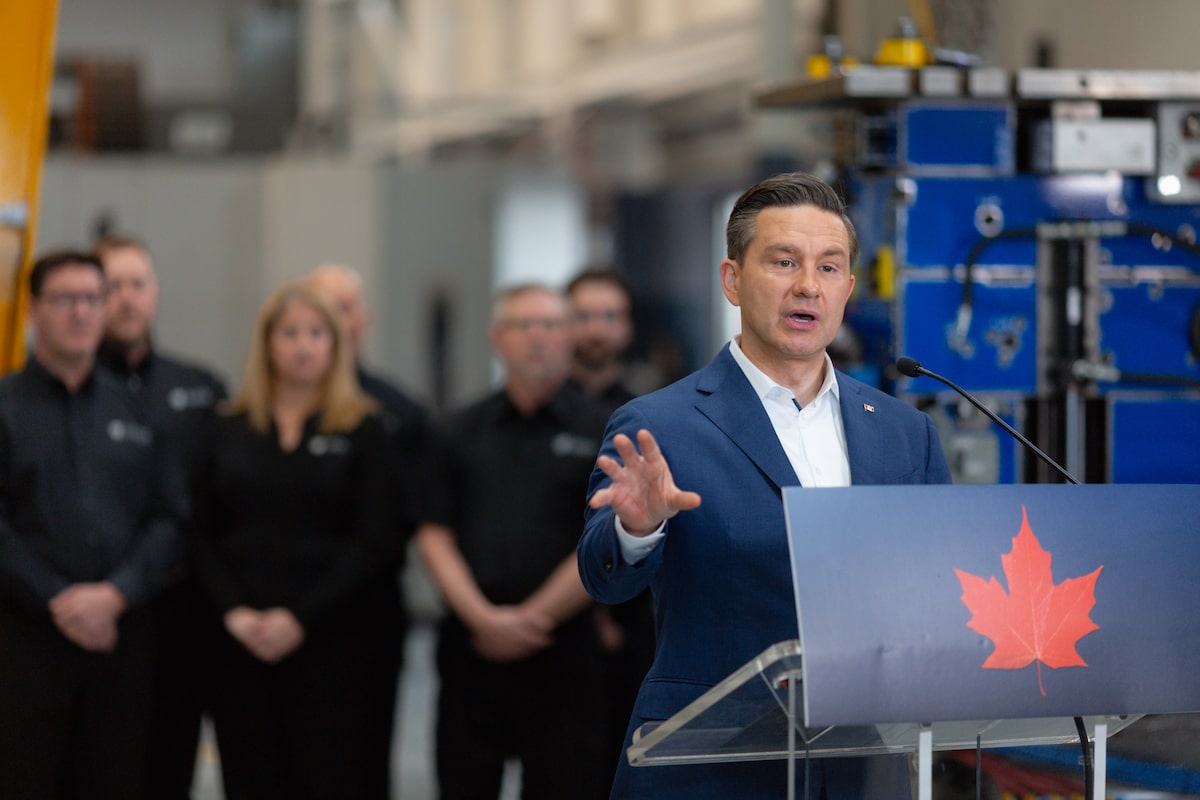
Conservative Leader Pierre Poilievre outlines his North American auto policy at Cavalier Tool & Manufacturing Ltd., in Windsor, Ont., on Sunday.Dax Melmer/The Canadian Press
Federal Conservative Leader Pierre Poilievre is pitching a new plan for Canada’s automotive industry that hinges on a tariff-free auto pact with the United States, saying this country can’t steer away from its biggest export market if it wants to revive the battered sector.
The plan would offer consumers an incentive to buy a Canadian-made vehicle by removing the federal sales tax on their purchase while urging provinces and territories to do the same. And it would align Canada with the United States and Mexico on Chinese tariffs, a bid to win “maximum leverage” in coming trade talks.
The Conservatives also want to implement a “dollar-for-dollar” rule to stoke domestic production, a move that harks back to the 1965 Canada-U.S. auto pact. For every vehicle a carmaker manufactures in Canada, it would be allowed to import the equivalent value in cars or trucks from the U.S. or Mexico duty-free.
“Canada’s auto sector must stay alive and it must have access to the U.S. to do so,” Mr. Poilievre said Sunday during a news conference in Windsor, Ont., ahead of a trip to the U.S.
“I have a plan here that will massively increase production on both sides of the border that will be attractive to both partners.”
Campbell Clark: Poilievre arrives late to the auto debate with a plan from 1965
The Conservative Leader is trying to project an alternative to Prime Minister Mark Carney’s government, which has stressed the importance of diversifying Canada’s political and trade ties in the face of an unpredictable White House.
Mr. Poilievre said Canada should harmonize tailpipe emissions reductions with its North American partners and create a harmonized North American cybersecurity and data standard. He said it should also ban vehicles using Chinese or Russian-connected software, a direct rebuke of Mr. Carney’s plan to admit up to 49,000 Chinese electric vehicles a year into Canada at a low-tariff rate and lay the groundwork for a Chinese auto manufacturing presence in this country.
It’s “a fantasy and dangerous illusion that we can replace auto sales to the U.S. with EVs overseas,” Mr. Poilievre said in a statement. U.S. President Donald Trump has also blasted the Carney government decision on China, warning it could have serious economic consequences.
Ottawa is seeking ways to bolster its auto sector as U.S. tariffs on imports trigger new production cuts and layoffs. Last year, Mr. Trump applied 25-per-cent import levies on the non-U.S. content of Canadian-made cars, declaring the U.S. doesn’t need them.
Andrew Coyne: Pierre Poilievre plants the seeds of an alternative to the Carney doctrine
Poilievre announces U.S. tour to talk trade, promote auto and energy sectors
Southern Ontario is home to five automakers: Ford, General Motors, Stellantis, Honda and Toyota. Ford, GM and Stellantis, which are based in Detroit, have reduced output and laid off thousands of workers in recent years. Manufacturers produced about 1.2 million vehicles last year in Canada, barely half of the output in 2016.
Last month, Mr. Carney announced federal purchase incentives encouraging shoppers to buy electric vehicles, which the Conservatives say should be scrapped.
He also said his government is considering imposing a system of tradable credits on automakers to reward companies that manufacture in Canada and penalize those that do not. Companies with a surplus of credits would be able to sell them to those seeking to import vehicles to Canada, effectively monetizing their investments in Canadian production, according to the government.
In addition, Ottawa is trying to build out the industry by tying it to defence procurement. It has asked the governments of South Korea and Germany, two countries with companies bidding to build the Canadian navy’s next submarine, to facilitate auto industry production pledges in Canada as part of the pitches.