
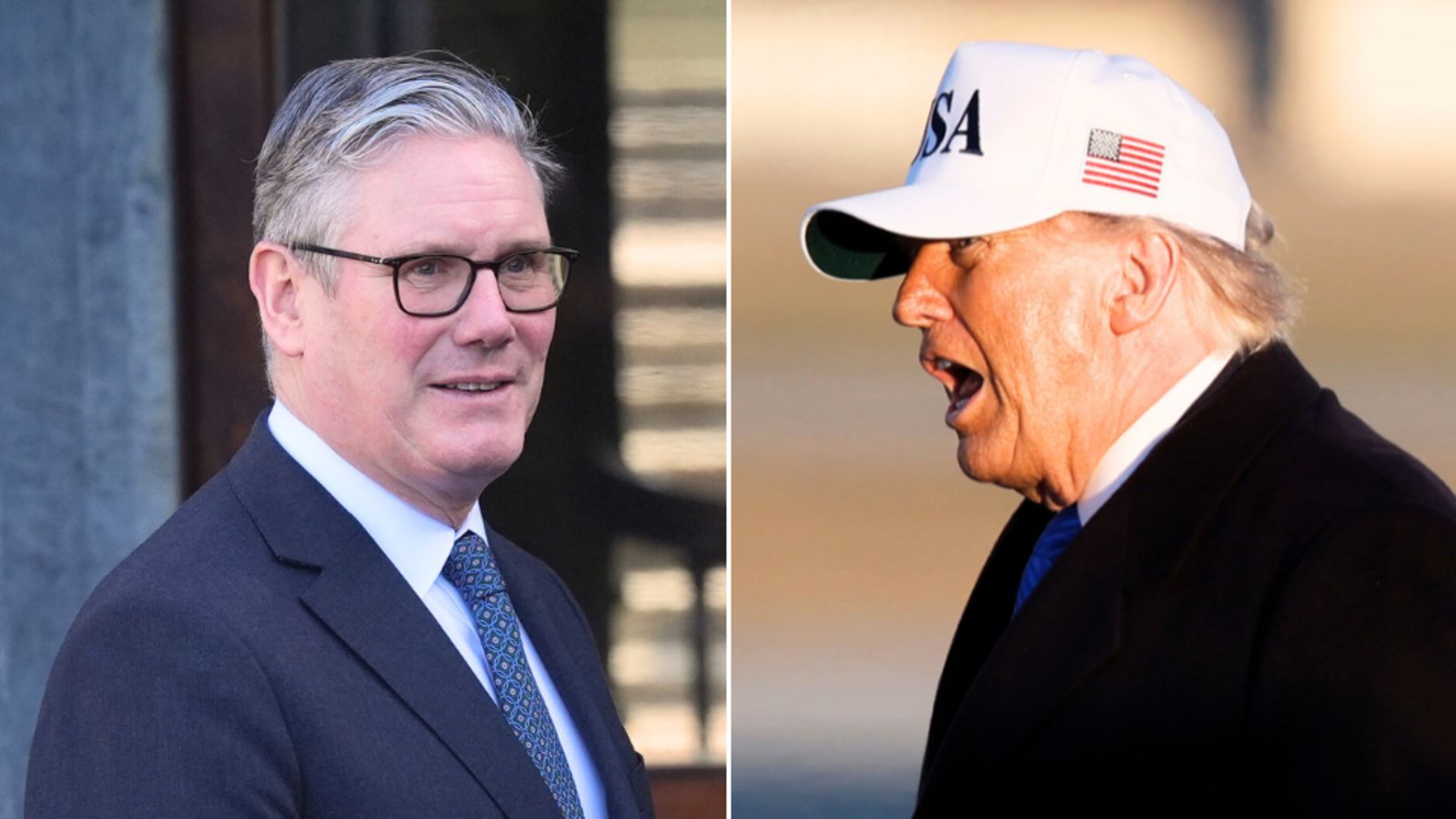
Sir Keir Starmer and Donald Trump have spoken of the importance of reopening a key shipping route in the Middle East, in their first conversation since the US president called for Britain to send warships to the Strait of Hormuz.
Tehran’s stranglehold on oil tankers passing through the narrow sea passage has driven energy prices up across the world.
A Downing Street spokeswoman said the pair “discussed the ongoing situation in the Middle East and the importance of reopening the Strait of Hormuz to end the disruption to global shipping, which is driving up costs worldwide”.
“The prime minister also expressed his condolences for the American service personnel who have lost their lives during the conflict,” she added.
Sir Keir and Canada’s Prime Minister Mark Carney also agreed on the importance of ending the blockade in a separate call on Sunday.
Mr Trump’s plea for aid from the UK and other nations on Saturday came only a week after he said the US does not “need people that join wars after we’ve already won”, in response to reports that Britain was considering sending more warships to defend its bases in the region.
It comes after Energy Secretary Ed Miliband said the UK is “intensively” looking at what it can do to help reopen the key shipping route.
On Saturday President Trump called on the UK and other nations to send ships to the Middle East to protect oil tankers from Iranian attacks.
Posting on his Truth Social platform, Mr Trump said: “Hopefully China, France, Japan, South Korea, the UK, and others, that are affected by this artificial constraint will send ships to the area so that the Hormuz Strait will no longer be a threat by a nation that has been totally decapitated.
“In the meantime, the United States will be bombing the hell out of the shoreline and continually shooting Iranian boats and ships out of the water. One way or the other, we will soon get the Hormuz Strait OPEN, SAFE, and FREE!”
The Ministry of Defence responded by saying “a range of options” were being considered to secure shipping through the strait, where some 20% of the world’s oil ordinarily passes through each day.
Numerous oil tankers have come under fire as they attempted to pass through since the start of the conflict.
There have also been growing concerns that Iran has starting placing sea mines in the strait to frustrate shipping.
Military chiefs are now considering the deployment of minehunting drones to deal with that threat, it is understood.
Subscribe free to our weekly newsletter for exclusive and original coverage from ITV News. Direct to your inbox every Friday morning.
In a statement, a Ministry of Defence spokesperson said: “While our current Octopus production is only for Ukraine, the situation in the Middle East has shown the benefits of Ukrainian technology, and, in the future we will explore use for the UK Armed Forces.
“Production of British-built Octopus interceptor drones has begun and we are accelerating this work to boost Ukraine’s ability to defend itself against Russian drone attacks.
“Developed by Ukrainian engineers and refined by British industry, Octopus interceptors use frontline battlefield data to defeat Shahed-style drones before they reach homes, hospitals and power stations.”
From Westminster to Washington DC – our political experts are across all the latest key talking points. Listen to the latest episode below…