
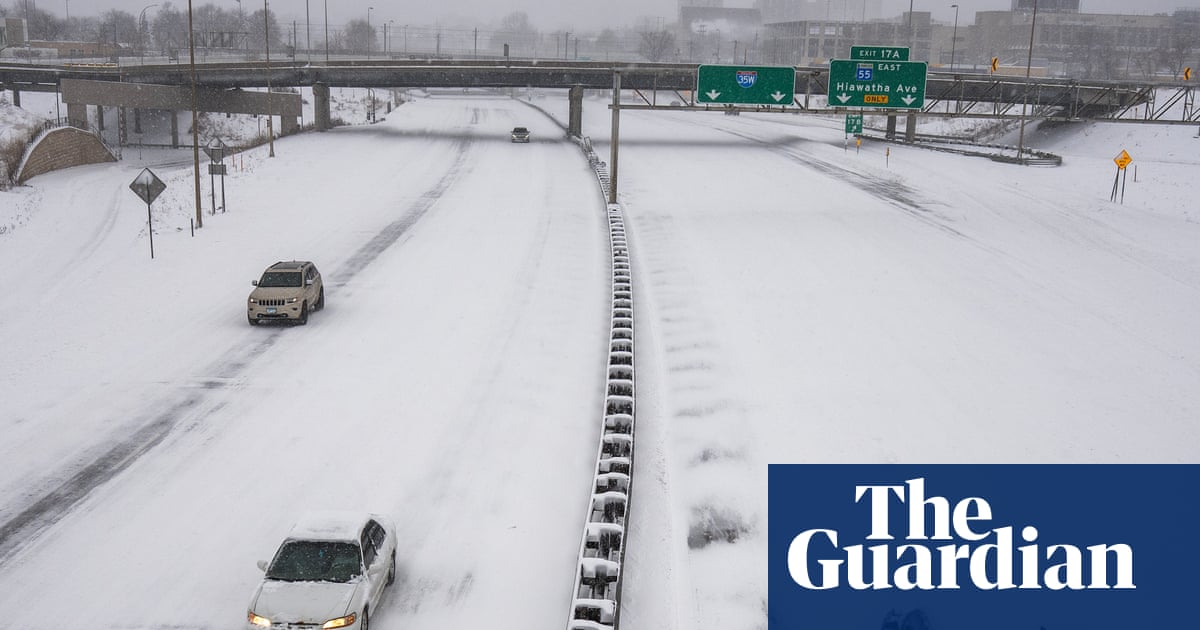
Winter’s grip has yet to release as an erratic patchwork of severe weather moved across much of the US, dumping heavy snow and making roads impassable in the upper midwest while damaging high winds swept across the Plains.
As portions of the mid-south readied for thunderstorms, forecasters said the storms will spread eastward and by Monday threaten a large swath of the eastern US, with mid-Atlantic states and Washington DC at greatest risk for high winds and tornadoes.
AccuWeather called the approaching weather a “triple-threat March megastorm” that will affect nearly 200 million people across the US and warned that travel disruptions are likely as the components of wind, snow, rain and cold developed into a bomb cyclone and would rank among the most impactful US weather event of the year so far.
“The severe weather setup across parts of the mid-Atlantic can be volatile on Monday if several atmospheric factors conspire together, which may produce one of the most impactful and dangerous early-season severe weather events in this part of the country over the last decade,” said Jonathan Porter, AccuWeather’s chief meteorologist.
Among the hazards, Porter said, were damaging straight-line winds, a few tornadoes – including the possibility of an especially intense tornado near the Baltimore and Washington DC metro areas through Virginia and into North Carolina.
A plow removes heavy snow from a cul-de-sac on Sunday in Brooklyn Park, Minnesota. Photograph: Jerry Holt/AP
Further north, from near New York City into southern New England, “flooding downpours can be a concern into Monday night. Some spots could get a brief, intense burst of rain that could provide 0.5 inch to 1 inch in less than an hour, resulting in flooding, especially in urban and poor drainage areas.”
The National Weather Service warned that the line of severe storms with damaging winds would cross much of the eastern US by late Monday. It was to begin on Sunday afternoon and cross the Mississippi, Tennessee and Ohio valleys.
The storm threat was expected to enter the Appalachians early Monday, then move toward the east coast, where “severe thunderstorms with widespread damaging winds and several tornadoes” were expected during the day on Monday, the weather service said.
A stretch from parts of South Carolina to Maryland appeared most likely to experience the greatest damaging winds on Monday afternoon, the weather service said. That could include Raleigh, North Carolina; Richmond, Virginia; and the nation’s capital. The weather service said an increased – albeit much lower – risk stretched north to New York and south to Florida, with thunderstorms possible in New England.
More than 20in (50cm) of snow had fallen in some portions of south-eastern Minnesota and western Wisconsin as of Sunday afternoon, according to National Weather Service reports, with more snow likely to fall in places including Minneapolis amid blizzard warnings by the weather service.
More than 600 flights flying out of and into the Minneapolis-Saint Paul international airport were canceled on Sunday, according to FlightAware, a website that tracks flight disruptions. Dozens more through Detroit were also scrapped.
An area from central Wisconsin to Michigan’s Upper Peninsula was likely to see more than 2 feet (60cm) of snow, with higher isolated totals on the peninsula, Roys said. Lower snow accumulations in places such as Chicago and Milwaukee will still probably create trouble for commuters on Monday, he added.
Aaron Haas, a snowplow driver in Wisconsin, said it was one of the worst storms he had seen in years. On Sunday around the city of Marshfield, Haas was stacking piles of snow as high as his truck.
A family sleds at Lyndale Farmstead Park during a snow storm on Sunday in Minneapolis, Minnesota. Photograph: Richard Tsong-Taatarii/AP
“You can’t see anything when you’re on the highways outside of the city,” he said.
Jim Allen, 45, who lives on the Upper Peninsula, said his family stocked up on necessities and he was ready to clear snow several times on Sunday with the shovel and snowblower.
“We’re basically prepared to just kind of hunker down for a few days if we need to,” Allen said.
More than 210,000 utility customers in six Great Lakes states were without electricity as of Sunday afternoon, according to PowerOutage.us. Some originated on Friday when gusts in the region reached 85mph (135 km/h).
In Nebraska, about 30 national guard members were deployed to help combat multiple wildfires across a broad swath of range and grassland, the state’s emergency management agency said.
As of Saturday, three of the largest wildfires had damaged well over 900 sq miles (2,330 sq km), the agency said. One fire-related fatality was reported on Friday, and in a news release Jim Pillen, the Nebraska governor, urged residents to follow locally issued evacuation orders, adding that winds were “supposed to be extraordinary” on Sunday.
The weather service issued a high-wind warning on Sunday for most of Nebraska, with wind gusts of up to 60mph (97 km/h) possible amid falling snow. Roys said high winds would affect a region stretching from the US-Mexico border to the Great Lakes, and from Denver eastward to the Appalachian Mountains.
Associated Press contributed reporting