
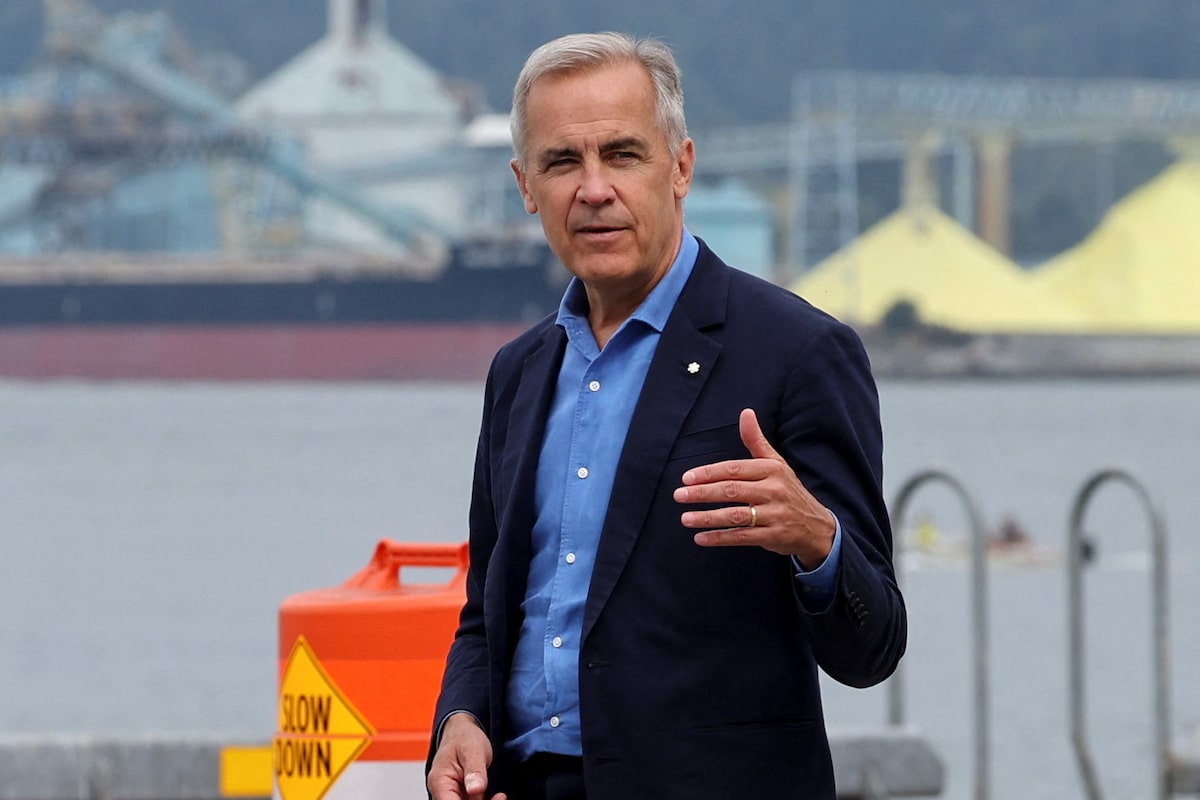
Prime Minister Mark Carney visits the Centerm container terminal at the Port of Vancouver on Sunday.Chris Helgren/Reuters
Prime Minister Mark Carney is meeting with his cabinet, and then provincial and territorial leaders, for the first time since the Trump administration hiked tariffs on Canadian products.
Canada has so far held off any retaliatory action since the increase, with Mr. Carney telling reporters on Tuesday that the aim of the government is to minimize impact on domestic industry.
“We look at what we can do for our industry that’s most effective. In some cases, that will be to remove tariffs,” Mr. Carney said.
Liberal cabinet ministers defend Canada’s U.S. trade strategy in Mexico
Ontario Premier Doug Ford told reporters he remains “100 per cent supportive” of Mr. Carney and the government, but he is still in favour of reciprocal tariffs.
“You can’t have tariffs on one side and not the other,” Mr. Ford told reporters after an announcement Wednesday in Thornhill, Ont.
“I still stand by what I say, ‘dollar for dollar, tariff for tariff.’ They understand strength, not weakness, and we should never, ever roll over and be weak.”
Mr. Ford said the meeting with Mr. Carney and the premiers will see the leaders talk through the current situation.
Ontario Premier Doug FordNathan Denette/The Canadian Press
“When you sit around the family dinner table, you discuss all sorts of ideas, and that’s what we’re going to do,” he said.
Mr. Ford said he personally spoke to U.S. Secretary of Commerce Howard Lutnick on Tuesday and it was a positive discussion, though he declined to elaborate.
“He said he really likes Canadians, which is good. Liking and cutting tariffs are two different things, so we’re going to continue communicating,” Mr. Ford said.
Canadian goods that are not covered by the United States-Canada-Mexico free trade agreement are now subject to 35-per-cent tariffs, up from 25 per cent since the U.S. first imposed them back in March.
When those were first levied, Canada responded by announcing tariffs on a wide range of goods imported from America.
Canada also responded when the U.S. imposed 25-per-cent tariffs on steel and aluminum, and again when the U.S. put 25-per-cent tariffs on the auto sector. The retaliatory tariffs in that sector were later paused.
When U.S. President Donald Trump raised the steel and aluminum tariffs to 50 per cent, Mr. Carney did not increase retaliation, promising he would consider adjusting them depending on progress made in the broader trading arrangement with the U.S.