
The Iranian Arena
The extensive strikes across Iran continue. During the night between March 15 and 16, the IDF carried out a wide wave of strikes in Tehran targeting infrastructure linked to the Iranian regime. According to an IDF spokesperson, the Air Force also attacked sites where, according to Israel’s assessment, the regime is attempting to fortify and conceal components related to the nuclear program. It was also reported that in recent days more than one hundred targets connected to the regime’s production systems were struck. According to military sources, the main operational effort at this stage is focused on thwarting missile launches and striking headquarters of the regime and of the Islamic Revolutionary Guard Corps.
Since the beginning of the campaign, the IDF has carried out more than 7,600 strikes across Iran as part of nearly 5,000 aerial sorties. Of these strikes, about 4,700 were directed against the Iranian regime’s missile program. At the same time, it was reported that the IDF struck more than 700 targets related to the missile array in real time, and that more than 70% of the regime’s missile launchers have been neutralized. It was also reported that more than 85% of the regime’s detection and defense capabilities—including air defense systems and radars—have been neutralized in the strikes. In addition, more than 100 targets related to production and armament were struck, as well as more than 500 command and control targets.
On March 15, the Air Force completed another wave of strikes against infrastructure of the Iranian regime in the Hamadan area in western Iran. As part of these strikes, several central headquarters of the Islamic Revolutionary Guard Corps and the Basij unit were attacked. According to the IDF spokesperson, more than 200 targets were struck in western and central Iran that day.
It was also reported that the IDF destroyed the aircraft of the “Supreme Leader” at Mehrabad Airport in Tehran. The aircraft had been used by senior Iranian officials for flights outside the country. At the same time, strikes continued on March 16 in several major locations across the country, including Tehran, Tabriz, and Shiraz. It was also reported that a base of the Iranian army’s air force was attacked in the city of Isfahan.
At the same time as the Israeli activity, the United States continues military operations in the region and is striking targets on Kharg Island, which constitutes a central hub in Iran’s energy and logistics infrastructure.
Iran Attacks Targets in the Middle East
Over the past 24 hours, a series of attacks and threats by Iran have been reported, alongside responses and interceptions by countries in the region.
The Iranian Khatam al-Anbiya Headquarters issued a public threat toward Saudi Arabia, warning that the presence of the American aircraft carrier Gerald Ford in the Red Sea constitutes a direct threat to Iran. The statement said that any entity providing logistical support to the aircraft carrier, including facilities and centers in the region, would be considered a legitimate target for attack.
At the same time, the Saudi Ministry of Defense officially announced that the kingdom’s air defense systems intercepted about 60 unmanned aerial vehicles launched from Iran toward eastern Saudi Arabia during the night. According to the statement, the drones were intercepted before reaching their targets.
In the United Arab Emirates, an attack using Iranian drones was also reported. According to several reports, fuel storage facilities at Dubai Airport were damaged during the attack. It was also reported that one person was killed in an attack carried out in Abu Dhabi. At the same time, reports were received of attacks in Bahrain as well, although at the time of writing the details of these events are still not fully clear.
Iraq
An Iranian attack targeting the United States Embassy in Baghdad was reported. At the same time, reports were received of rockets fired at an American logistical facility located near Baghdad International Airport. In addition, over the past 24 hours, strikes against targets belonging to pro-Iranian Shiite militias across Iraq have continued as part of efforts to damage their military infrastructure.
The Israeli Arena
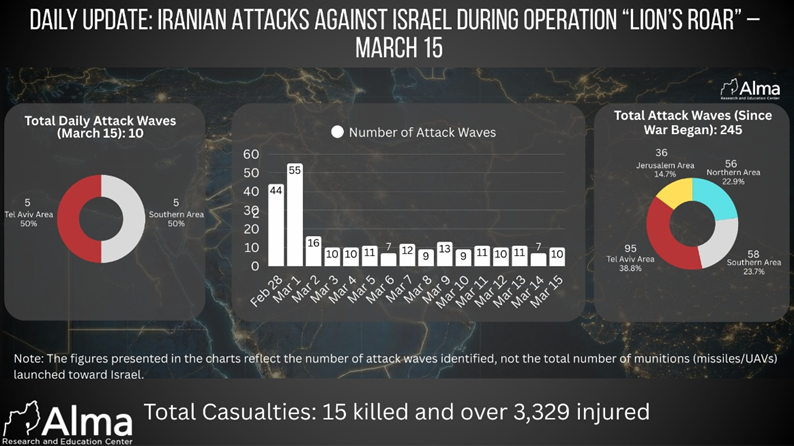
On March 15, 10 Iranian attack waves against Israel using ballistic missiles were identified. Geographically, the attacks were evenly divided between two main areas: 5 attack waves (50%) were directed toward the Tel Aviv area, and 5 additional waves (50%) were directed toward southern Israel.
Since the beginning of the campaign, a total of 245 Iranian attack waves against Israel have been identified. In the cumulative geographic distribution of all attacks, the central region—particularly the Tel Aviv metropolitan area—continues to be the main target, with 95 attack waves (38.8%). It is followed by the southern region with 58 attack waves (23.7%), the northern region with 56 waves (22.9%), and the Jerusalem area with 36 attack waves (14.7%).
An examination of the daily trend indicates that after the peak recorded at the beginning of the campaign (44 attack waves on February 28 and 55 waves on March 1), there has been a significant decrease in the scope of the attacks and a relative stabilization in the pace of activity. Over the past two weeks, the number of attack waves has averaged around 10 waves per day.
Since the beginning of the war, 15 civilians in Israel have been killed, and more than 3,329 people have been injured to varying degrees as a result of direct impacts, falling interception fragments, and secondary damage.
The data indicate that despite the decrease in the scope of attacks compared to the first phase of the campaign, Iran continues to maintain sustained pressure on the Israeli home front, combining a focus on the Tel Aviv metropolitan area with a geographic distribution of attacks toward southern Israel as well. This expands the threat area and makes it more difficult for a return to routine in any specific region in Israel.
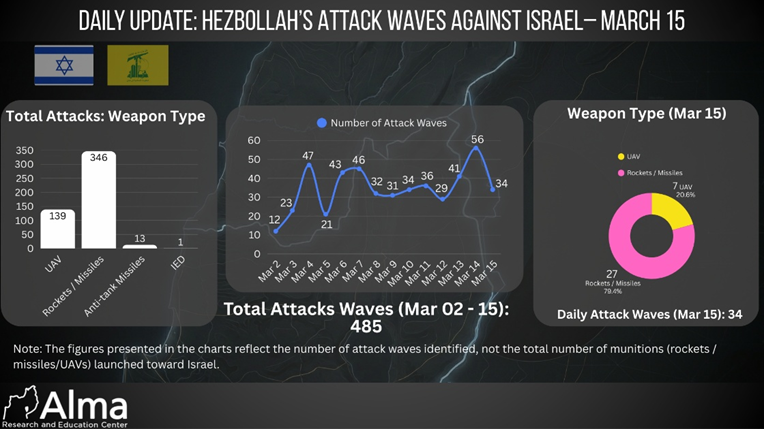
On March 15, 34 Hezbollah attack waves against Israel were identified. In terms of the types of weapons used, 27 attack waves (79.4%) were carried out using rockets and missiles, while 7 attack waves (20.6%) were carried out using UAVs. The data refer to the number of identified attack waves and not to the total number of munitions actually launched.
Most of the attacks were directed at communities along the border and in the Galilee, similar to the pattern observed in recent days. In addition, one attack wave was directed toward the central region. It also emerges that three of the attacks during the day were carried out against IDF forces operating in southern Lebanon. It should be noted that the information regarding attacks within Lebanon is based solely on claims of responsibility published by Hezbollah, and no additional indication of this was identified from other sources.
Since Hezbollah joined the fighting on March 2, a total of 485 attack waves against Israel have been identified. An examination of the types of weapons used by the organization so far indicates that rockets and missiles continue to be the primary means of attack, with 346 attack waves, alongside 139 attack waves using UAVs, 13 attacks using anti-tank missiles, and one explosive device attack.
An examination of the daily trend indicates fluctuations in the scope of attacks throughout the days of the campaign. After a peak in activity recorded on March 14 with 56 attack waves, a certain decrease was recorded on March 15 (34 waves), but the level of activity remains relatively high and continues to hover around dozens of attack waves per day. This indicates the maintenance of a sustained offensive pace of activity by Hezbollah, combining rocket fire with the continued use of UAVs.
Lebanon and Hezbollah
According to a report by the Reuters news agency, Israel and Lebanon are expected to hold talks in the coming days. At the same time, a senior Iranian security official told the Lebanese channel Al-Mayadeen, which is affiliated with Hezbollah, that at this stage there is no scenario for a ceasefire and no relevant option for ending the war. According to him, Iran’s strategic partners in the Axis of Resistance will be an integral part of any future agreement that may be signed.
On the internal Lebanese front, the Lebanese newspaper Al-Modon reported that the Lebanese government submitted a prosecutor’s statement to the military court ahead of the filing of indictments against four Hezbollah operatives who were arrested in southern Lebanon with weapons in their possession that were allegedly intended for launch toward Israel. The government’s representative at the military tribunal, investigative judge Claude R’Anem, told the judges that the four detainees admitted during questioning that they were Hezbollah operatives and linked the weapons found in their possession to the war against Israel. According to the report, two of the detainees are expected to be charged with the offense of illegal transfer of ammunition, while two others will be charged with the criminal offense of violating the principles of neutrality declared by the Lebanese state.
At the same time, another trend is emerging in Lebanon’s political and media arena. The country’s official media is ceasing to use the term “resistance” in reference to Hezbollah. According to Al-Modon, the Lebanese Minister of Information, Paul Morcos, instructed state media outlets—following the government’s decision to outlaw Hezbollah’s military and security activities—to refrain from using the term and to refer to the organization only by its name: Hezbollah.
Meanwhile, in Lebanon the role of the Lebanese Army as a central state authority continues to be emphasized. Lebanese Member of Parliament Qassem Hashem welcomed the army’s decision to continue its deployment in the town of Shebaa, noting that the army’s presence provides a sense of security to local residents and encourages them to remain in their homes despite the ongoing fighting.
In contrast, figures associated with Hezbollah continue to emphasize that the outcome of the campaign will be determined on the battlefield rather than through diplomatic moves. Hezbollah Member of Parliament Hassan Ezz al-Din stated during a visit to reception centers for displaced people in Beirut that the battlefield will determine the results of the war and the future of Lebanon.
In the military arena, the IDF continues extensive strikes in southern Lebanon. Among the targets struck were Radwan Force headquarters and launch sites. In addition, the IDF has expanded its ground operations in the area. According to the IDF spokesperson, the activity is focused on key targets in southern Lebanon in order to expand the forward defensive space.
The IDF also confirmed that in a strike carried out last week, Ibrahim Muhammad Ghazali was eliminated. He served as a weapons team commander in Hezbollah’s anti-tank unit within the organization’s Badr Unit.
The war continues to significantly affect the Lebanese economy. According to economic assessments published in Lebanon, large parts of the economy are operating only partially or have been completely shut down. Commercial and industrial activity has declined by about 50 percent, while the restaurant and hospitality sectors have been severely affected due to the collapse of tourism and a significant reduction in activity.
Estimates indicate that losses to the Lebanese economy amount to approximately 20 million dollars per day. The cumulative indirect losses are estimated at around 260 million dollars, while direct losses resulting from the destruction of buildings and infrastructure are estimated at about 450 million dollars. In total, the overall losses to the Lebanese economy since the beginning of the war are estimated at more than 700 million dollars.
The International Arena
In recent days, the United States has been working to expand a multinational coalition aimed at ensuring the safe passage of vessels through the Strait of Hormuz, against the backdrop of regional escalation and concerns over disruptions to global shipping routes and energy supplies. As part of this effort, President Donald Trump called on several key countries—including China, France, Japan, South Korea, and the United Kingdom—to join the international effort to secure the strait.
However, several countries have already announced that they do not intend to participate in the military effort at this stage. The Prime Minister of Japan stated that Tokyo will not send warships to assist in securing the Strait of Hormuz. The Australian government also announced that it will not take part in military activity in the area and will not send vessels to secure the shipping route. In the United Kingdom, Prime Minister Keir Starmer announced that London will not send warships for this mission. Starmer also added that Britain will not be drawn into a broader war in the Middle East. The French Ministry of Foreign Affairs likewise announced that France will not deploy military vessels in the Strait of Hormuz as part of the American initiative.
At the same time, according to a report in The New York Times, Saudi Crown Prince Mohammed bin Salman spoke with President Trump and expressed support for the continuation of military operations against Iran.
Diplomatic efforts to curb the escalation are also continuing. French President Emmanuel Macron spoke with Iranian President Masoud Pezeshkian and called on Iran to halt what he described as “unacceptable” attacks against countries in the region, whether directly or through its proxies in Lebanon and Iraq. Macron warned that the current escalation could drag the entire region into chaos, with severe consequences both in the immediate term and in the years to come. According to him, only a new political and security framework can ensure stability and security in the region, emphasizing that any future arrangement must ensure that Iran never acquires nuclear weapons.
