
The Islamic Republic faced scrutiny on Monday at the Human Rights Council, where two damning reports were presented on the bloody repression of protests earlier this year. At the same time, a US bombing of a school in Minab, in the south of the country, sparked a wave of condemnation.
Iran is not close to capitulating. In the face of Israeli-American strikes, it declared on Monday that after seventeen days of conflict with the United States and Israel, it promises to go “as far as necessary”. Yet while hostilities continue in the Middle East, the Islamic Republic was also at the centre of discussions at the Palais des Nations in a piece of political theatre that escaped no one’s notice. Tehran was first placed in the dock by two damning reports presented to the UN Human Rights Council.
Mai Sato, the UN’s special rapporteur on the situation of human rights in Iran, said she was deeply alarmed by the number of executions carried out by the regime: 1,600 in 2025 alone. Thirteen protesters from January are facing the death penalty. The Japanese expert denounced severe restrictions on cyberspace, the forced confessions of protesters broadcast on state television, and the regime’s labelling of the December and January demonstrators as “terrorists.”
The protests showed, “the scale of citizen mobilisation and, at the same time, an unprecedented repression that intensified as a result,” Sato said. While the UN speaks only of some 7,000 deaths during the unrest, several organisations – including the London-based media outlet Iran International – estimate the number of victims at more than 30,000. “Our estimates are conservative because we are waiting to be able to officially confirm the number of victims. Ten thousand additional deaths still need such verification,” the special rapporteur said.
Speaking to journalists, Sato rejected narratives suggesting that there is one truth on one side and another on the other. She herself condemns the Israeli-American bombings carried out since 28 February, which she says violate international law. But at the same time, she denounces the critical human rights situation in Iran: “Both realities coexist. One thing is certain: since the American-Israeli strikes, the repression carried out by the Iranian regime has increased further. The authorities have, for example, broadened the scope of the espionage law. For an Iranian citizen, it has become forbidden to communicate with foreign media. The war has clearly exacerbated the human rights situation.” Sato notes that Iranian citizens are still heavily threatened by security forces in the streets – but not only there. She has gathered information indicating that doctors in several hospitals were ordered to provide information about injured patients. “Wounded protesters lying in hospital beds have been arrested,” she observes.
Sara Hossain, chair of the International Independent Fact-Finding Mission on Iran, highlights in her report: “A credible human rights organisation estimated that by mid-February, more than 50,000 people had been arrested, including women, university students, schoolchildren, human rights defenders, lawyers, journalists, and members of minorities. As of 26 January, the intelligence service of the Islamic Revolutionary Guard Corps indicated that at least 11,000 people had been summoned by intelligence and security forces. On 17 February, the judiciary stated that 10,538 people had been referred to the courts and that more than 8,800 indictments had been issued.” While Hossain is highly critical of Tehran’s record on fundamental rights – lamenting that the number of executions in Iran is the highest in a quarter of a century – she nevertheless states clearly: “Justice cannot be delivered through war”.
Video staging
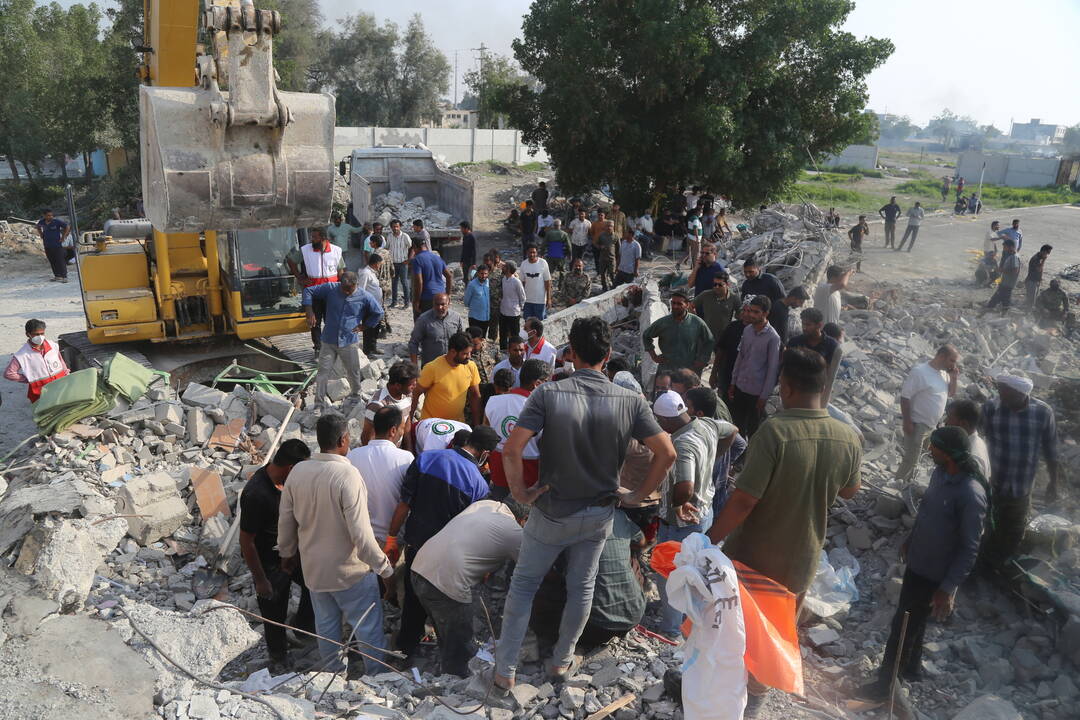
On the Iranian side, the country’s ambassador to the UN in Geneva, Ali Bahreini, did not dwell on the victims of the regime’s repression but seized the opportunity presented by a serious blunder committed by US forces, which mistakenly struck a school in Minab in the province of Hormozgan, not far from the Strait of Hormuz. At an event organized on the sidelines of the Human Rights Council, he presented a video showing, on the one hand, a schoolgirl preparing her backpack with a Hello Kitty keychain and leaving home to go to school, and on the other, an American preparing a missile on a fighter jet ready to strike the Shajarah Tayyebeh primary school in Minab.
Bahreini emphasised: “Schools are protected under international humanitarian law. Yet two Tomahawk missiles, known for their high precision, struck the school. This proves it was a deliberate action.” The diplomat suggested that the inappropriate use of artificial intelligence may explain the blunder that cost the lives of 168 schoolchildren and teachers. He also described the impact of the American-Israeli bombings: “1,348 civilians have been killed and 17,000 injured.” Sato states that since the beginning of the war, more than three million Iranians have been displaced.
Invited by the Iranian authorities, former UN official Alfred de Zayas – an American of Cuban origin and a Swiss national – lashed out at the “war of aggression” waged by Washington and Tel Aviv, arguing that there is no principle of “preventive self-defence,” as the Americans claim. “If there is one country that can rely on Article 51 of the UN Charter on self-defence, it is Iran.” In a diatribe against Washington, he insisted that people should now refuse to buy American weapons and aircraft, US Treasury bonds, and should stop selling rare earths to the US. For his part, UN independent expert on international order George Katrougalos described it as a “war crime” that the US and Israel launched the war while diplomatic negotiations were still ongoing, in violation of Article 37 of Protocol I of the Geneva Conventions prohibiting “perfidy.”
This article was originally published in French in Le Temps. It has been adapted and translated into English by Geneva Solutions. Articles from third-party websites are not licensed under Creative Commons and cannot be republished without the media’s consent.