
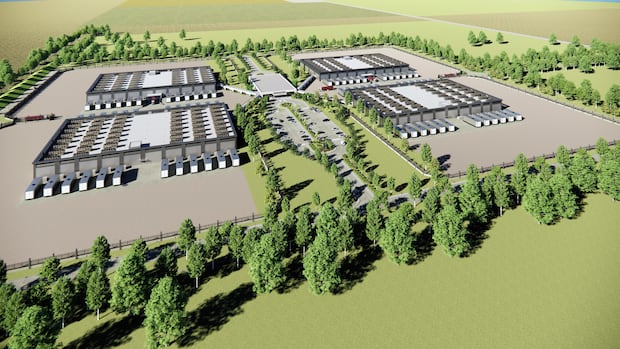
Bell Canada will start construction this spring on what it says will be Canada’s largest AI data centre, located on the outskirts of Regina.
Mirko Bibic, CEO of Bell Canada, said the telecom giant will partner with the Saskatchewan government and George Gordon First Nation as it spends $1.7 billion to construct the data centre.
“We’re a 145-year-old company and this will be our largest ever investment in this province,” Bibic told a news conference in Regina on Monday.
Bibic said the project will bring about $12 billion in revenue to the province’s economy, and add 800 temporary construction jobs and 80 full-time jobs at the facility once it starts operating in 2027.
 Saskatchewan Premier Scott Moe, from left, is joined by the Minister of Crown Investments Corporation Jeremy Harrison, Bell Canada CEO Mirko Bibic, George Gordon First Nation Chief Shawn Longman and Saskatchewan Chamber of Commerce CEO Prabha Ramaswamy for an announcement on the construction of an AI data centre outside of Regina. (Alexander Quon/CBC)
The centre is part of Bell Canada’s initiative to build sovereign AI data infrastructure under Bell AI Fabric, including a data centre “super cluster” in British Columbia.
The Regina centre will be built in phases and is expected to be operational by the end of 2027 with long-term tenancy agreements contracted with artificial intelligence companies Cerebras and CoreWeave.
WATCH | Premier Scott Moe touts ‘Canada’s largest AI data centre’ as economic boon for Sask.:
Premier Scott Moe touts ‘Canada’s largest AI data centre’ as economic boon for Sask.
Bell Canada and Premier Scott Moe announced Monday that Saskatchewan will be home to Canada’s largest AI data centre — a 300 MW facility in the rural municipality of Sherwood, just outside Regina. Moe says this is a ‘historic investment’ in the province’s technology sector that will create jobs and partnerships.Questions answered
Last month, the Rural Municipality of Sherwood passed a rezoning application for a 160-acre parcel of land just south of the City of Regina, near the Sask. Polytechnic campus.
The application was submitted through a numbered company, but details in letters of support included as part of the application package made it clear Bell Canada was behind the proposed campus.
At the time, Bell Canada repeatedly declined to address the application, saying it had “no announcement to make at this time.”
On Monday, Bibic provided more details on the 300 MW facility.
He confirmed the centre will be built adjacent to an existing SaskPower substation, which will help provide the power needed to operate it and additional buildings related to the project.
The original rezoning application raised concern in the community about the possible strain it could place on power supplies.
For context, SaskPower told media in 2021 that the province set a record for power usage when it reached 3,910 megawatts in power use as a result of extreme cold.
The 300 MW needed for this AI data centre facility would account for about 7.7 per cent of that record total load.
On Monday, Premier Scott Moe said the province has capacity to power the facility.
“This is one of the few provinces where we do have available power to build, at scale, the data sovereignty that we very much require as Canadians,” Moe said.
He said the province also intends to bring nuclear power online, including large-scale reactors.
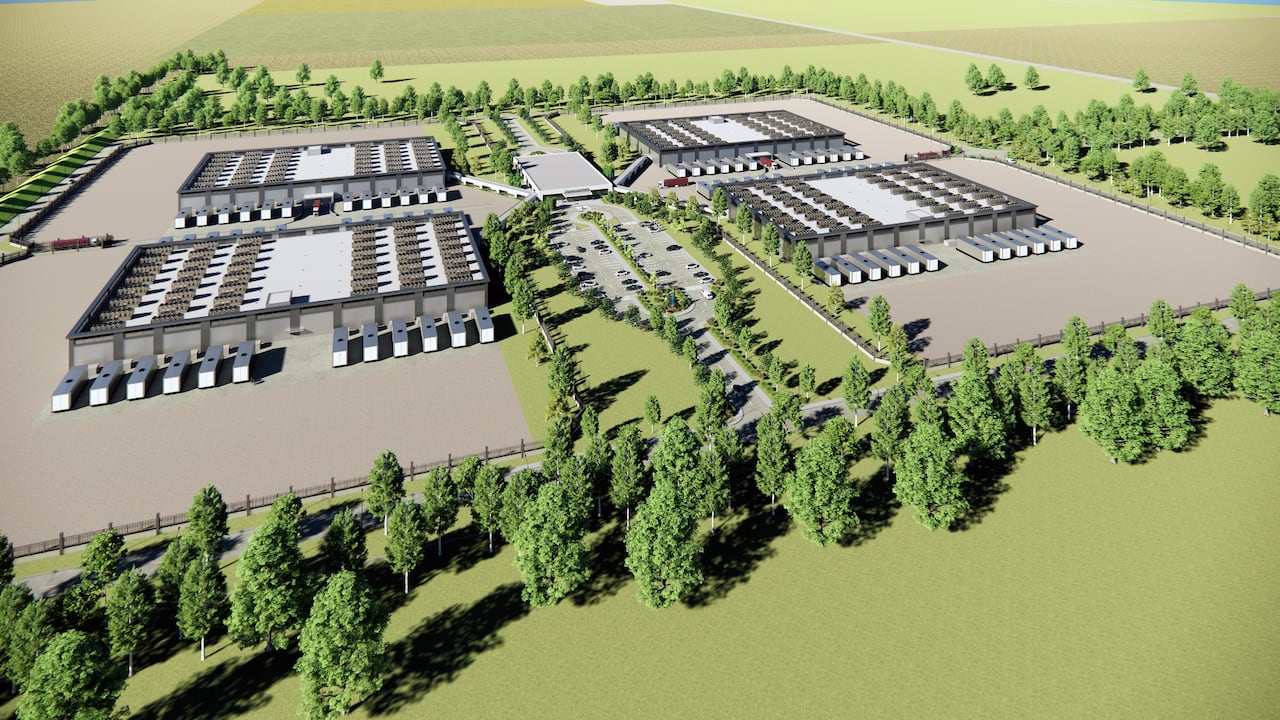 A developer’s rendering of Bell Canada’s AI date centre, due to begin construction in spring 2026. (Submitted by Bell Canada)
Bibic said ensuring adequate power supply was crucial to the decision to build in Saskatchewan.
“You need the power in order to deliver that compute capacity and what we have is a province that is willing to make the power available to generate that compute capacity,” Bibic said.
The original rezoning application also raised concern in the community about the possible strain it could place on local water supplies.
During a briefing on Monday, John Watson, Bell Canada’s group president, said the centre will use a water-smart and energy-efficient design, “including a closed-loop cooling system that does not draw water from municipal water sources.”
Instead, the cooling system will pull from private cisterns built into the facility.
The cooling system itself will not use drinking water, but instead use “technical water,” Bibic said, describing how the highly purified water will be shipped in drums before filling the closed-loop system.
Bell is aware of the concerns raised by the public, Bibic said.
“We are not drawing on municipal water sources and we said that a couple of times now. It’s very important to, again, to reemphasize that, and in terms of waste heat would be looking to, to plug into a district energy system.”
Partnership with George Gordon First Nation
Bell Canada’s news release said the data centre includes a partnership with the nearby George Gordon First Nation as well as a working relationship with Saskatchewan Polytechnic and the University of Regina.
Chief Shawn Longman of George Gordon First Nation confirmed the First Nation had signed a memorandum of understanding with Bell Canada.
Longman said he believes the facility provides an opportunity.
“We’ve had experience on other projects within the province of Saskatchewan where we took these initial steps, we got together and we found our niche and how we could actually benefit from the jobs that will be here,” Longman said.
Don Ross, the CEO of George Gordon Developments, said he believes the First Nation can play a key role in the project’s development.
Its members have been involved in every major industrial project built in Treaty 4 territory over the past 10 years, Ross said.
This is just one more industry they can contribute to, he said.
Ross said he doesn’t support any kind of quota for George Gordon First Nation members to be included in the project. Instead, he’s aiming for 100 per cent contribution from George Gordon First Nation.
“We should have a chance to compete for all $12 billion of that opportunity and I can tell you, at George Gordon Developments we could deliver an all $12 billion,” he said, referring to the estimated revenue of the project.
Bell Canada has also earmarked adjacent parcels of land for future expansion and development.