
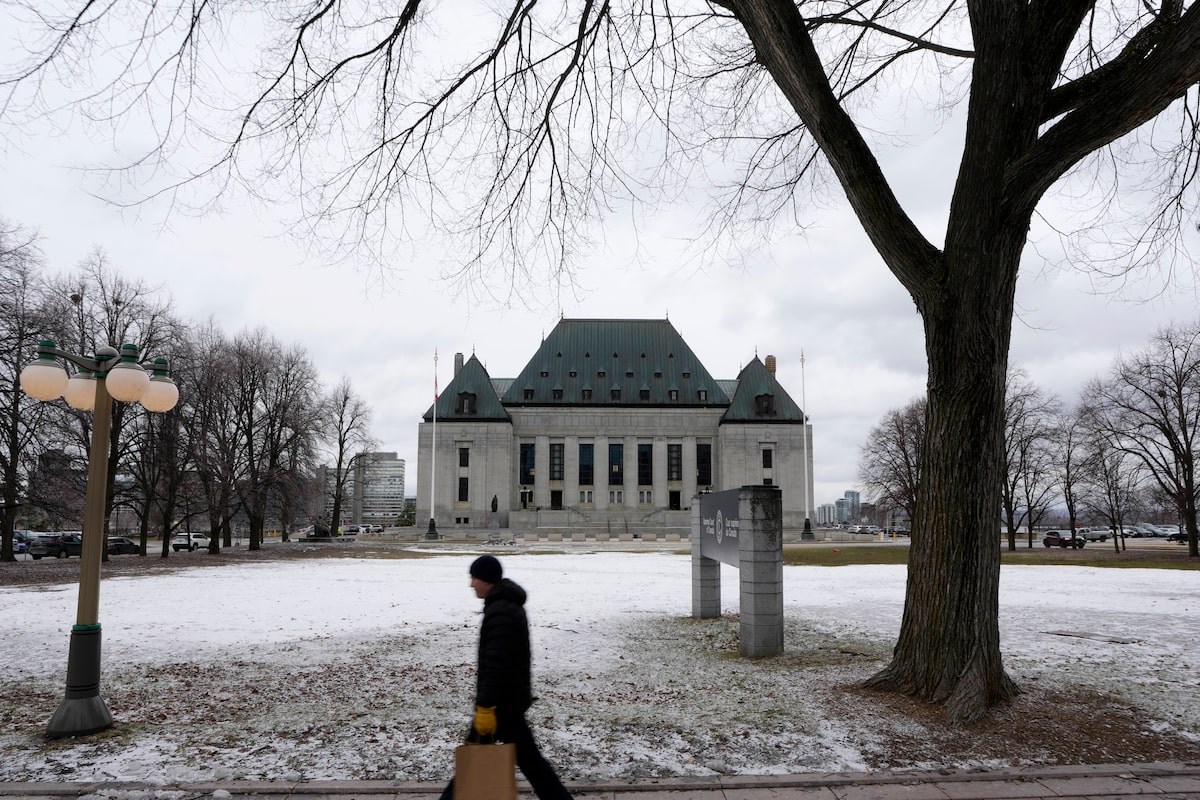
The Supreme Court of Canada in Ottawa.Justin Tang/The Canadian Press
Ottawa on Tuesday called on the Supreme Court of Canada to hear its defence of the former Trudeau government’s 2022 use of the Emergencies Act, after lower courts twice concluded that wielding the law to end weeks-long convoy protests in the country’s capital was not legally justified.
In the winter of 2022, hundreds of protesters driving semi-trailer trucks and other vehicles gridlocked the centre of Ottawa around Parliament. They were angry over pandemic vaccine mandates and generally aggrieved with the federal government. There were also several protests across the country at the border with the United States.
On Feb. 14, 2022, the federal government cited a threat to the security of Canada as it invoked the Emergencies Act. This move gave the government extraordinary temporary powers, which included prohibiting citizens from assembling in public and freezing bank assets.
On Tuesday, the federal government said in its application to appeal to the Supreme Court that “the proposed appeal offers an ideal forum in which to address these issues of public importance.”
It argued that the lower courts had incorrectly reviewed the use of the Emergencies Act, which was deployed in what it called “extraordinary circumstances.”
Trudeau’s use of Emergencies Act to clear convoy protests unjustified, appeal court rules
The legal filing at the top court asserts that the lower courts should have asked whether the government “acted reasonably in finding reasonable grounds to conclude that a public order emergency existed.”
The federal government further said that legal flaws in the earlier court rulings “hamstrings governments’ ability to respond effectively to future crises” and “neuters” the Emergencies Act.
“It amounts to second-guessing with the benefit of 20/20 hindsight,” Ottawa told the Supreme Court of the previous judgments.
The proposed appeal follows two losses in court. In early 2024, the Federal Court ruled that Ottawa had overstepped its authority. That decision was upheld in mid-January by three judges on the Federal Court of Appeal, who signed their ruling with “The Court” to emphasize legal unanimity.
The appeal court judges said that while protests in Ottawa in 2022 were “disturbing and disruptive,” they did not constitute an emergency: “They fell well short of a threat to national security.”
The appeal court ruling clarified the limits of executive power and the actions of the Prime Minister in intense moments during which there is the potential to overstep the boundaries of the law in political decision-making.
Editorial: The Liberals’ unacceptable Charter breach
Ottawa’s use of the Emergencies Act was supported in the conclusions of a public inquiry, held in 2022 and required after the act is invoked. Justice Paul Rouleau, in a report in early 2023, concluded that the use of the act was appropriate but also said it could have been avoided.
The Emergencies Act became law in 1988, and 2022 was the first time it was used. It replaced the previous War Measures Act, and, in response, the Emergencies Act included a high bar for its use. Two courts have now clearly ruled that then-prime minister Justin Trudeau and his government failed to meet that strict legal test.
Tuesday afternoon was the deadline for the federal government to file an application to have an appeal heard at the top court, after its loss at the Federal Court of Appeal.
Based on recent averages, the Supreme Court may decide on whether to hear the case by July – but in potentially complicated cases such as this one involving the Emergencies Act, the yes-or-no decision could land months later.
If the top court does say “yes” to the case, a final hearing would likely be roughly a year away.
Lola Dandybaeva, a spokeswoman for Justice Minister Sean Fraser, said in a statement: “Our government remains committed to ensuring it has the tools needed to protect the safety and security of Canadians in the face of threats to public order and national security.”
The Federal Court of Appeal, in a summary of its 185-page judgment, said: “The government did not demonstrate that it had reasonable grounds to believe that a threat to national security or a national emergency existed within the meaning of the Act, or that existing laws were unable to resolve the situation.”
In the judgment, the earlier conclusions of the Federal Court about how the situation could have been handled without emergency powers were reiterated. Provincial laws could have helped clear the trucks from Ottawa. More police could have been brought in, to clear blockades and protesters.
The Canadian Civil Liberties Association, which had challenged the use of the Emergencies Act in the lower courts, said on Tuesday that it is ready to “defend our historic victory for the rule of law and civil liberties” if the Supreme Court chooses to hear the appeal.
The Canadian Constitution Foundation, another group that had challenged the use of the law, said the Emergencies Act is designed to be a tool of last resort.
“What the Justin Trudeau government did with the Emergencies Act was wrong and in filing for an appeal, Mark Carney is doubling down on that mistake,” said Christine Van Geyn, interim executive director of the foundation, in a statement on Tuesday.