
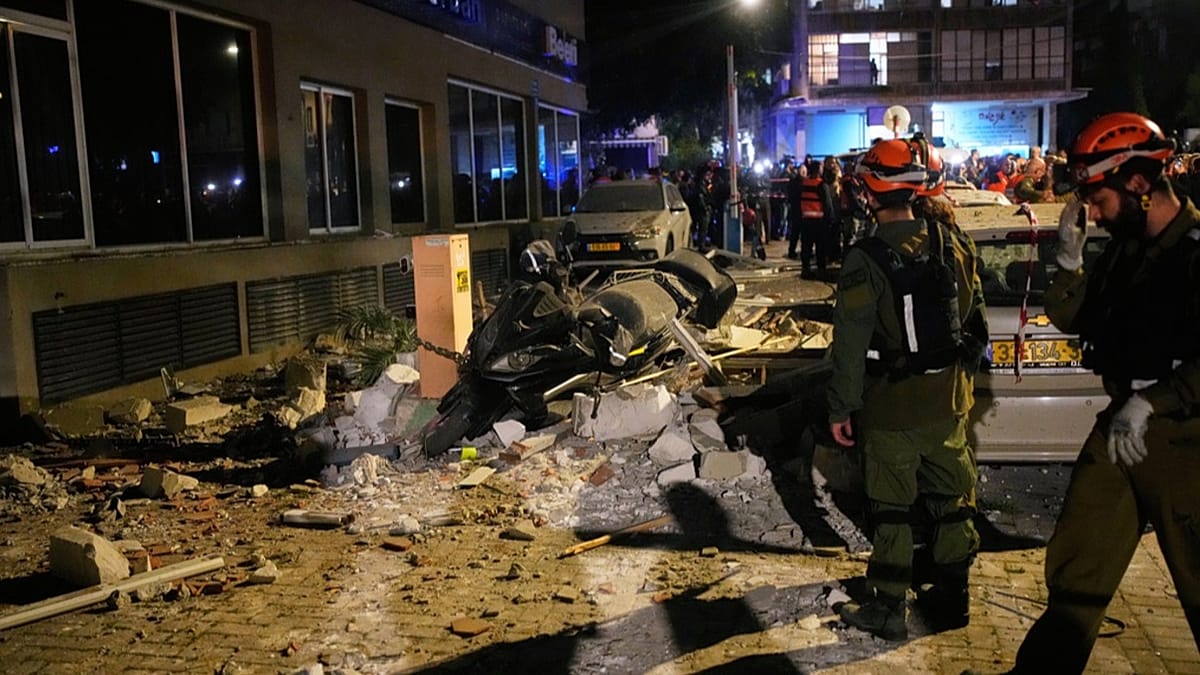
Iran launched a barrage of what it said were multiple-warhead missiles aimed at central Israel on Wednesday to avenge the deaths of two of its top security officials, who were killed in overnight Israeli strikes the day prior, as the war enters day 19.

ADVERTISEMENT
ADVERTISEMENT
In a major blow to the Islamic Republic’s leadership, Israel announced on Tuesday that its strikes in Tehran eliminated Gholam Reza Soleimani, the IRGC’s all-volunteer Basij paramilitary unit chief, and top security official Ali Larijani, who served as secretary of Iran’s Supreme National Security Council.
Larijani is the second highest-ranking Iranian official to be killed during the war since the country’s former Supreme Leader Ayatollah Ali Khamenei, who was eliminated in a strike on his compound in Tehran after US-Israeli forces fired the war’s opening salvo on 28 February.
Iran confirmed the killings of the men, who were key to Iran’s violent crackdown on protests in January that challenged the theocracy’s 47-year rule.
Iran fires advanced munitions at Israel
The retaliatory attacks on Wednesday killed two people in Ramat Gan in central Israel, according to the country’s Magen David Adom medical service, who also added that several more were being treated for injuries.
Iran acknowledged launching the multiple-warhead missiles at Israel early on Wednesday, the latest use of a weapon designed to spread maximum damage and evade Israel’s multiple layers of air defences.
Circulating footage showed the release of the cluster munition from at least one missile over Israel. A statement from Iran’s paramilitary Revolutionary Guard said the force launched the Khorramshahr-4 and Qadr multiple-warhead missiles to avenge Larijani’s killing.
Tehran’s strikes continue to target wider region
Tehran also fired early morning barrages targeting its neighbours in the Gulf region, who have been sustaining daily attacks since the war broke out over two weeks ago, with Iranian drones often targeting US bases and embassies, but also civilian and energy infrastructure.
Saudi Arabia, Kuwait and other Gulf Arab states reported intercepting incoming incursions in the early hours of Wednesday. Riyadh said it shot down a ballistic missile targeting the area around Prince Sultan Air Base, which hosts US forces and aircraft.
In the United Arab Emirates, an Iranian projectile struck near an Australian military base on Wednesday, sparking a small fire but causing no injuries, Australia’s Prime Minister Anthony Albanese said.
In Iraq, a strike hit inside the US Embassy compound in Baghdad early on Wednesday, according to two Iraqi security officials. No further details were immediately available. There was no immediate statement from the US State Department. A day earlier, a drone crashed inside the compound.
Israel launches more attacks on Lebanon
Meanwhile Israel renewed its attacks on Lebanon, as it continues to operate against who it claims are Iran-backed Hezbollah targets, mainly in the country’s south, but also extending to the capital, Beirut.
Israeli strikes hit apartment buildings in central Beirut early on Wednesday, killing at least 6 people and wounding 24 others, according to a statement by the Lebanese health ministry.
Another strike in the Nabatiyeh district killed three people and wounded another. Rescue teams were still searching for eight missing people, the statement added.
The Israeli military has in recent days also launched “limited and targeted ground operations” in Hezbollah stronghold areas in an effort to “create a larger security buffer” to protect North Israeli communities from the group’s attacks.
The strikes have displaced more than 1 million Lebanese — roughly 20% of the population — according to the Lebanese government, which says more than 900 people have been killed.
The war in Iran has so far produced many fatalities, with authorities in Iran last claiming that over 1,300 people were killed, including around 450 women and children.
In Israel, the death toll has now risen to 14, while the US has suffered 13 deaths of its service members across the region. Some deaths were also recorded in Iranian retaliatory attacks across the Gulf, with the UAE reporting an eighth civilian death on Tuesday.
With concerns growing about a global energy crisis, an Iranian official noted that Tehran had no intention of relinquishing its tight grip on shipping through the Strait of Hormuz, a crucial waterway for oil responsible for the flow of one-fifth of global energy supplies, which has remained effectively closed for weeks.
Oil prices and global markets have spiralled as a result over the last 10 days, as Brent crude, the international benchmark for oil, continues to trade at over $100 a barrel, marking a 40 per cent hike in prices compared to pre-war figures.