
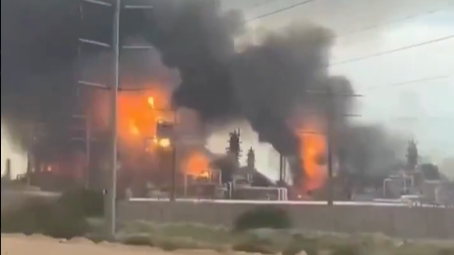
Iran has ordered Saudi Arabia, Qatar and the UAE to evacuate their petrochemical facilities, implying an impending attack.
The warning, issued from state media, comes shortly after a US–Israeli attack on the South Pars gas field in Iran.
It said the facilities would be targeted by strikes “in the coming hours” and would target Saudi Arabia’s Samref Refinery and Jubail Petrochemical Complex, the UAE’s Al Hosn Gas Field, and Qatar’s Mesaieed Petrochemical Complex, Mesaieed Holding Company and Ras Laffan Refinery.
“These centres have become direct and legitimate targets and will be targeted in the coming hours. Therefore, all citizens, residents, and employees are requested to immediately leave these areas and move to a safe distance without any delay,” the warning said.
An Israeli official told journalist Barak Ravid that the strike on Wednesday on the key Iranian gas infrastructure was done by Israel with US approval and coordination.
New MEE newsletter: Jerusalem Dispatch
Sign up to get the latest insights and analysis on
Israel-Palestine, alongside Turkey Unpacked and other MEE newsletters
Following the attack, US President Donald Trump posted on his Truth Social platform: “Remember, for all of those absolute ‘fools’ out there, Iran is considered, by everyone, to be the NUMBER ONE STATE SPONSOR OF TERROR. We are rapidly putting them out of business!”
Iran’s South Pars field is the world’s largest natural gas field, with both Qatar and Iran operating facilities on it.
Fire teams are controlling the blaze on the facility and so far no casualties have been reported, according to Fars News Agency.
The US-Israeli war on Iran has already had a devastating impact on energy price markets, not least due to Iran’s closure of the crucial Strait of Hormuz.
The latest news caused oil prices to jump, with Brent crude futures LCOc1 gaining over four percent to a session high above $108 per barrel.
Qatar, which has already fully shut its liquefied natural gas production due to the war – cutting 20 percent of the world’s liquid natural gas (LNG) supplies – has warned any damage to facilities could extend the outage beyond May.
Majed al-Ansari, a spokesperson for Qatar’s Ministry of Foreign Affairs, condemned Israel and US targeting of Iranian’s energy facilities and warned against escalation that could further harm production in the region.
“Targeting energy infrastructure constitutes a threat to global energy security, as well as to the peoples of the region and its environment,” he wrote on X.
“We reiterate, as we have repeatedly emphasized, the necessity of avoiding the targeting of vital facilities. We call on all parties to exercise restraint, adhere to international law, & work toward de-escalation in a manner that preserves the security and stability of the region.”
Energy crisis
Since launching their war on Iran on 28 February, US-Israel attacks have killed more than 3,000 people, including at least 1,351 civilians, according to the US-based rights group HRANA. At least 207 of those were children.
Several senior Iranian officials have also been killed, including Supreme Leader Ali Khamenei, security chief Ali Larijani and Esmail Khatib, the intelligence minister.
In response, Iran has launched repeated attacks on Gulf states hosting US military bases and assets, as well as closing the Strait of Hormuz, a crucial lifeline for much of the world’s oil supply.
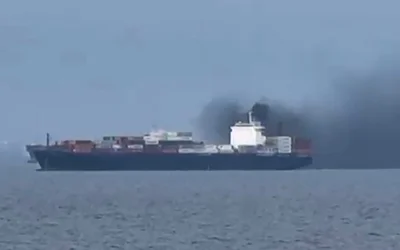
By wresting control of the Strait of Hormuz, Iran has turned the tables on US
Numerous governments have called for a resolution and end to the conflict, partly in fear of the impact of energy shocks, but have resisted US requests for assistance to help forcibly reopen the Strait of Hormuz.
The UK, Germany, Spain and France have all publicly said they would not become directly involved with operations to re-open the strait, with Germany stating outright that the conflict with Iran was “not Nato’s war”.
On Wednesday, Nato chief Mark Rutte said the alliance’s members were discussing the “best way” to open the strait.
“I have been in contact with many allies. We all agree, of course, that the Strait has to open up again. And what I know is that allies are working together, discussing how to do that, what is the best way to do it,” Rutte told a news conference during a visit to a Nato exercise in northern Norway.
“They are working on that collectively, to find a way forward.”
Russia also said on Wednesday that it was considering redirecting its remaining energy supplies away from Europe due to the energy shocks.
Kremlin spokesman Dmitry Peskov said President Vladimir Putin had instructed officials to study the possibility of shifting Russian oil and gas flows away from European buyers.
Peskov added that Moscow has not received any signals from European governments about reopening discussions on energy supplies.