
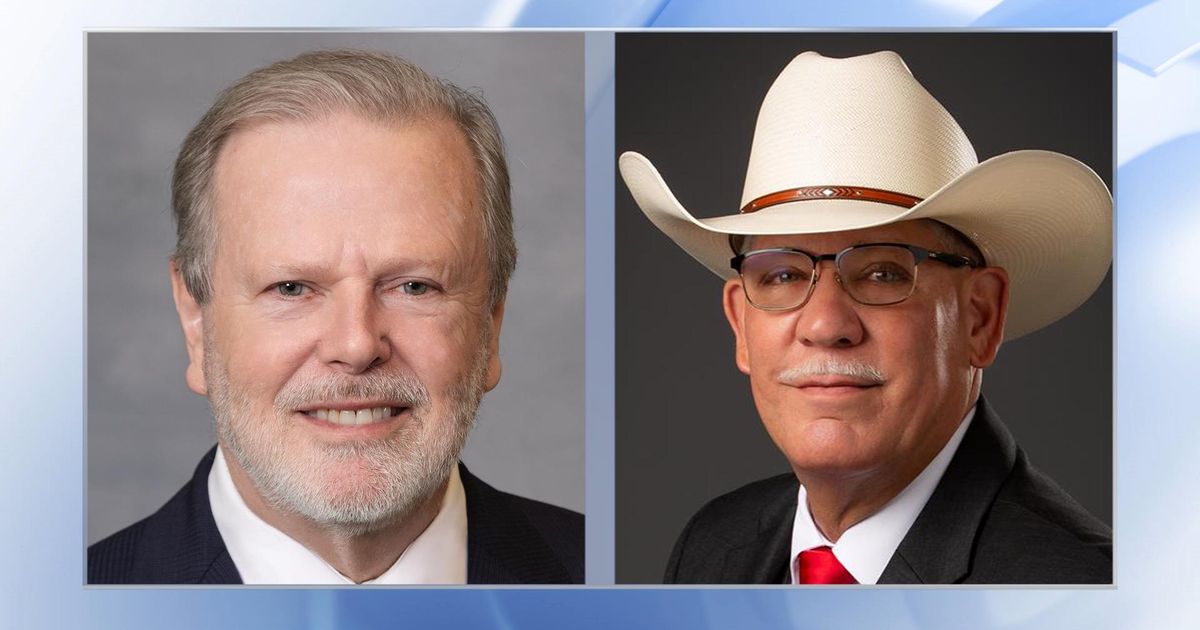
State elections officials on Wednesday rejected a request by state Senate leader Phil Berger to use new rules for the recount process, as he seeks to defend the seat he’s held in the state legislature for nearly three decades.
Rockingham County Sheriff Sam Page challenged Berger for his seat in this month’s Republican Party primary. Initial results show Page ahead by 23 votes. But the result hasn’t yet been made final because Berger requested a recount.
While the recount process is underway, Berger had asked state officials to go outside the normal process and single out 220 specific ballots for special attention. On Wednesday they demurred, saying they don’t think they have the legal authority to do what Berger wants. It was a bipartisan decision.
“It can’t be done in the state of North Carolina,” Republican board member Angela Hawkins said. “We can’t address those.”
“We’re going to let the normal process play itself out, and not do anything special,” Democratic board member Siobhan Millen said.
It’s possible Berger could now sue, to try to convince a judge to force the elections board to take up his request. Other legal fights have already begun in this race; Berger also filed legal protests over 13 ballots on Tuesday. Those protests will wind through the system separately from the recount process.
In the meantime, though, it’s still possible the ballots he wants examined will be looked at in a later stage of the recount process. It’s just not guaranteed to happen at this point, due to the rules for how recounts work in North Carolina.
How recounts work
In North Carolina, recounts work under highly specific rules. The first step is a machine recount in which ballots are fed through vote-counting machines a second time to double-check the initial results. There are also two kinds of “hand-to-eye” recounts, in which election officials can go through the ballots one by one to tally them up.
On Tuesday Berger sent a letter to the state asking for a hybrid type of recount that isn’t articulated under state law.
Berger said his campaign has identified 220 ballots, cast by local voters, in which people weren’t recorded as voting in every race on the ballot. As both counties conduct their machine recounts, Berger is asking that they also pull out the 220 individual ballots in question to more closely examine them by hand — to determine if the voters did just skip some of the races, or if some of their votes weren’t recorded due to an error.
Since the number of ballots he identified is greater than the margin separating Page and Berger, Berger wrote to Hayes, a closer examination of those ballots “could very likely determine the outcome of this race.”
There’s no specific process in place for the state to single out specific ballots to examine by hand like Berger wants to happen. Berger said he believed the state elections board had the discretion to do it anyway. But after the board decided not to grant that request Wednesday, Page criticized Berger for making the request in the first place. He also repeated his calls for Berger to conceded defeat.
“Senator Berger has resorted to asking the Board to ignore state law in his attempt to cling to power after losing more than two weeks ago,” Page said in a written statement. “That’s not how elections work in North Carolina — and the Board made that clear today.”
While Berger lost in his attempt to have certain ballots single out for closer examination, that won’t stop him from requesting a hand-to-eye recount pursuant to state law.
Two types of hand-to-eye recounts exist. First, officials take a random sampling of 3% of all the ballots cast, review them, and tabulate any differences in the vote count. It’s then possible — but not guaranteed — to do a full hand recount of every ballot cast.
State law says that full hand-to-eye recount can only be ordered if the partial recount identifies enough changes to the vote count that there’s a mathematical indication that a full recount could change the outcome of the race.
“If the results of the hand‑to‑eye recount differ from the previous results within those precincts to the extent that extrapolating the amount of the change to the entire jurisdiction (based on the proportion of ballots recounted to the total votes cast for that office) would result in the reversing of the results, then the State Board shall order a hand‑to‑eye recount of the entire jurisdiction in which the election is held,” state law says.
Questions of impartiality
The board’s decision came as Page has questioned whether the top state leader in charge of overseeing elections can be trusted during these post-election processes.
Page has raised concerns with these post-election processes being handled by the State Board of Elections, noting that its work is overseen by Republican State Auditor Dave Boliek, a Berger ally. Page wants Boliek to distance himself from the process.
Boliek endorsed Berger and campaigned with him in Rockingham County ahead of the March 3 primary. “That just shows a total conflict of interest,” Page said of Boliek.
Boliek has declined to recuse himself, saying he doesn’t have a vote on decisions made by the State Board of Elections. Boliek appoints the members of the state elections board who take those votes, and he picks who will chair each of the county election boards. He also runs oversight of county election boards out of his office. But Boliek isn’t personally tasked with making decisions on recounts, election protests or similar issues.
“There’s nothing to recuse myself from,” Boliek told WRAL previously.
On Wednesday, after the board decided not to grant Berger’s request for special recount rules, reporters asked State Elections Director Sam Hayes reiterated that Boliek has very little personal involvement in what’s happening now.
“There’s really nothing to recuse from,” Hayes said. “The auditor’s role is limited to appointing the members of the state board and the county chairs of all 100 boards. Beyond that, the State Board of Elections is administratively housed with the office of State Auditor. But only for the purposes of budget procurement. So there really is no role for the auditor to play.”