
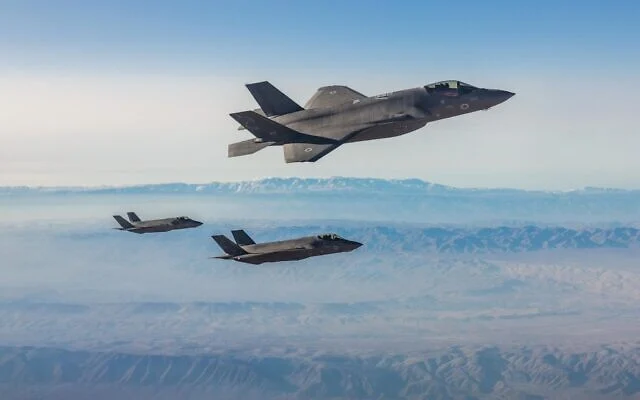
How the F-35I reshaped air supremacy in the US–Israel campaign against Iran
Every nation has its icons.
For Israel, some are human: soldiers, scientists, statesmen. Others are technological marvels that quietly stand guard over the nation’s survival. Iron Dome is one. Arrow is another. David’s Sling belongs on that list too.
But today, I want to talk about a different kind of guardian – not a shield, but a sword.
The F-35I “Adir.”
If Israel’s multilayered defense system is the kingdom’s armor, the F-35I is the crown jewel of its striking power – the aircraft that ensures the Jewish state does not merely defend itself but can reach far beyond its borders when necessary.
I have long had a soft spot for Israel’s defense technologies. Some time ago, I wrote about what I called the “kings” of Israel’s multilayer missile defense architecture – the systems that intercept rockets and missiles before they can harm Israeli civilians.
But the other day, while reflecting on the Israeli Air Force and its extraordinary evolution, I realized there was one king I had not yet properly saluted.
The F-35I Adir – the Mighty One.
And what a mighty one it has proven to be.
I remember vividly the images from December 12, 2016.
Two sleek aircraft descended through the desert darkness toward Nevatim Air Base in southern Israel. Their arrival had been delayed by weather in Italy, but when they finally touched down, the atmosphere was electric.
Israel had just become the first country outside the United States to receive the fifth-generation stealth fighter.
That fact alone carried enormous significance.
Israel had beaten major NATO allies – including some of America’s closest European partners – to become the first operational foreign operator of the F-35. It was a testament not only to the trust between Washington and Jerusalem, but also to Israel’s reputation as a military innovator capable of integrating and improving cutting-edge technologies.
At the ceremony that evening, Prime Minister Benjamin Netanyahu – himself a veteran of the Israel Defense Forces – captured the moment perfectly.
“Our long arm has now become longer and mightier,” he declared. It was a simple sentence. But it was also prophetic. Israel did not merely purchase the F-35. It transformed it.
The Israeli variant, designated F-35I, incorporates unique Israeli systems layered onto the American platform – including electronic warfare suites, specialized communications systems, and the ability to carry Israeli-made weapons.
In essence, the aircraft became a fusion of American engineering and Israeli innovation.
The result is something quite remarkable.
The F-35I is not simply a fighter jet. It is a flying intelligence center, capable of gathering vast amounts of information about the battlespace, sharing that data with other aircraft and ground systems, and guiding entire strike packages.
Its stealth allows it to slip through enemy air defenses. Its sensors allow pilots to see the battlefield with extraordinary clarity. And its networked capabilities allow it to orchestrate attacks involving multiple aircraft and weapon systems simultaneously.
Even the pilot’s helmet is extraordinary – a marvel of engineering that projects flight data, targeting information, and battlefield imagery directly onto the visor.
In the words of one American general, calling it merely a helmet is almost misleading. “It’s a workspace,” he said.
For years after its arrival, the F-35I quietly accumulated flight hours across the region – in Syria, Lebanon, and elsewhere.
But the aircraft truly revealed its strategic significance during the June 2025 Twelve-Day War with Iran.
That war marked a turning point in the Middle East.
Israel’s objective was clear: neutralize Iran’s nuclear program and dismantle its growing ballistic-missile arsenal before it could threaten Israel’s existence.
The opening wave of strikes stunned observers.
Within days, Israeli aircraft had achieved air superiority over large portions of Iran, including the skies above Tehran.
This was no small feat.
Iran had invested heavily in air defenses, including Russian-designed systems and locally developed missiles. For years analysts debated whether those defenses could challenge Israel’s air force.
The answer came quickly.
The F-35I Adir slipped through those defenses with astonishing effectiveness.
Iranian radar systems struggled even to detect the aircraft. Surface-to-air missile batteries failed to lock onto them. Command centers and missile facilities were struck with precision.
By the fourth day of the conflict, Israeli officials announced something remarkable: complete aerial superiority over Tehran’s skies.
In modern warfare, such dominance is exceedingly rare.
Yet the Israeli Air Force achieved it with speed and confidence.
The Adir had delivered.
Today, as Israel and the United States continue their campaign to degrade Iran’s military capabilities, the F-35I remains at the center of operations.
Israeli aircraft have struck hundreds of Iranian military targets, including missile factories, command centers, and air defense installations.
More than 1,700 assets of Iran’s defense industry have already been hit, according to military officials.
The strategic objective is clear: dismantle the infrastructure that allows Iran’s regime to threaten Israel and destabilize the region.
And once again, the Adir is proving its worth.
In one historic engagement earlier in the ongoing US-Israel military campaign, an Israeli F-35 shot down an Iranian aircraft over Tehran – the first confirmed air-to-air kill by the stealth fighter.
The symbolism was striking. A fifth-generation fighter jet defeating an aging adversary aircraft above the capital of a hostile state. A technological gap decades in the making.
There is another dimension to the story that should not be overlooked. The F-35I embodies the extraordinary alliance between Israel and the United States.
When the first two aircraft arrived in Israel in 2016, Donald Trump had just been elected president of the United States. Years later, after Israel’s elections of 2022, Benjamin Netanyahu returned to the prime minister’s office.
Today those two leaders find themselves coordinating a historic strategic effort against Iran’s terror empire.
It is an alliance built not merely on shared interests, but on shared values – democracy, innovation, and a commitment to defend freedom against those who would extinguish it.
In the skies over the Middle East, American and Israeli aircraft now operate side by side. Few partnerships in modern military history have demonstrated such seamless cooperation.
Of course, technology alone does not win wars. Behind every aircraft is a pilot. Behind every pilot is a team of technicians, engineers, intelligence officers, and ground crews working around the clock.
One Israeli Air Force officer recently described the atmosphere inside the squadrons. Pilots, he said, are eager – almost competing – for the chance to fly the missions. “They want to fly more,” he explained. “There’s pride in being part of this historic effort.” It is not hard to understand why.
These men and women know they are part of something larger than themselves – a moment that could reshape the security reality of Israel for decades.
Their determination reflects the deeper spirit that has always defined the Jewish state. Resilience and renewal.
In the end, the F-35I represents something more than military hardware. It represents Israel’s strategic philosophy.
Israel cannot afford technological stagnation. Surrounded by hostile forces and facing existential threats, it must remain several steps ahead.
The F-35I embodies that approach.
It ensures Israel maintains what defense planners call the qualitative military edge – the ability to defeat larger adversaries through superior technology, intelligence, and operational creativity.
And as artificial intelligence and next-generation software begin to enhance the aircraft’s capabilities even further, the Adir may remain dominant for decades.
That is how Israel continues to innovate its future – not just in laboratories and startups, but also in the skies above its enemies.
A mighty guardian
So when I read analysts marveling that Israeli aircraft can roam freely over Iran, I cannot help but smile.
Those of us who watched the Adir arrive in 2016 sensed something extraordinary had begun.
Now the world sees it too.
The F-35I has proven itself not merely as a fighter jet, but as a strategic game-changer – a machine that ensures Israel’s enemies must think twice before threatening the Jewish state.
In Hebrew, the aircraft’s name means “Mighty One.”
After watching what it has accomplished in the skies over the Middle East, it is hard to imagine a more fitting name.