
 Play Brightcove video
Israeli Prime Minister Benjamin Netanyahu says Iran no longer has the ability to enrich uranium, as he asserts: “we are winning”.
Donald Trump said there are no plans to deploy US ground troops in the region, after he threatened retaliation after Iranian strikes on a major liquefied natural gas production facility in Qatar.
The price of gas rose drastically in Europe and the UK, following an attack on Qatar’s Ras Laffan energy complex.
Brent crude oil, a benchmark for oil markets, was above $110 a barrel in morning trading, up more than 50% since Israel and the United States began their war with Iran on 28 February.
UK natural gas prices spiked by more than 20% on Thursday morning to around 172p per therm, a unit of heat energy – the highest in three years.
A summit of Gulf Arab countries and others ended with a renewed, unified call for Iran to halt attacks on its neighbours, saying they “cannot be justified under any pretext or in any way”.
More than 1,300 people in Iran have been killed. In Lebanon, 968 have been killed, while 1 million (around 20% of the population) have been displaced. 15 people have been killed in Israel, while at least 13 US service members have also died.
Iran said on Thursday it would show “zero restraint” if its energy infrastructure was targeted again, as it intensified its attacks on oil and natural gas facilities around the Gulf following an Israeli attack on one of its key gas fields.
An overnight strike on South Pars, the Iranian part of the world’s largest gas field, located offshore in the Persian Gulf and owned jointly with Qatar, sent global oil and gas prices rising sharply.
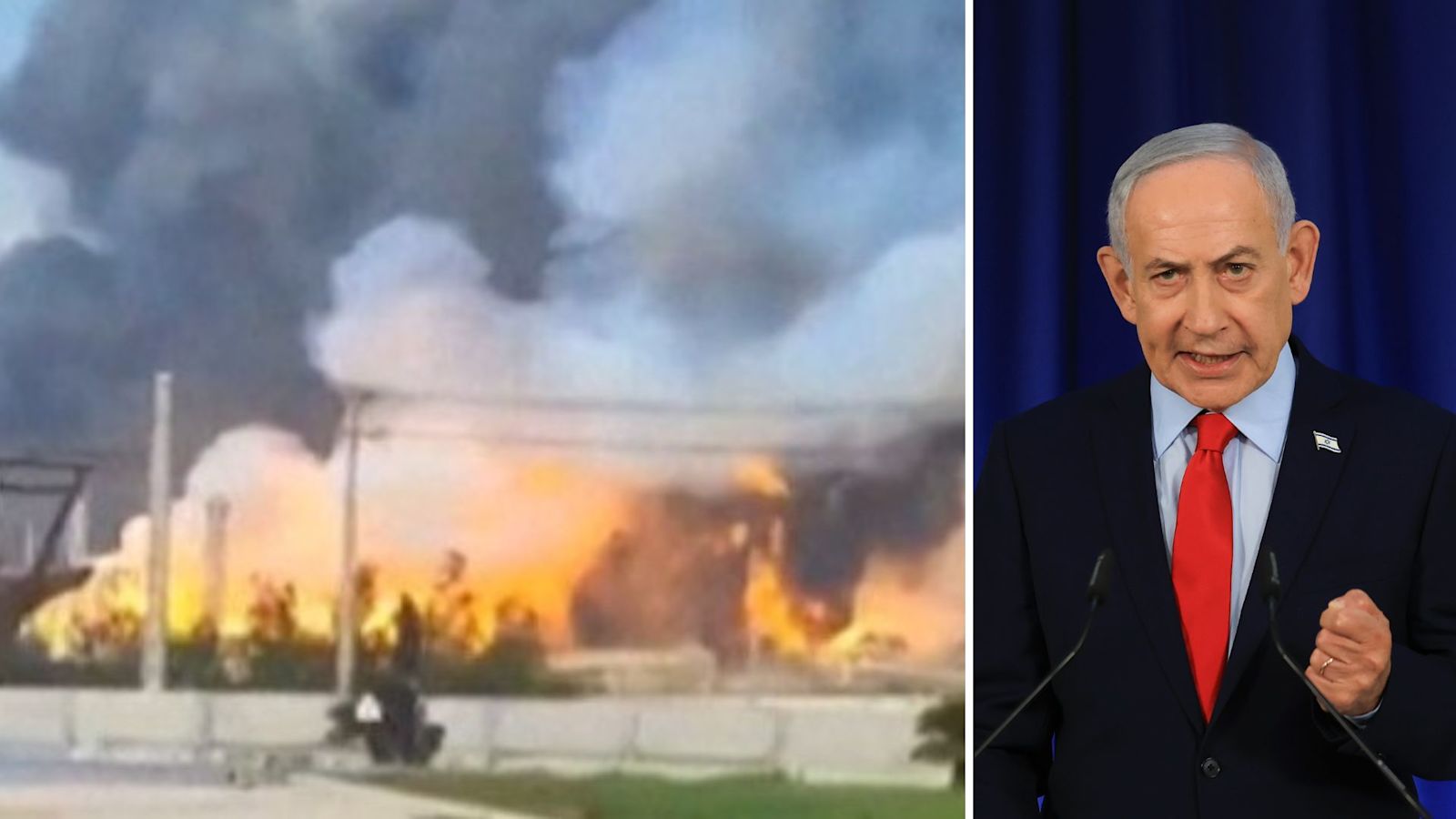
This was followed by an Iranian attack on the Ras Laffan liquefied natural gas (LNG) production and export facility in Qatar – a key source of natural gas for world markets.
Production had already been halted at Ras Laffan due to earlier attacks, and while firefighters managed to put out the blaze, state-owned QatarEnergy said the fire had caused “extensive” damage.
Qatar, Saudi Arabia and the UAE denounced the Iranian attacks, with Arab League Secretary-General Ahmed Aboul Gheit calling them a “dangerous escalation”, but Tehran has shown no signs of backing down.
The wave of attacks sent brent crude oil, a benchmark for the oil industry, up by 7% to reach a significant price of $114 – around £86 – on Thursday morning.
Before this month, prices had not passed the $100 per barrel mark since July 2022.
Netanyahu says Iran can no longer enrich uranium
In a televised address, Israeli Prime Minister Benjamin Netanyahu said Israel will hold off on any further attacks on Iran’s giant natural gas field, at Trump’s request.
Speaking during a press conference late Thursday, Netanyahu said that Iran has “no ability to enrich uranium at the moment and no capability of manufacturing ballistic missiles.”
The Israeli leader also said that “Iran’s air defences have been rendered useless, their navy is at the bottom of the sea… their air force is nearly destroyed.”
He also laid out Israel’s three main objectives for the war on Iran – those are to “completely annihilate” the country’s nuclear programme, as well as their ballistic missile programme; and to create conditions that allow Iranians to “take their fate in their own hands.”
He said Israel was “stronger than ever”, while Iran is “weaker than ever.”
Netanyahu also denied that Israel had pressured the United States into going to war, amid growing US domestic concerns about the country’s involvement.
“This canard that we dragged the United States into this is not just a canard, it’s ridiculous,” he said.
“I didn’t have to convince President Trump about the need to prevent Iran from developing its nuclear programme, putting it underground, and being able to launch nuclear-tipped missiles at the United States. He understood that.
“The world owes a debt of deep indebtedness to President Trump for leading this effort to safeguard our future”, he said, adding that his partnership with Trump is “the only way to avoid this catastrophic development.”
Trump says war with Iran is “ahead of schedule”
Earlier on Thursday, Donald Trump said the US and Israel had “obliterated” Iran’s navy, air force, and leadership.
The US president also said he would not be deploying US troops to the region, amid reporting that his administration was considering deploying thousands of troops.
“No, I’m not putting troops anywhere. If I were, I certainly wouldn’t tell you, but I’m not putting troops,” Trump said in the Oval Office on Thursday.
He confirmed that his administration may seek a further $200 billion in new Pentagon funding, calling it a “small price to pay” to ensure the military has all it needs to wage war with Iran.
“We want to be in the best shape, the best shape we’ve ever been in,” he said from the Oval Office. “It’s a small price to pay to make sure that we stay tippy top.”
He was speaking during a meeting at the Oval Office with the Japanese Prime Minister, Sanae Takaichi. She said she believes that Trump is the one “who can achieve peace across the world.”
Speaking during a meeting at the Oval Office in front of the world’s press, Takaichi told the US president that Japan has opposed Iran’s development of its nuclear programme.
“Japan condemns Iran’s actions such as attacking the neighbouring region and also the de facto or effective closure of the Strait of Hormuz.
“As a matter of fact, my fellow minister, (Foreign) Minister (Toshimitsu) Motegi, also had a direct exchange with the Iranian foreign minister and urged Iran to stop such activities.
Trump had previously complained that Japan was among the nations that did not join his call to help protect the Strait of Hormuz.
US President Donald Trump with Japan’s Prime Minister Sanae Takaichi. Credit: AP
UK natural gas prices spike
UK natural gas prices spiked by more than 20% on Thursday morning to around 172p per therm – the highest in three years.
Kathleen Brooks, research director at XTB, said the escalation in the conflict was “spooking the market” and traders were predicting “hefty losses for stocks”.
“This war looks far from over, and the energy crisis is shifting from a shipping crisis to a supply crisis,” she said.
UK Prime Minister Sir Keir Starmer has condemned “in the strongest terms” Iranian attacks on energy sites in the Gulf, adding that the UK is ready to “contribute to appropriate efforts” to re-open the Strait of Hormuz – a crucial shipping channel through which about one fifth of the world’s oil passes.
The prime minister has spoken with the Emir of Qatar, Sheikh Tamim bin Hamad bin Khalifa Al Thani.
In a readout of the conversation on Thursday afternoon, a Downing Street spokesperson said: “The prime minister began by condemning the Iranian strikes on Qatari energy facilities overnight.
“He said that such reckless attacks on critical infrastructure risk pushing the region further into crisis and worsening the severe economic impacts being felt globally, including in the UK.
“Discussing the ongoing defensive support the UK is providing to our partners in the region, the Prime Minister was clear that the UK would continue to stand with Qatar and all our allies in the Gulf.
“The leaders agreed that the immediate priority must be de-escalation and that they would stay in close touch in the coming days and weeks.”
Iran has effectively blockaded the channel, although Tehran has said the strait is only “closed to our enemies”.
Meanwhile, Defence Secretary John Healey said the UK would “step up the defensive support” the UK is offering to Gulf states following the latest strikes.
“They’re a serious escalation,” he said. “They further destabilise the region and we will step up the defensive support that we can offer to those Gulf states.”
Projectile hits ship off the coast of the Ras Laffan industrial site
As attacks in the area continued into Thursday morning, a projectile hit a ship off the coast of the Ras Laffan industrial site, according to the United Kingdom Maritime Trade Operations centre (UKMTO). No injuries were reported.
The UKMTO also reported that a cargo ship off the United Arab Emirates’ eastern coast was hit by an “unknown projectile” on Wednesday night, igniting a fire aboard, adding that the ship’s crew had managed the blaze.
Further strikes include a drone attack on Kuwait’s Mina Al-Ahmadi refinery, one of the largest in the Middle East, which sparked a fire but caused no injuries, the state-run KUNA news agency reported. Shortly after, a drone attack set ablaze the nearby Mina Abdullah refinery, officials said.
Saudi Arabia said its SAMREF refinery in the Red Sea port city of Yanbu had been hit, and that it intercepted six drones in Riyadh and its Eastern province. The kingdom had begun pumping large volumes of oil west toward the Red Sea to avoid the Strait of Hormuz.
Donald Trump arriving on Air Force One on Wednesday after attending a return of US casualties lost in the conflict. Credit: AP
Authorities in Abu Dhabi said they were forced to shut down operations at its Habshan gas facility and Bab field, calling Iranian overnight attacks on the sites a “dangerous escalation.”
Israel hit by wave of Iranian attacks
In Israel, more than a half-dozen waves of Iranian attacks targeting large parts of the country sent millions of people to shelters. The strikes caused damage to buildings but no significant casualties were reported.
Writing on his Truth Social platform, Trump claimed that “out of anger for what has taken place in the Middle East”, Israel had “violently lashed out” on the South Pars gas field and stressed that Qatar “was in no way, shape or form, involved with it”.
“NO MORE ATTACKS WILL BE MADE BY ISRAEL pertaining to this extremely important and valuable South Pars Field unless Iran unwisely decides to attack a very innocent, in this case, Qatar,” he wrote.
Trump said that if this happened again, “the United States of America, with or without the help or consent of Israel, will massively blow up the entirety of the South Pars Gas Field at an amount of strength and power that Iran has never seen or witnessed before.”
“I do not want to authorise this level of violence and destruction because of the long term implications that it will have on the future of Iran, but if Qatar’s LNG is again attacked, I will not hesitate to do so,” he added.
A woman looks through a damaged wall of a residential building in Tehran, Iran. Credit: AP
Hegseth says the US military “controls the fate” of Iran
Meanwhile, during a press conference in Washington, Defence Secretary Pete Hegseth told reporters that the US military “controls the fate” of Iran.
Iran has the ability to make the right choices,” he said, adding that Tehran “should not, going forward, target Arab allies, Arab countries, trying to create pain, the pain that they created themselves”.
Referencing senior Iranian leaders killed by US and Israel, he implied that more leaders could be targeted, referring specifically to the Islamic Revolutionary Guard Corps and the internal security unit, the Basij force.
“The last job anyone in the world wants right now, senior leader for the IRGC or Basij, temp jobs, all of them,” Hegseth said.
Meanwhile, a senior administration official has said the Pentagon is seeking an additional $200 billion in funds for the Iran war from the White House.
Asked about the figure at Thursday’s press conference, Hegseth did not directly confirm the figure, saying it could change. But he said “we’re going back to Congress and our folks there to to ensure that we’re properly funded. It takes money to kill bad guys.”
Subscribe free to our weekly newsletter for exclusive and original coverage from ITV News. Direct to your inbox every Friday morning.
From Westminster to Washington DC – our political experts are across all the latest key talking points. Listen to the latest episode below…