
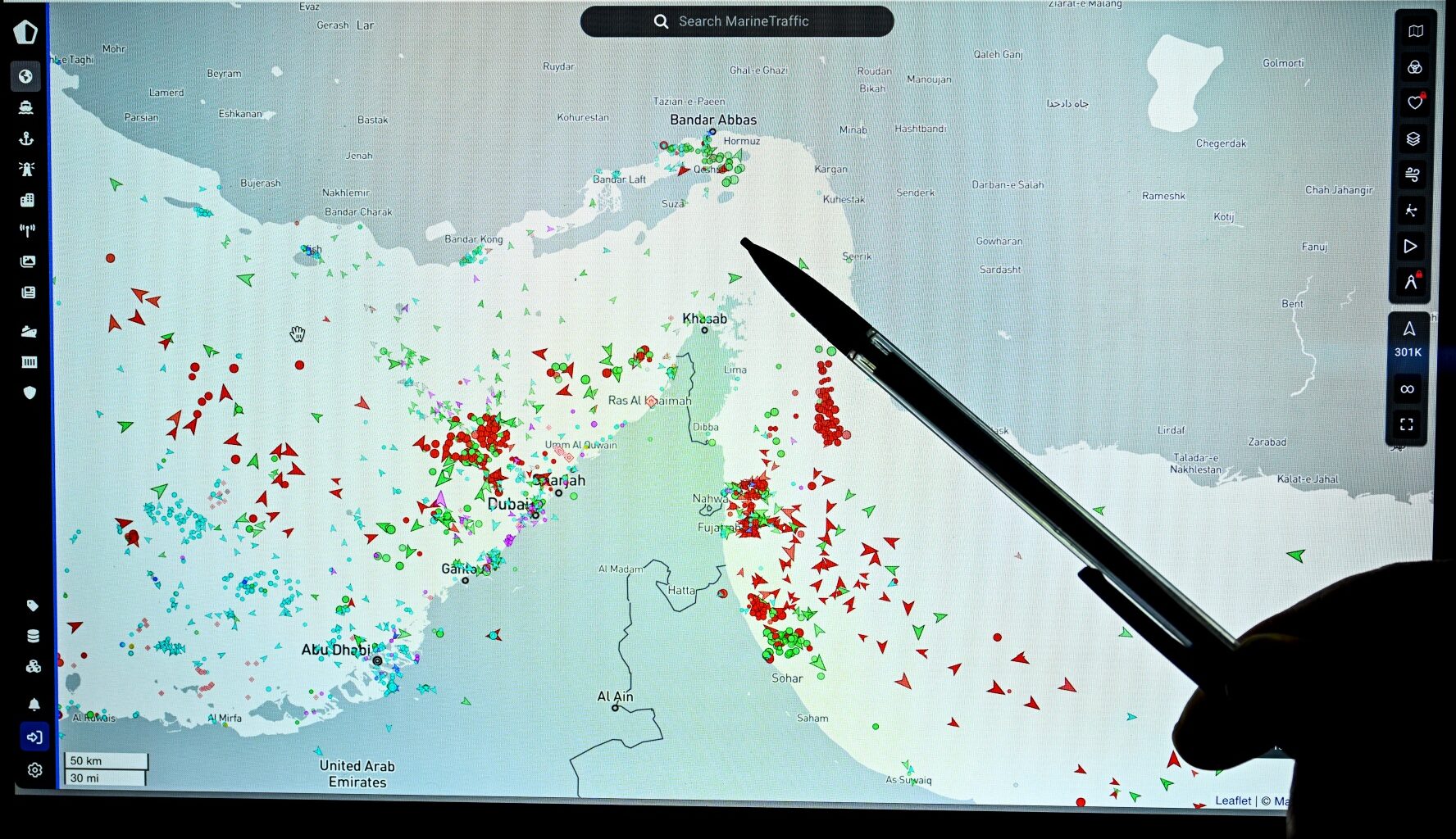
On Monday, March 16, Brookings experts Samantha Gross and Caitlin Talmadge sat down with Melanie W. Sisson to discuss what happens when military operations intrude on commercial operations in the Strait of Hormuz.
Melanie W. Sisson
Samantha, what is the status of the movement of oil through the Strait?
Melanie W. Sisson
Caitlin, the reason the Strait is effectively closed is that the United States, together with Israel, launched a war against Iran, and Iran didn’t surrender: it is fighting back. So it’s the military dynamics around the Strait that are preventing or dissuading commercial vessels from transiting. What is the status of the military picture?
Caitlin Talmadge
The U.S. military campaign is ongoing, although the relationship between that campaign and the attainment of U.S. strategic and political objectives remains unclear. The United States is attacking key Iranian military capabilities—their missile launchers and missiles, their drone capabilities, and their naval capabilities—but we don’t know how much progress is being made. For example, we know that there’s been destruction of Iranian missile launchers, but we don’t know how many are left. Without information about that denominator, it’s hard to assess how well the campaign is going, or how much longer it might last. And while it is true that Iranian launches of projectiles, such as missiles and drones, are down from where they were in the first days of the war, the Iranian posture is still one of defiance.
Against this backdrop, we’re seeing the dynamics with traffic in the Strait that Samantha just described. With an active shooting war going on in both directions, you can understand why tankers are especially reluctant to go through the Strait. Not just because they’re worried about getting hit, but because there are people on these vessels who can be killed or injured in some pretty terrible ways by Iranian assets that the U.S. can’t guarantee that it has completely eliminated.
Samantha Gross
I’ll add that you don’t have to close the Strait militarily or mine it such that nothing can come through. The very threat of harming ships means the ships have a hard time getting insurance to go through the Strait. It means their crews don’t want to go through the Strait, and so there are ways you can wreak a lot of havoc without a ton of military power, just because of fear.
Melanie W. Sisson
Caitlin, Samantha just mentioned this possibility that Iran might mine the Strait. What does mining the Strait mean, and what does Iran have at its disposal to do it?
Caitlin Talmadge
For many decades, Iran has worked to develop asymmetric naval capabilities for precisely this sort of scenario. This includes an arsenal of probably 5,000 to 6,000 mines of different types and varying levels of sophistication, along with numerous platforms that could deliver those mines. Some of those platforms are larger naval vessels that probably have been sunk by the strikes we hear CENTCOM briefing us on. But the concern is that Iran also potentially has hundreds of smaller vessels: midget submarines, fast attack craft, even civilian boats of a certain type that could be used to lay small numbers of mines, and that potentially are very hard to find because they’re in all these small ports all along the coast. Some of them may be in an extensive tunnel network Iran built along the coast that hides them until right when they enter the water. So, it’s not very hard to tell a story about how, if it chooses to, Iran could conduct a significant mine-laying campaign in the Strait. Just the possibility of this—or at least the inability of the United States to confirm that there are no mines—is a deterrent for tanker traffic.
Melanie W. Sisson
Samantha, tanker traffic carries a lot of oil, but not only oil. What other energy assets are implicated in what’s happening in the Strait, and how are the combined effects felt in the broader energy sector?
Samantha Gross
Qatar is the world’s third-largest producer of liquefied natural gas, and all of its production has to go out through the Strait of Hormuz. That production is completely shut down now. So, we’ve not just lost oil supply, we’ve also lost 20% of the world’s seaborne natural gas trade.
A couple of other products that come through the Strait are also really important. One of them is nitrogen-based fertilizer, which in a sense is just natural gas in a different form. Fertilizer may be one of the most important non-energy commodities that’s not getting onto the market. It’s planting season in the Northern Hemisphere, so a lot of countries will need that fertilizer. And they may not have as much as they want, and what they can get might be very expensive, which has implications for food prices. Not just immediate food prices, but food prices months from now, when they’ll be harvesting those crops.
Melanie W. Sisson
U.S. President Donald Trump has pointed out that the United States produces all the oil it could possibly need, and so it isn’t a big problem for the United States if oil is not transiting through the Strait. Is the president correct?
Samantha Gross
No, he’s not correct in his assessment of what this stoppage means for the United States, but there’s more to say than that. Oil and natural gas together make up about 72% of U.S. energy supply. About half of that is oil, about half is natural gas. But the way that limited supply of those two fuels is going to affect us is quite different.
Let’s start with natural gas. We produce all the natural gas we need in the United States, and we’re the world’s largest exporter of liquefied natural gas. But our LNG export facilities are already running at full tilt. So even though demand for LNG will increase in other places, we’re not going to be able to supply it.
The oil market is different. We are a net exporter if you combine crude oil and petroleum products. But those are priced on a global market, and so consumers here in the United States are paying the global price for oil and for fuels made from oil. Any supply crunch in the global oil market comes through as an increase in price, and prices will rise until supply and demand are balanced.
Given the significant cut to supply, I’m surprised oil prices aren’t higher. I think it’s because there’s still hope in markets that the Strait will be reopened soon.
Melanie W. Sisson
Caitlin, can the Strait be reopened soon? Is there a way for the U.S. military to open the Strait?
Caitlin Talmadge
We’ve heard from the earliest days of this war calls for U.S. naval escorts of traffic in the Strait. I can understand why the idea of having U.S. warships travel along with traffic in the Strait would seem reassuring to markets, but the reality, unfortunately, is not quite so appealing. You can send a warship into the Strait or attack helicopters into the Strait, but as you do that, you’re actually moving expensive and scarce U.S. platforms very, very close to the Iranian shore, where Iran would have one of its best opportunities to target them with weapons that may not yet have been destroyed by the U.S. bombing campaign. Escorts are vulnerable. The mission is just very difficult to do when you’re in the middle of a shooting war.
It’s also very demanding in terms of the number of platforms that would need to be involved, given the volume of maritime traffic that is needed to get commerce going again. If you’re thinking about sending more than 100 vessels per day through the Strait, you’re going to need a lot of surface and air power. But we might want to use those assets to do other things in the conduct of the war. So it’s not as straightforward as just sending a couple of destroyers through the Strait and calling the Strait back open.
And of course, the other issue is the mines. If Iran has mined the Strait—and again, we can’t confirm that they haven’t, or that they won’t—the U.S. could send in mine clearance vessels, but they also would then be vulnerable to Iranian attacks.
Melanie W. Sisson
What would the consequences be of a failed escort, if the U.S. Navy does try to open a path and take a commercial vessel through and is attacked?
Caitlin Talmadge
In military terms, there is a real possibility for casualties and for expensive damage to U.S. warships. I’m in no way underestimating the U.S. Navy, but when you send your expensive forces up into the teeth of Iranian shore-based assets and asymmetric naval assets, and you do it on the scale that would be relevant here, it gives the Iranians a lot of opportunities to get a lucky shot. And then the United States would be in the position of doubling down and continuing the campaign and suffering even more costs, or escalating in another direction, or capitulating. But I don’t think any of those options would fix the market problem.
Samantha Gross
I agree with that completely. Part of what is keeping ships from going through this Strait is fear. If we put forward an escort campaign, and that campaign fails, you’ve escalated the fear factor rather than reducing it. Markets are reacting not just to the real shortage, which is happening and getting worse over time, but to this fear. You could actually get higher prices and more market concerns for longer if you had a failed escort campaign. Because instead of bringing fear down, you will have ratcheted it up. So I think the potential of it backfiring, not just from a military point of view but from a market point of view as well, is really high.
Melanie W. Sisson
So military escort seems to you both not to be viable, at least for now, despite how much attention it is getting. But you also said, Samantha, that the markets haven’t reacted in terms of pricing the way that you thought they would. Why not?
Samantha Gross
I think part of what’s causing it is the disconnect between the energy side and the military side of the equation. The markets quite understandably are looking for reassurance that the military dynamics are manageable. As Caitlin said, on the face of it, escorts seem like a reasonable way out of the box we’re in. But as she also said, from the military perspective, escorts really aren’t as ready a solution as we would wish them to be.
Melanie W. Sisson
If naval escorts and military escorts aren’t going to be a solution to the supply problem in the near term, what about releases of strategic petroleum reserves?
Samantha Gross
Unfortunately, also no. There is an organization, the International Energy Agency (IEA), which started after the oil shocks of the 1970s, that requires its members to hold certain amounts of oil stocks. In reaction to the blockage in the Strait, the IEA is planning for a number of its countries to make the largest release ever of crude oil stocks. This is set to be 400 million barrels over roughly two months. That sounds like a lot of oil, and it is, but if it were released evenly over those two months, it would amount to about 7% of global demand. Remember, with the Strait closed, the market has lost more like 15 to 17% of global demand, considering that some oil can bypass the Strait through pipelines. So the oil release is important and it sends the right signal, and it’s a very big deal. But it won’t make up for the hole in the market.
One other thing to note is that governments usually sell the reserves onto the market. We call it a release, but really we mean that government sells the oil that it has been holding back—they sell it when there is a shortage, and the price is high. When the shock is over, supply and demand have hit a new equilibrium, and the price is lower again, then the government buys barrels to replenish the reserve.
That’s not what the United States wants to do this time. This time, they’re setting up a swap. What that means is that they want companies to agree that if they take oil now, during the shortage, they will return that same amount of oil, plus extra, when the market shock is over.
This is logistically more difficult than just selling the oil and buying oil back later when the prices go down. And it strikes me as being a little bit cute, as an attempt to find a way to say that getting the oil back won’t cost the taxpayer anything.
Melanie W. Sisson
It sounds like the U.S. government is saying, hey, market, we broke the Strait of Hormuz. We don’t think we can use the military to un-break it and get your industry back on track, but we will give you our reserves to ease the supply crunch. You won’t have to give us money for this oil—you’ll just have to give it back to us, plus some interest barrels, when the war is over. We can’t tell you when that will be, or whether the price of those barrels will be high or low when we ask for them back. Do I have that right?
Samantha Gross
Well, there is some truth to that characterization. In my view, the swap does make it unnecessarily difficult for the market to access the oil we all want out there, given this massive disruption. And yes, I can see why you’d find it a little bit rich that these stock releases are happening due to a war that we caused. You’re pointing out that the reason we have this shortage is that we embarked on a war of choice, clearly without the market’s input, and now we’re looking to industry to help defray the consequences. But keep in mind that it’s always true that these stocks are held for when there are disruptions, no matter the cause of those disruptions.
Melanie W. Sisson
Caitlin, what needs to happen militarily for there to be enough stability for secure passage—or at least to buy down enough fear—that the industry might be willing to attempt a transit?
Caitlin Talmadge
I don’t see the markets calming down and traffic resuming to pre-war levels until the war itself is over. I think the question of what operations we can do during this war to convince normal volumes of maritime traffic to traverse the Strait is just sort of a non-starter for all the reasons that we’ve been talking about. Then it really becomes a question of, well, how long is the war itself going to last? And we just don’t know.
We don’t know, not just because we don’t know what the United States and Israel intend to do militarily, but because we also can’t forget that the Iranians get a vote in how long this disruption goes on. And in fact, their military strategy is about playing for time, prolonging the economic and military pain that’s inflicted on adversaries. They might not need a lot of military assets to just continue launching a few projectiles and harassing tanker traffic. It could be enough to keep traffic at least down from where it normally would be. Asking when the United States will decide to declare victory and go home is a different question from asking when Iran will decide that it’s going to behave in a way that reassures markets in the Strait of Hormuz. I imagine that Iran isn’t just thinking about this war, but is also thinking about how to deter the next one. And part of the way you deter the next round is to teach more powerful adversaries that they don’t control when the dance stops, once the music starts.
Samantha Gross
On the energy side of the equation, the longer this goes on, the more the shortage settles in. To reiterate, it’s not going to be enough for someone just to say that the Strait is open. That alone won’t be enough to reassure the crews who operate those ships and would be putting themselves at risk, or the insurers who have huge financial interest in the integrity of these tankers and the commodities on them. Getting to a place of confidence will take time—more time than the military action itself, no matter how and when the shooting war ultimately resolves.
The Brookings Institution is committed to quality, independence, and impact.
We are supported by a diverse array of funders. In line with our values and policies, each Brookings publication represents the sole views of its author(s).