

Listen to this article
Estimated 5 minutes
The audio version of this article is generated by AI-based technology. Mispronunciations can occur. We are working with our partners to continually review and improve the results.
It’s worth noting when Vancouver city council doesn’t give the green light to two high-profile proposals in a week, in part because it happens so rarely.
But last week, it did.
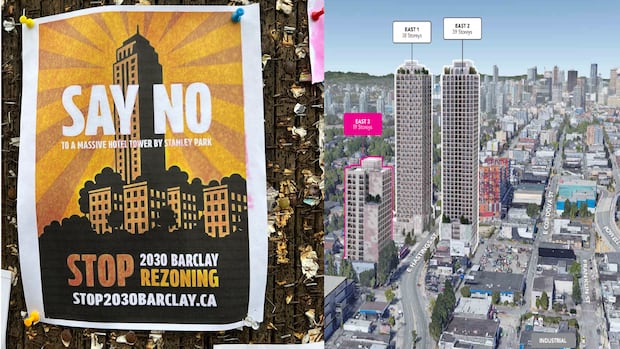
The first was a proposed 25-storey hotel in the deep West End, just a few blocks from Stanley Park. The second was a trio of towers in Strathcona, the tallest reaching 39 storeys, clustered near East Hastings Street and Glen Drive.
Community opposition to the West End hotel centred around the fit of a large hotel on a quiet street so close to Stanley Park, while the Strathcona complex was criticized for being out of scale to the surrounding neighbourhood and not having any connecting rapid transit lines.
In both cases, Coun. Mike Klassen put forward an amendment referring the development proposal to staff, in hopes that it could be brought back in a more amenable form to the public more quickly than if the projects were rejected altogether.
“You’re listening to the community thoughtfully every single time. That’s part of the job,” said Klassen.
“But at the end of the day, you had two projects that you could tell the majority of council were probably getting ready to vote against, and so this was an opportunity for us to take another look at those projects.”
It was a different ending than the typical arc for public hearings in B.C.’s biggest city: residents who live near the proposal show up to city hall in considerable numbers, concerns are raised, councillors listen — but eventually, council approves the project.
And it also hints at what could become a point of debate in this October’s upcoming election.
LISTEN | Justin McElroy and Stephen Quinn discuss Vancouver council pouring cold water on two different developments last week:
This is Vancouver31:58Are Vancouver’s housing plans starting to stall — and could lifeguard cuts sway the election?
Vancouver council just rejected two major housing projects, breaking a pattern that rarely changes. So why now? And what does it mean for the upcoming election? Plus, Stephen and Justin talk about a fight over lifeguard cuts and who’s really in charge at the park board.OneCity says it ‘kicks the can down the road’
Councillors from ABC Vancouver, COPE, Greens and Vote Vancouver approved Klassen’s amendments, while OneCity Coun. Lucy Maloney voted no to the West End referral and abstained to the Strathcona referral.
She accused ABC Vancouver politicians of not upholding their stated commitment to increasing the city’s hotel capacity and building more homes across the city.
“All the referral does is … kick the can down the road so the decision doesn’t have to be made before the election,” she said.
“I think that we need to take seriously the obligation we have to demonstrate what our parties stand for and what we, as councillors, stand for, even in an election year, even when it’s difficult, even when there’s considerable interest in a matter.”
While ABC Vancouver has generally continued the development philosophy of the Kennedy Stewart and Gregor Robertson administrations — increasing density, and continuing to move forward on the city’s Broadway Plan and Official Development Plan — Klassen pointed out there had been a few times earlier in its term where proposals were rejected at the public hearing stage.
And he also said that being pro-development did not mean automatic approvals.
“In [some] cases, we have to sometimes kind of take a step back and go: ‘Yeah, it’s great to build more housing, but at what cost?'” he said.
“This is an opportunity for us to look at making sure that we do this more thoughtfully.”
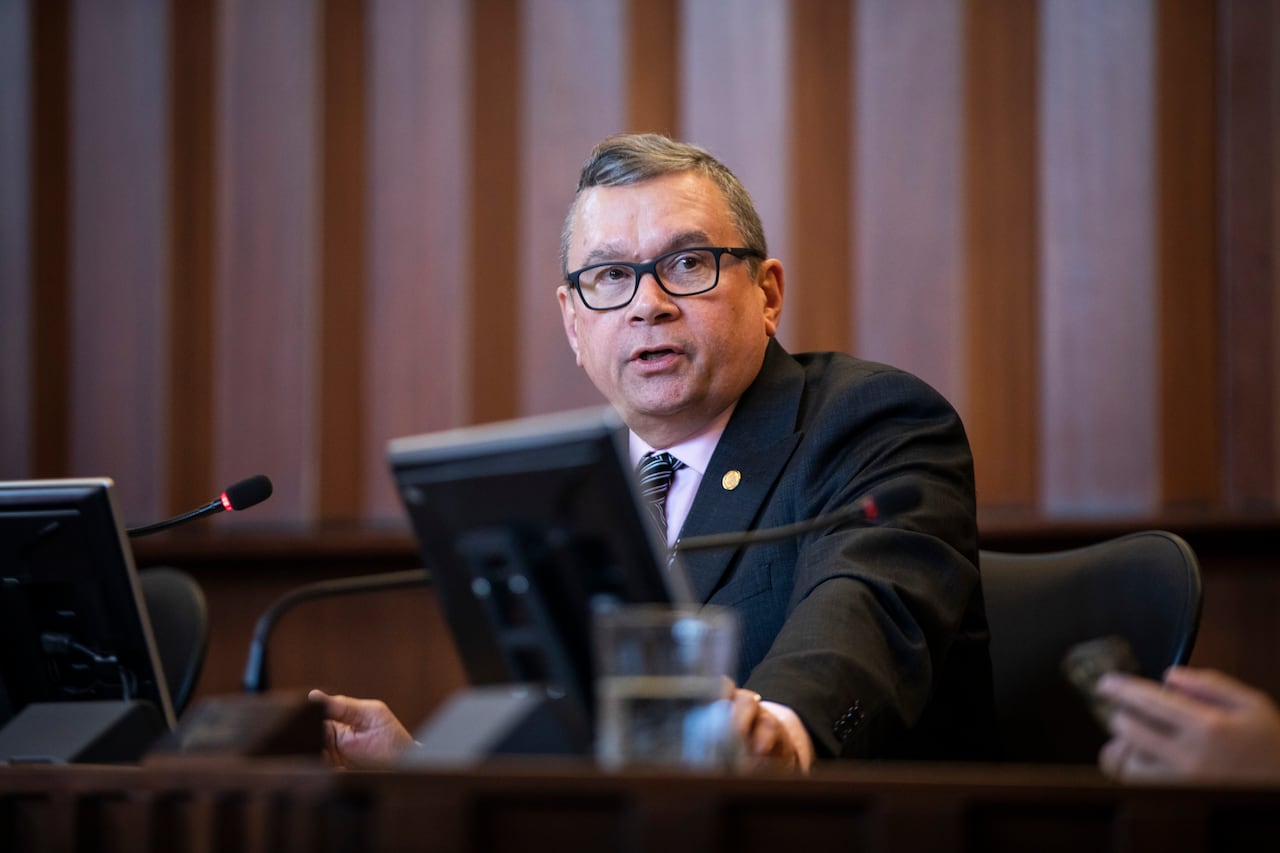 Vancouver city councillor Mike Klassen during a city council meeting in Vancouver, B.C., Wednesday, Feb. 26, 2025. (Ben Nelms/CBC)Vancouver politics: left, right and development
UBC political scientist Stewart Prest said housing votes have a particular way of exposing the fault lines in Vancouver politics.
“I sometimes talk about it being a two-dimensional space where we have politicians slotted on a left-right spectrum, but also on a pro-development and more anti-development axis,” he said.
“These are the kinds of votes that can expose those divisions a little bit more, and so a [referral back to staff] is an easy way to try and paper over some of those divides.”
In addition, both the West End and Strathcona tend to have higher voter turnout than most neighbourhoods at election times, and Prest said it’s only natural that political parties would be more attuned to their sensitivities the closer to the Oct. 17 election.
“I think [ABC Vancouver] are trying to build the case that they are responsive to feedback and perhaps to push against the fairly well-established narrative at this point that ABC … do not take criticism well. And so here they’re trying to show that they do listen,” he said.
Whatever the motivations, it will add an additional wrinkle to Vancouver’s already-layered housing politics this election.
“It does remind us of some of the complexities of Vancouver politics,” said Prest.
“We tend to think of it in these stark left-right divisions, but there is more to it than that.”