
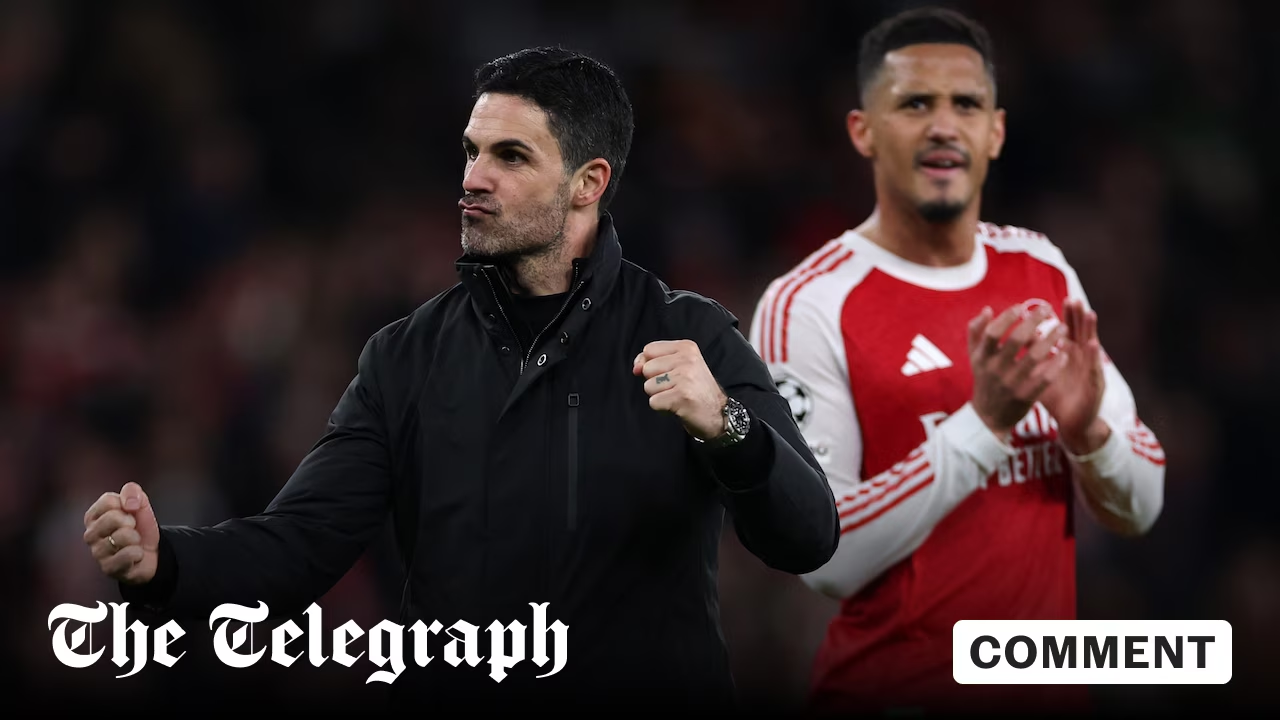
This was not the original expectation when Arteta took the reins at the Emirates. The initial anticipation was that he would redesign Arsenal in the image of his mentor, Guardiola, and in his first few years, this seemed to be the case. However, the limitations exposed when Arteta fielded what was his most attractive line-up two years ago explained why he was compelled to change. That team was very good, but City were simply better.
Certain long-standing criticisms of Arsenal could not be easily shaken off: they were often accused of being more about image than substance; too soft against the most physical teams; lacking the necessary quality against the elite sides in Europe; and, crucially, lacking the cunning and game-management required to succeed when it truly mattered.
Aside from the final hurdle of winning a major trophy, those negative perceptions have now largely been flipped.
For Arteta to be competing intensely on four fronts is a tribute to his foresight and his courage to completely rebrand the team. This transformation has prompted me to regularly compare Arteta with José Mourinho’s Chelsea sides, which were also unpopular with neutrals – a point John Obi Mikel seems to have conveniently forgotten when attacking Arsenal’s style earlier this week. Like Mourinho’s Chelsea, the current Arsenal are unafraid to be more pragmatic than flamboyant, building their title charge on a robust defensive structure rather than prioritising elaborate, flowing attacking patterns.
Arteta also bears comparison to Diego Simeone, particularly the 2021 La Liga winners – an Atlético Madrid side who mastered the “dark arts” and became renowned for being “horrible” to play against. While many supporters intensely dislike Simeone’s approach, my own view is that he is one of the greatest and most important managers of his generation, one who has made the tactical landscape of the Champions League far more interesting.
Arteta will always be instinctively closer to Guardiola than to either Mourinho or Simeone and will continue to evolve Arsenal. But he was undeniably compelled to rethink his immediate strategy. While there are periods of every game when Arsenal are a better watch than their critics admit, he could not stand still.
Like Simeone, Arteta had to assess a league dominated by two clearly superior teams: City, the best in the world with the ball, and Liverpool, the best in the world at retrieving it. The question became: where could Arsenal realistically fit in, challenge the main contenders, and ultimately win? I felt Arsenal needed more superstars in attack or for the likes of Martin Odegaard and Bukayo Saka to step up a level. Arteta has calculated that trying to defeat City by simply replicating their beautiful, possession-based game was doomed to failure. He has found a darker, more resolute way to take on his former master.
He has not succeeded in winning the ultimate prizes yet, but he is getting closer. Denying Guardiola a major trophy in their first Wembley cup final head-to-head would represent a hugely symbolic leap forward.
As I argued on Monday Night Football early this week, attacking Arsenal for how they play their football is nonsense. To quote Thierry Henry: “You don’t have to like it, but you must respect it.”
There is no “right” or “wrong” way to win a football match; there are only different tastes to satisfy. I vividly remember playing against Wenger’s Arsenal, particularly at Highbury, where every time we dared to kick the ball forward, a dismissive shout of “hoof” would come from the Clock End. Arsenal fans revelled in their image of being the most sophisticated, attacking team in the Premier League for much of that period.
Under managers like Gérard Houllier and Rafael Benítez, the only way to have success against such teams was to employ the very same defensive, pragmatic tactics that are being so chastised this season. I won a treble and a Champions League playing largely defensive, counter-attacking football, so no one is going to convince me that there is only one acceptable way to approach getting your hands on the biggest trophies.
If Arteta does achieve that ultimate victory, much of the prevailing anti-Arsenal sentiment will give way to grudging admiration as the biggest stick used to beat them will be de-weaponised.
Laughing at Arsenal’s recent near misses has become a source of national entertainment. This mockery has been amplified by the club’s own supporters, who have been particularly prominent in fan media and a proactive online presence in the digital age. No major club’s fanbase have been so adept at getting too high after wins and too low after defeats. Even now, closing in on the success they crave, there is hysteria whatever the outcome.