
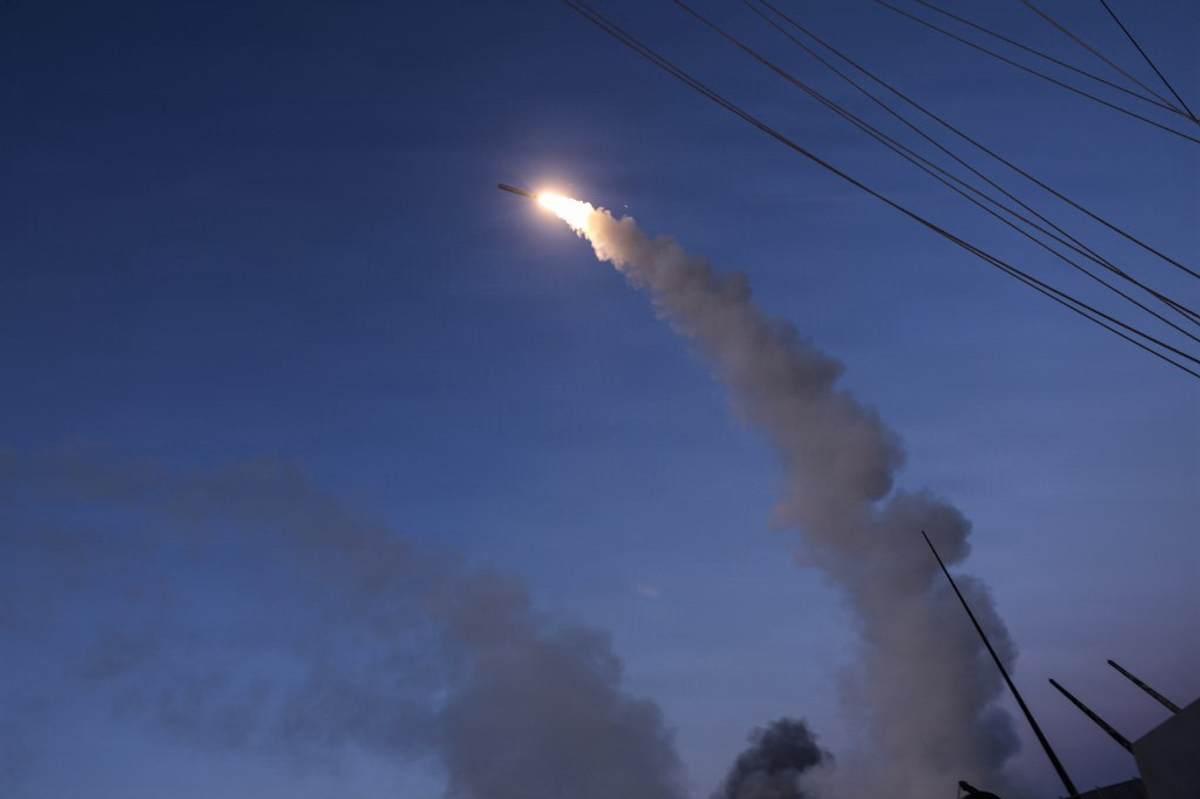
Ukrainian air defense advisers deployed to the Middle East were reportedly struck by the US military’s reliance on expensive interceptor missiles to shoot down low-cost drones, highlighting a sharp contrast with Ukraine’s battlefield-tested tactics.
According to President Volodymyr Zelensky, around 200 Ukrainian specialists have been sent to Kuwait, Qatar, the United Arab Emirates, and Saudi Arabia to assist in defending against missile and drone threats.
JOIN US ON TELEGRAM
Follow our coverage of the war on the @Kyivpost_official.
The United States Central Command requested Ukrainian advisers, who have since been deployed to the Gulf, a senior Ukrainian Air Force officer told The Times.
The Ukrainian officer said he was “astonished” by reports that Gulf air defenses were firing as many as eight Patriot interceptor missiles – each costing more than $3 million – at a single target, including low-cost drones.
“Often they were firing thoughtlessly,” the officer said. “For example, they used SM-6 missiles… This missile costs about $6 million, and they used it to shoot down a Shahed costing $70,000.”
By contrast, Ukrainian crews typically use one or two missiles to intercept far more complex targets, such as ballistic missiles, while constantly adapting to evolving Russian tactics.
Despite sharing operational data with allies, Ukrainian officers say their experience has not been fully incorporated.
“I don’t understand what they had been doing… for the four years we’ve been fighting,” one officer said.

Other Topics of Interest
Ukraine’s Mahuchikh Wins World Indoor High Jump Gold, Levchenko Takes Silver
Ukraine’s Yaroslava Mahuchikh cleared 2.01 meters to win gold at the World Indoor Championships, while Yuliia Levchenko claimed silver.
The gap in approach was further underscored by an incident on March 1, when Kuwaiti air defenses shot down three US F-15E fighter jets while they were pursuing drones. Ukrainian advisers described the episode as avoidable.
“In any war friendly fire happens, but in this particular case it was clear negligence,” the officer said.
Analysts suggest the difference may lie in operational methods: Gulf crews often leave systems in automatic mode while taking cover, whereas Ukrainian operators remain at their posts and manually control engagements.
In the first four days of the Iran war, the US and its allies reportedly launched more than 800 Patriot missiles – exceeding the number Ukraine received over three years of full-scale war.
At the same time, relatively cheap Shahed drones have managed to inflict significant damage, including strikes on high-value radar systems worth hundreds of millions of dollars.
“For two months they stood in exactly the same place… Then the Shaheds flew in… And that was it,” the Ukrainian officer said, emphasizing the importance of mobility and concealment.
Ukraine has refined its air defense tactics through years of high-intensity warfare, integrating Soviet-era and Western systems into a flexible, layered network.
Crews have learned to rapidly relocate batteries, manually control engagements, and prioritize high-value targets.
Moreover, Ukrainian Patriot crews have pioneered new ways of using US-supplied systems, turning them from purely defensive into offensive weapons.
On May 13, 2023, a Patriot unit led by a 25-year-old battle management officer known as “Matyoryi” shot down three Russian jets and two helicopters over Russia’s Bryansk region. The aircraft had been launching glide bombs at Chernihiv from across the border.
The unit moved its battery close to the border to ambush the planes in what they believed was safe airspace, assembling and dismantling the system far faster than standard US procedures to avoid detection.
Ukrainian crews have also adapted to newer Russian ballistic missiles, which use complex flight paths to obscure their targets. Operators often disable automatic targeting and wait until the last possible moment to engage.
“No country should be complacent,” said Colonel Kyrylo Peretyatko, who was awarded the title of Hero of Ukraine after his NASAMS (Norwegian Advanced Surface-to-Air Missile System) unit shot down 12 cruise missiles in two minutes. “Such operations… have not existed in world history like those happening in Ukraine now,” he added. “This is a completely different war, which all countries are studying.”
The Times reports that Ukraine has built one of the world’s most complex air defense systems, combining Soviet-era and NATO equipment into a layered network that includes electronic warfare, air power, ground-based systems, interceptor drones, and even machine guns.
On March 13, US President Donald Trump said the United States does not need Ukraine’s help with drone defense.
Earlier, Zelensky said there had been “requests from the American side” to help defend Gulf states from Iranian drones.
Despite this, Trump told Fox News: “No, they are not helping. We do not need their help. We know more about drones than anyone else. We have the best drones, actually.”
Previous reports also indicate that the US declined a Ukrainian proposal last year to use Kyiv’s drone interception technologies against Iranian-made Shahed drones. Two US officials told Axios that the decision is now seen as one of the administration’s biggest tactical mistakes since strikes against Iran began on Feb. 28.
Ukraine has also offered its expertise to Gulf states which have spent vast sums using US-made air defense systems to counter Iranian drones. The UAE alone reportedly spent $1 billion per day in the first 48 hours of the conflict, while the cost of Iranian munitions was significantly lower.
Ukrainian specialists are believed to be assisting not only Qatar, the UAE, and Saudi Arabia, but also helping protect US military bases in Jordan.
In a March 11 interview, Zelensky said Ukraine now holds valuable “cards” after receiving a US request to help defend American bases in the region.
“I think that a year ago we had them. I didn’t show them. But now everybody understands that we have,” he said.
On March 17, Zelensky stressed that Ukraine is intercepting drones with systems costing as little as $10,000, while the US and its allies rely on missiles costing up to $4 million per shot.
He warned that the mass use of drones is reshaping warfare, with Russia already launching 350-500 drones daily and aiming to increase that number to 1,000.
Zelensky said Ukraine has adapted by deploying cheaper interceptor drones and other cost-effective systems, reducing reliance on expensive missile defenses. “Everyone is using hundreds and thousands of drones,” he said, adding that such tactics could challenge even the world’s most advanced militaries.
Zelensky said that Ukraine has become a testing ground for modern warfare and proposed a joint drone initiative with the US, combining American industrial capacity with Ukraine’s battlefield experience.
“We could build the world’s biggest drone factory,” Zelensky said.
Other countries, meanwhile, appear to be taking note. Ahead of Zelensky’s visit to London last week, Downing Street announced that Britain and Ukraine are set to sign a defence partnership aimed at addressing the threat of low-cost drones.