
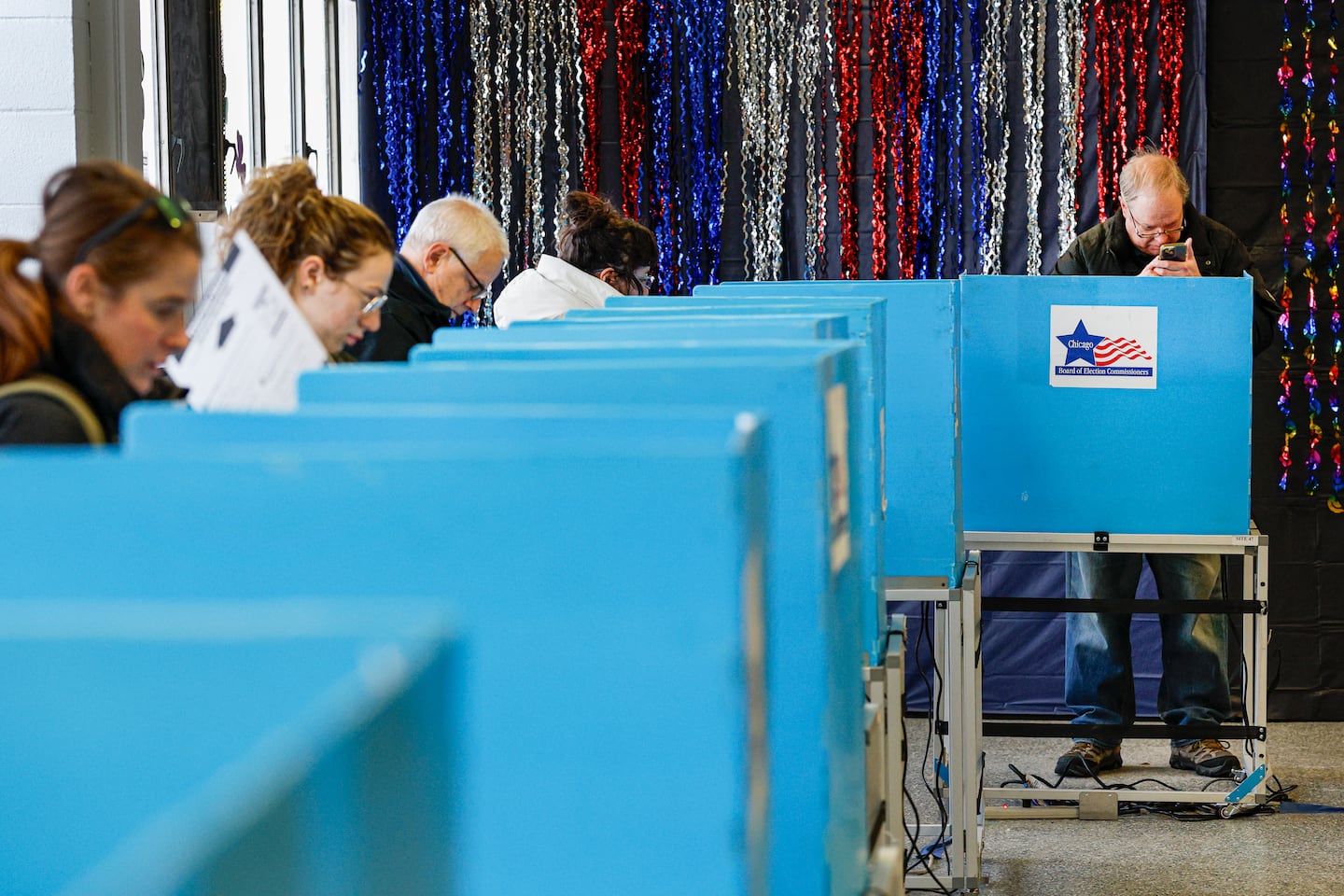
Among its sweeping proposals: mandating voters prove their citizenship in person to register to vote and also show a photo ID to vote at the polls; and ending mail-in ballots for nearly all voters. Combined, those measures could block millions of eligible voters from the polls, according to analysis from voting rights advocates.
Complying with the changes, and helping voters comply, would be a massive, complicated undertaking, according to election officials. Amanda Gonzalez, the clerk of Jefferson County, Colo., outside Denver, said it could take her office “thousands of hours” of additional work to get voters reregistered under the proposals.
Get Starting Point
A guide through the most important stories of the morning, delivered Monday through Friday.
There’s an even more personal reason for alarm among election officials: the Republican legislation would also impose criminal penalties on election workers accused of running afoul of the complex new rules.
If the changes require time and money to properly implement, the legislation offers neither. And the bill’s proponents, chiefly Trump, are claiming the changes must take effect for this fall’s elections — even though preliminary contests have already been held in some jurisdictions.
“Whether you believe in verifying citizenship at the front end of that process, put that aside,” said Isaac Cramer, executive director of the Charleston County Board of Voter Registration and Elections in South Carolina, a nonpartisan position.
“Do we have systems in place to make this work on day one across this country?” he said. “The answer is no.”
Stephen Richer, a Republican and the former top elections official of Maricopa County, Ariz. — the most populous swing county in the country — put it more bluntly.
“It’s laughable,” he said, “to think it could be implemented for the midterms.”
In reality, the bill is unlikely to become law, given that it lacks the 60 votes required in the Senate to pass. All the chamber’s Democrats, along with three Republicans, oppose the bill, which was debated on the Senate floor this week.
Conservative senators and activists are pushing Senate majority leader John Thune to advance the legislation through other means, like circumventing the normal filibuster rule, to pass it with a simple majority. Thune has thrown cold water on such tactics, which could spark a process mess for the GOP.
The warnings issued by elections administrators from both ends of the political spectrum about the feasibility of enacting the changes have been underappreciated in Washington so far. But their concerns could increasingly factor into the debate around the bill, which is likely to resurface even if it fails to pass now.
Several GOP senators said they had not heard any concerns from election officials in their states, and aren’t concerned themselves.
“I don’t think it’ll be a problem,” said Senator Rick Scott, of Florida, a vocal supporter of the legislation.
But Senator James Lankford, of Oklahoma, acknowledged it would not be possible for the legislation to be entirely implemented before the midterms. Some provisions, he said, “need to be deferred to the next election; some of them, we’re trying to determine, what can we get done in this one?”
Many GOP lawmakers believe the provisions to mandate proof of citizenship and photo ID to vote are of existential importance to democracy — as well as their own political fortunes. And many proponents — including the president — argue that Republicans will lose the elections if such changes aren’t in place by the fall.
Their claims are based on the premise that vast numbers of noncitizens are fraudulently voting in US elections, which has never been backed with evidence. There are instances of noncitizens voting, but in statistically insignificant numbers, and in every election people are referred for prosecution for allegedly voting unlawfully.
Some Republican proponents cite the public response to the photo ID mandate — widespread support in opinion surveys — to argue that the bill itself is “common-sense” legislation.
But the most fundamental change proposed by the bill is the requirement that voters prove their citizenship in person to register.
Voters who are already registered would not immediately need to do anything if the bill passed. But anyone needing to update their registration due to a move or name change, as well as those registering for the first time, would need to go to their local elections office in person, with a US passport or birth certificate.
Currently, election offices rarely process in-person registrations; they’re largely completed online or by mail. The Save America Act would send large numbers of voters into election offices, which would likely not be staffed to handle such an influx, making for long lines and delays.
Kurt Bahr, the Republican director of elections of St. Charles County, Mo., said his office would have to process hundreds of people per day. In the worst case, he said, the scene could be like a typical motor vehicle registry office “times 10.”
State officials would also need processes for disentangling one of the most controversial aspects of the Save America Act: voters who have changed names through marriage or divorce and no longer match those on their birth certificates or passports. The bill offers no specific instructions on how to handle the issue, just that states must figure it out.
Election administrators are already spending time addressing such concerns.
“I probably get a question about this every single day,” said Gonzalez, the clerk in Jefferson County, Colo. “People, particularly women, are nervous they don’t have the documents they need in order to register to vote.”
It reflects a key duty for elections officials: communicating rules and deadlines to the voting public. In virtually every jurisdiction, that work is already underway for the fall. Governments would have to undo that progress and communicate an entirely new set of complicated guidelines if new laws pass.
According to the National Association of Counties, they would need “significant time to update systems, develop procedures, train staff, and educate voters” to comply.
“An implementation period of at least 18 to 24 months would be necessary to avoid disruption,” Jeffrey Thorsby, the group’s legislative director, wrote in a memo.
But election professionals see some aspects of the law as deeply misguided no matter the timeline. No provision is more concerning than holding election workers criminally liable for registering a noncitizen to vote — with penalties of up to five years in prison.
Election officials believe the legal burden should rest with the person breaking the law, not an administrator or poll worker who might make a mistake. But the proposal lands particularly poorly at this moment, years into a dramatic uptick in threats and harassment that election officials at all levels have faced since Trump launched a movement around his refusal to concede the 2020 election.
The Save America Act could supercharge an alarming trend of election professionals leaving the field altogether because it has become too risky and stressful.
“I could see people leaving elections because of how ambiguous the bill is,” said Cramer, of Charleston County.
“If there’s criminal penalties for something, it makes it much harder to recruit for that job,” added Kristin Connelly, the clerk of Contra Costa County in California.
Ultimately, if Trump and congressional Republicans pass legislation — however complex and vague the instructions and however tight the timeline — it will be elections administrators who have to implement those changes.
In a moment of unprecedented politicization of their work and deep distrust, they are cognizant of what that could mean.
“We have to be perfect in this moment,” said Connelly, “so that the public trusts us.”
Sam Brodey can be reached at sam.brodey@globe.com. Follow him @sambrodey.