
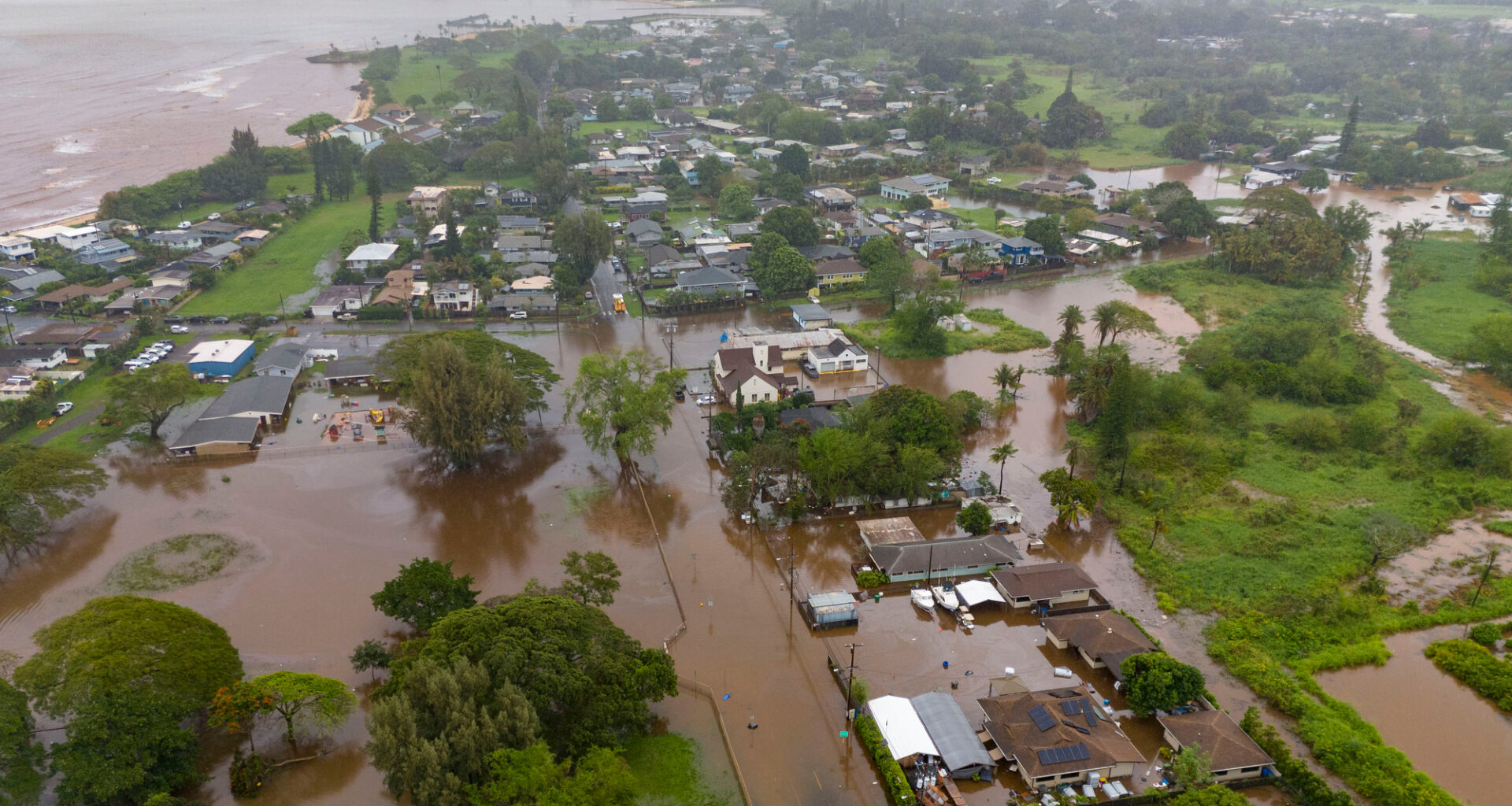
Streets are flooded from severe rains, Friday, March 20, 2026, in Haleiwa, Hawaii. (AP Photo/Mengshin Lin)
Mengshin Lin/AP
Streets are flooded from severe rains, Friday, March 20, 2026, in Haleiwa, Hawaii. (AP Photo/Mengshin Lin)
Mengshin Lin/AP
Storms flood a road on Oahu last week. An intense storm battering Hawaii resulted in the “imminent failure” of a dam on the island, and evacuation orders have been issued.
Hawaii Department of Transportation
Hawaiian search teams worked Friday to rescue residents swept out into the water and stranded on their rooftops as a historic storm flooded streets and threatened to cause the “imminent failure” of an Oahu dam.
The slow-moving storm dropped record-breaking rainfall across the Hawaiian islands, but caused particular devastation on the North Shore of Oahu, where more than 10,000 residents have been ordered to evacuate due to flooding, local officials said. Up to 10 inches of rain fell overnight Thursday, according to the National Weather Service. In some areas, the muddy water completely swallowed up cars parked on the street.
There were still no known fatalities by Friday evening, said Hawaii Gov. Josh Green. But he stressed that the storm was the largest the state has seen in two decades, with heavy rains still to come. Green described neighborhoods flooded with so much churning water that it “looked like people could practically surf some of our roads and highways.”
Article continues below this ad
Emergency sirens and door-to-door knocking efforts to evacuate residents began early in the morning. By Friday evening, 233 people had been rescued, said Honolulu Mayor Rick Blangiardi, including 37 people in the hour before the 5:30 p.m. news conference where spoke.
“On any given day, if you woke up and you saw a headline that said, ’37 people rescued from treacherous conditions,’ that in and of itself would be a wow factor,” Blangiardi said “That’s 37 people just in the last hour. That’s how fluid and how dangerous this situation is.”
San Francisco Chronicle Logo
Make us a Preferred Source to get more of our news when you search.
Add Preferred Source
The rescues began around 6:20 a.m. Friday, when an “unknown number of people may have been swept into the water in the vicinity of Haleiwa,” a coastal surfing community, according to according to Jennifer Nilson, a spokesperson for the U.S. Coast Guard. Nilson said the report initially came from the Hawaii Emergency Management Agency. The Coast Guard, along with other agencies, used boats, cutters and helicopters to search the ocean and locate people in distress.
Green told told Hawaii News Now that some residents in Oahu were rescued from their rooftops, while others waded through water up to their chest and been hospitalized due to hypothermia.
Article continues below this ad
Authorities also used helicopters to rescue 32 children, 15 adults and two dogs who were stranded at a campground when the water made it impossible to get out, according to the state’s Adjutant General, Stephen Logan. Many of the children were on spring break from Hawaii’s public schools.
Earlier Friday afternoon, Blangiardi said officials had not yet been able to get a full grasp of the scale of the destruction or the number of individuals requiring rescue.
“There’s no question the damage done so far has been catastrophic. It’s hard to say exactly what the damage is because some of the roads have been unpassable, but clearly, at the very least dozens, if not maybe hundreds of homes, people being displaced,” he said at the Friday afternoon press conference.
Green estimated Friday evening that the damage done to airports, hospitals, infrastructure and homes could cost the state more than a billion dollars. His chief of staff spoke to a representative of the White House Friday, he said, who offered “their assurance that we’re going to have support.”
The areas under evacuation include Haleiwa, home to the famous Matsumoto Shave Ice shop, and several other communities that line the Seven Miracle Mile — a stretch of Oahu’s shore that is world-renowned for its surfing conditions.
Article continues below this ad
The historic downpour threatened to collapse Wahiawa Dam, a 120-year-old dam near the community of Waialua. Around 8:30 a.m. Hawaii time, the Honolulu Department of Emergency Management warned the dam could “collapse or breach at any time.” Officials with the National Weather Service issued a warning lasting through Saturday afternoon.
Blangiardi told reporters the language was cautionary, noting that water levels at the dam’s reservoir had begun to decline but could surge at any time due to the unpredictable storm. Just after 1 p.m. local time, the Honolulu Department of Emergency Management noted the dam had “not failed but remains at risk.”
About 5,000 of the residents under evacuation orders are at risk of flooding if the dam collapses, according to Molly Pierce, public information officer for the Department of Emergency Management. Evacuees were advised to use Kamehameha Highway to head south.
“Heavy traffic — Please carpool,” the evacuation notice read. Some roads out of the area are narrow and low-lying, and several were shut down Friday due to flooding and landslides.
Joseph Clark, a meteorologist with the National Weather Service in Hawaii, told Fox News that on on Thursday night and Friday morning, the north shore of Oahu “got about a foot of rain in a very short time. … We had homes washed away, cars washed off the road. We have a road closure because of a house on the road.”
Article continues below this ad
One of the designated assembly areas for evacuees, Waialua High and Intermediate School, was itself evacuated after the area began to flood, according to officials. As of 1 p.m. local time, shelters at Wahiawa District Park, Leilehua High School and Kahuku Elementary School remained open.
Evacuation orders were issued Friday for this area of Oahu, below the dam that is failing.
Everbridge
Green shared on social media that the Hawaii National Guard was activated early Friday morning to aid in the evacuation and run shelters. Army officials from the the Schofield Barracks on the island have deployed high-water vehicles to assist in the rescue effort, according to Piece.
“It’s going to be a very touch-and-go day,” Green said.
Evacuation orders were triggered early Friday when sensors detected the Wahiawa Reservoir was set to exceed 85 feet. Minor flooding at the dam canstart when the water reaches 84 feet, according to the U.S. Geological Service. By 8:35 a.m., the water reached an all-time record of 85.3 feet, sparking concerns that more rain could cause it to collapse.
Article continues below this ad
The crest of the dam is 88 feet high, but its owner has installed a portable barrier extending the height to 90 feet, the Honolulu Civil Beat reported.
As of 10:30 a.m., the water levels in the reservoir declined back below 85 feet, according to sensors run by the U.S. Geological Service. The water level since then has continued to decline. Pierce said the Department of Emergency Management was closely tracking the water, and that it had not reached a level that could trigger full failure.
Even if the dam holds, floodwaters from the extraordinary amount of rain have already consumed downed trees and powerlines. On Friday morning, Hawaiian Electric turned off power for about 4,100 residents along the North Shore, worried that energized lines could pose a threat to evacuees trying to wade through the water. The utility cautioned residents to stay at least 30 feet away from all downed power lines. Several landslides have also been reported, according to Scheuring.
While rainfall had tapered off slightly Friday, the risk of water runoff remained “significant,” the weather service said, capable of producing dangerous flooding. Heavy rainfall earlier in the week had already saturated much of the ground in Oahu, making it hard to absorb the incoming influx of water. Just before 1 p.m. Friday Hawaii time, the agency extended its flash flood warning through 4 p.m.
Flood watch goes into effect tonight through Sunday for another kona low that is expected to bring widespread rain. Peak of the event will be Friday night to Saturday night. Saturated ground from last week’s weather will bring potential for flooding even with less rain. #hiwx pic.twitter.com/dvgyNIGos6
— NWSHonolulu (@NWSHonolulu) March 19, 2026
The National Weather Service also issued an extreme rainfall totals forecast with the worst of it expected Friday night through Saturday. Honolulu was expected to see 8 to 10 inches of rain over the three days, Wailea 10 to 15 inches and Kona 4 to 6 inches. Around 9:30 a.m. Friday, residents on Maui were also advised to evacuate parts of the island due to flash flooding.
Anthony Edwards and Dominic Fracassa contributed to this report.