
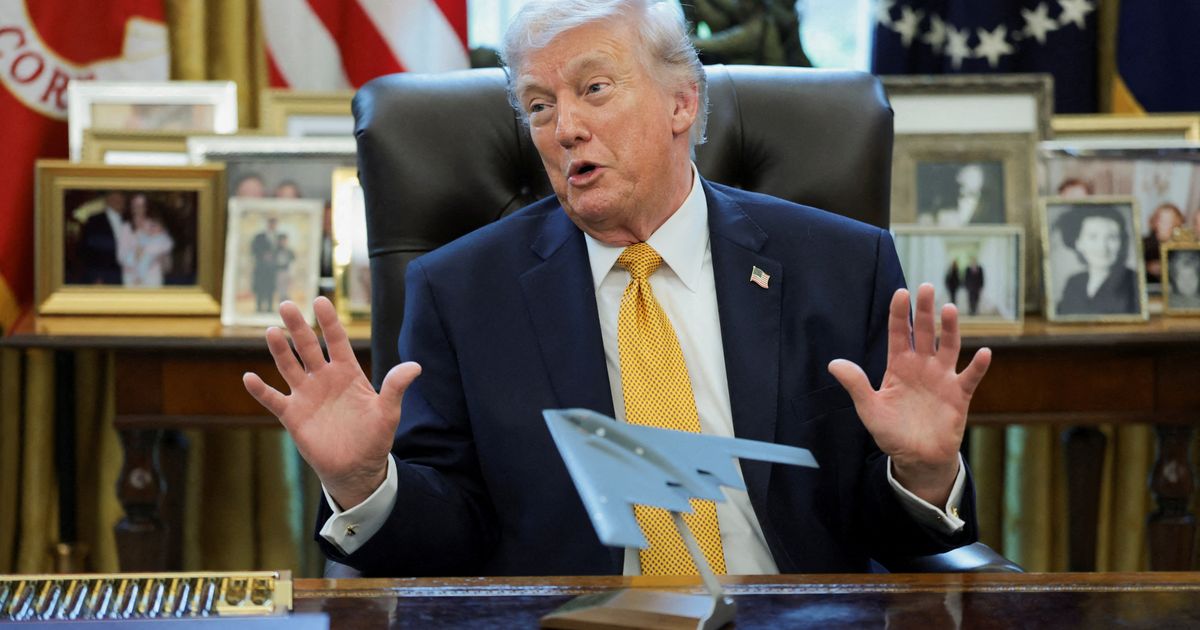
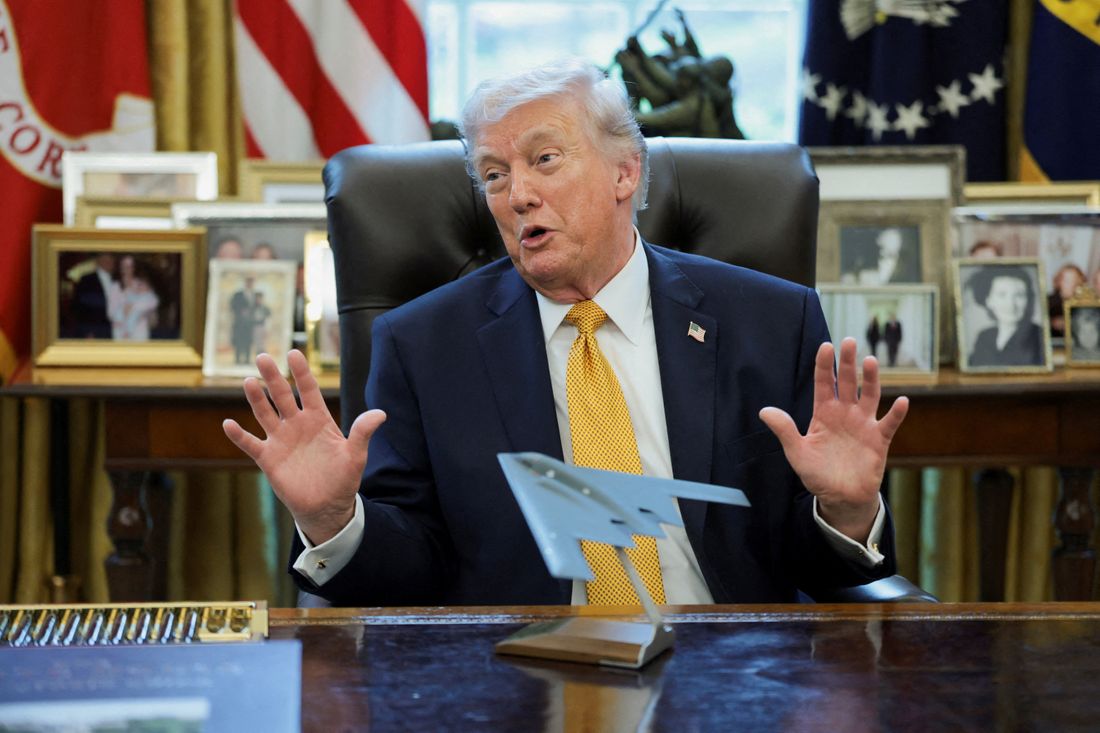
With a model of a stealth bomber on March 16.
Photo: Jonathan Ernst/Reuters
Why are the United States and Israel at war with Iran? No one, least of all the men waging the conflict on our reluctant and terrified behalf, seems to know. A variety of possibilities has been proposed by a variety of public officials, from the lilting Lindsey Graham to the dipsomaniacal Pete Hegseth to our commander-in-chief, all of them bearing the deflated, beery air of a routine resentfully workshopped in the Comedy Cellar. What do we hope to accomplish? When will the lights go up? When can we go to the bathroom without getting heckled from the stage?
“War,” wrote Carl von Clausewitz, “is merely the continuation of politics by other means.” This generously assumed a politics to begin with. By the time the Great War rolled around almost a century later, the paradigm was already exhausted. What politics or policy impelled Europe to slaughter the better part of a generation? A dying map of dynastic inheritance and Napoleonic ambition? The ideological battles of the rest of the 20th century seemed to rescue the theory of war-as-politics: the contest against fascism; the rivalry between western democracies and various flavors of socialism; the struggles of the colonized to throw off the yokes of their rulers.
The 21st century briefly continued the illusion. The attacks of 9/11 were propounded as a new clash of civilizations akin to the glorious Cold War, Islam (or some version of it) serving as the implacable Soviet menace to our imperiled free world. About 90 percent of Americans supported the war in Afghanistan, then we stayed there for 20 years before turning it back over to the very people we wrested it from in our initial campaign of vengeance. We invaded Iraq, again, an effort that also failed and petered out ignominiously. Its signal image remains an American president dressed up like a G.I. Joe figurine, grinning stupidly on the deck of an aircraft carrier underneath a “MISSION ACCOMPLISHED” banner right before things really turned to shit.
The present conflict with Iran has many fathers. Generations of American leaders who have failed to restrain our junior partner in Israel as it has ravaged and antagonized a region. A Democratic Party whose defensive crouch on matters of national security has led it down an endless garden path of regretfully funding military adventures about which it has forelock-tugging concerns. The void where notions, however misguided, of American purpose on the global stage once stood. We are left with the weird machinations of a would-be despot with the scattershot style of a sundowning lounge act long past his prime. The result is a conflict that, like the First World War, will be remembered above all for its bloody and pointless absurdity.
The American people are more befuddled than ever. Gas is nearing $4 a gallon. No one has taken to the streets, but then, what would they be protesting exactly? There is no congressional authorization. The war-making powers of the presidency are seemingly absolute, and the goofball in office seems to operate entirely on his whims. His retainers and lackeys no longer even bother to speak from the same script. The war on Iran may last a few more days, or it may last weeks, or it may last months. We invaded because of nuclear capabilities that we supposedly destroyed last year, or we invaded because of an imminent threat to the United States, by which we mean a vague threat of nonspecific menace. Or we invaded because of a threat to Israel, with whom we do not actually have a mutual-defense pact, or we invaded because Israel was imminently to invade Iran, though Israel is definitely not leading us around by the nose. Or something.
We will leave when Iran unconditionally surrenders. Or when it abandons nuclear enrichment. Or when its missiles are obliterated. Or when its people rise up and overthrow the Islamic Republic, which we will support, though not directly, or possibly directly.
We have completely destroyed Iran’s retaliatory capabilities, and we condemn its ongoing retaliatory strikes against our Gulf allies. We have a plan to open the Strait of Hormuz, and we condemn the ongoing closure of the Strait of Hormuz. We object to Iran’s targeting of civilian oil-and-gas infrastructure, although, regrettably, we must threaten to target its civilian oil-and-gas infrastructure. We condemn its mobilization of regional allies, and we demand the mobilization of our global and regional allies.
Over all this hovers the demiurgic face of Donald Trump. If George W. Bush’s presidency was a wildly Freudian attempt to compensate for his own father’s masculine failures, then Trump’s discontinuous second term is the same — only for himself. Restrained somewhat in his first term by various generals and party apparatchiks who, for all their flaws, lived in something resembling a shared material reality with the rest of us, he is now entirely unrestrained except for, as he put it, by “my own morality. My own mind.”
His apparent success in replacing Nicolás Maduro with a pliant Venezuelan regime, albeit with a minimally altered cast, seems to have convinced him of his own omnipotence. He plainly thought he would do the same in Iran, except the U.S. and Israel killed some of the people who might have proved to be a more amenable leader than Ayatollah Ali Khamenei, and those now rising to power are by many accounts more hard-line and radical than those who were so blithely assassinated. There was a half-baked theory, based on a misreading of recent popular protests, that “the people” — whoever they are — would topple the Islamic Republic, as its supporters rose up more than 40 years ago to overthrow the last stupid regime we imposed upon them. It hasn’t happened.
What is the endgame here? The question assumes there is one. What rational calculus would determine how much pain extracted and capacity degraded would represent a good point at which to cease hostilities? Commentators and experts talk about the “escalation trap.” Even this assumes a degree of logic on both sides, a set of war aims whose incentives lock in certain conclusions.
Here is the grim reality: Two of the world’s most powerful militaries are waging a war without a strategy. Our commander-in-chief is lurching from one ill-considered threat to another. The Israeli prime minister, our supposed ally, is a crook who will kill indiscriminately to stay out of jail. Not even Sohrab Ahmari, a supposedly heterodox conservative co-author of the embarrassing 2022 endorsement of Trump “He’s Still the One,” can deny that this particular conflict is shaped more by character than by a discernible politics.
In some sense, it’s silly to ask where this leaves America. No one is bombing our mainland. Our gas is expensive, but our supply is not constrained. Our politics are as venal and stupid as ever. Except that there lurks now a disquieting sense, which we felt in Afghanistan and Iraq but didn’t quite grasp in either, that time is up. That the geriatric structures of our government are no longer capable of restraining the wackos we elect because, damn it, we are justifiably tired of the status quo.
“War,” said Georges Clemenceau, “is too important to be left to the generals.” In Dr. Strangelove, the madman General Ripper updated this aphorism. “War,” he said, “is too important to be left to the politicians. They have neither the time, the training, nor the inclination for strategic thought.” Now we’ve transcended both. We are in a war with no clear political motives or strategic aims, just an eructation of personalities and egos that has, to date, caused more than a thousand deaths. Our only hope seems to be that the initiators of this absurdity will be too old and exhausted and scared of the oil industry to keep it up. But I fear there are a few too many eager opportunists who will wrench the keys from Grandpa’s hand and then happily take the wheel themselves.
Thank you for subscribing and supporting our journalism.
If you prefer to read in print, you can also find this article in the March 23, 2026, issue of
New York Magazine.
Want more stories like this one? Subscribe now
to support our journalism and get unlimited access to our coverage.
If you prefer to read in print, you can also find this article in the March 23, 2026, issue of
New York Magazine.