

While the government has argued it will not rule in or out any proposal before the roundtable, Prime Minister Anthony Albanese has been clear he has little appetite for a change to the GST.
When the tax was introduced by the Howard government, an agreement was struck with the states and territories that they would get all revenue raised by the GST.
Treasurer Jim Chalmers on Wednesday said the government had not been “beavering away” to find a way around the Howard-era deal with the states.
“And I think the prime minister’s comments make it pretty clear about how we’re approaching issues around the GST,” he said.
Fellow independent Allegra Spender, an advocate for tax reform and the only non-major party MP invited to the roundtable, said the summit should confront the size of the NDIS, citing research from McKinsey and the e61 Institute showing the non-market economy was holding back productivity.
Spender stressed that the NDIS was transformative for disabled people but warned that if the current 8 per cent yearly growth target was not tightened, the ballooning $50 billion program risked losing its social licence.
“Many people in the community have raised this with me … The participants are concerned that if it’s not sustainable, it loses the goodwill of the people then it is actually under threat,” Spender told this masthead.
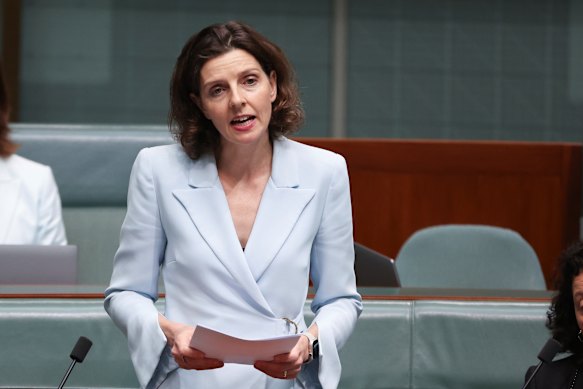
Wentworth MP Allegra Spender, the only independent at the roundtable, says the government has to find ways to reduce spending pressures across the care economy.Credit: Alex Ellinghausen
“If the non-market economy is going backwards, and it has seen virtually no measurable productivity growth in the last 20 years, then it is very hard for the overall economy to be growing productively”.
Spender said she expected spending on the care economy to be discussed on day one of the roundtable in a session on making government services efficient.
The independent Centre for Policy Development think tank, in its submission to the roundtable, said changes to the GST and other elements of the tax system had to be on the table.
Loading
It said while lifting productivity went beyond tax changes and reduction of red tape, the government could make substantial gains by reducing its reliance on income taxes and moving toward consumption and economic rent taxes.
This includes increasing the GST rate and broadening the number of goods and services captured by the tax, creating a single resource rent tax, indexing personal income tax thresholds to inflation, axing taxes such as those on insurance duties, and replacing state stamp duties with a land tax.
The right-leaning Centre for Independent Studies on Thursday will warn that without a lift in productivity, Australians’ living standards will continue to ebb.
In an essay for the centre on the productivity outlook, economist Jim Cox argues Australian businesses are not adopting new technologies as fast as overseas competitors, regulation – especially at the Commonwealth level – has “exploded” in recent years, while the country is undergoing a cultural change that puts environmental protection above economic growth.
Loading
Cox said a new wave of micro-economic reform, smarter regulation and a national conversation about the drivers of innovation were needed.
“Prosperity is not automatic. It requires deliberate choices: investment in skills, encouragement of risk-taking, and institutions that reward creativity rather than rent-seeking,” he said.
Meanwhile, the ACTU wants the government to introduce a national skills levy that would compel medium to large employers to contribute to the cost of training workers.
Unless medium to large businesses with an annual turnover of above $500,000 spend 1.5 per cent of payroll on training, the ACTU argues they should pay a levy of the same amount.
Cut through the noise of federal politics with news, views and expert analysis. Subscribers can sign up to our weekly Inside Politics newsletter.