
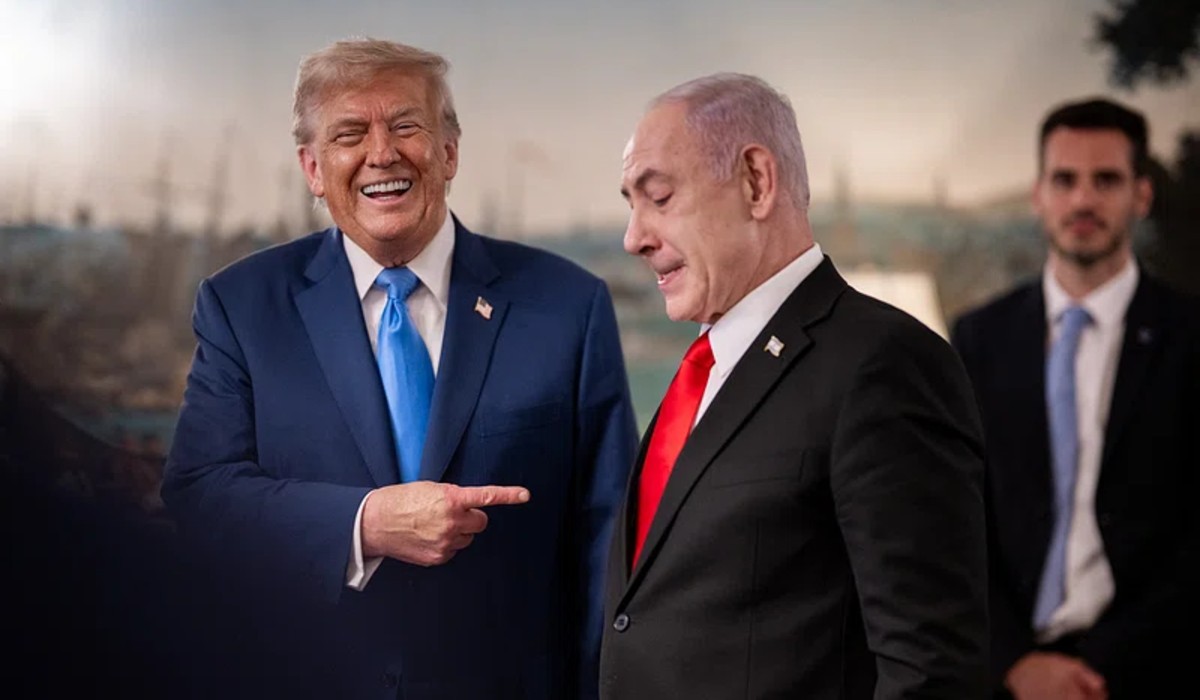
Chris Bambery looks at the growing tensions in the sixty-year alliance of Israel and the USA
Tony Cliff was the son of Zionist pioneers in Palestine. Cliff became a Marxist, and his consequent persecution drove him out of Palestine to become an émigré in the UK. In 1982, he wrote an article, The roots of Israel’s violence, in which he examined Zionism’s changing allegiance to a variety of imperialist powers. Cliff summed it up neatly: ‘The Zionists, if not for sale, were always for hire’.
The Zionists allied themselves with first British and then French imperialism but dropped both. After the 1967 Six Day War, when it proved its worth in defeating Arab nationalism, Israel moved into the alliance with US imperialism and is still there.
US-Israel relations are a ‘special’, long-standing strategic partnership anchored in military cooperation, shared intelligence, and economic ties, with the US providing significant annual aid (roughly $3.8 billion annually) to maintain Israel’s qualitative military edge. Successive US administrations have described their relationship with Israel as ‘ironclad’. Let’s test how true that is.
During the current war I have argued that Israel does not control US foreign and military policy as many on the left like to argue. This argument is becoming increasingly important and recent events have shown the strains and cracks in the US-Israel alliance.
The most obvious strain, evident in White House briefings particularly, is over where this war is headed and what the aims of the war are. Israel does not just want regime change in Iran, it wants the country to fall into chaos and civil war, as in Libya, Sudan and Syria. And this is in sharp contrast to Washington’s desired outcome.
Washington does not want chaos in the economically and strategically important Persian Gulf. Saudi Arabia and the Gulf States are of considerable importance for America, and for the Trump dynasty. They fear what would happen if Iran falls into chaos.
The Israelis applauded Benjamin Netanyahu’s success in getting Trump to join a war against Iran. Netanyahu has wanted this for three decades. The applause in the Israeli media contained an element of cynicism about their American enabler that few commentators picked up on.
Some of Netanyahu’s backers clearly see the US as a declining power. This might explain why Netanyahu sees Trump as his best, and possibly his last, chance for an all-out war on Iran while Washington maintains its global military dominance.
Recent contradictory statements about the war’s progress and whether it might end sooner or later are confounding mainstream media analysts. For example, Trump has continued to make statements suggesting that Iran is all but defeated and the war might end soon. In contrast, statements from Tel Aviv say the opposite.
For example, Israeli Defence Minister, Israel Katz, responded to journalists by stating that the war is open-ended, and, ‘The operation will continue without any time limit, as long as required, until we accomplish all objectives and achieve victory in the campaign.’
Last week Tulsi Gabbard, Trump’s Director of National Intelligence, confirmed to Congress in plain language that US and Israeli war aims are different. She said, ‘The objectives that have been laid out by the US President are different from the objectives that have been laid out by the Israeli government.’
The sixty-year alliance, a sacred pillar of US foreign policy, seems to be cracking with some in the Maga faithful pointing to the spiralling costs to the American taxpayer, and that US support is clearly enabling Israel to pursue its own independent policy.
Trump knows that the war is unpopular both at home and among his allies and is creating instability in the world economy. Oil prices have climbed to over $100 (£75) a barrel. Trump is faced with midterm elections in October, and is likely to want the conflict to end soon.
Netanyahu, on the other hand, faces a general election in October. He wants to go into that as the victor who imposed a decisive defeat on Iran that ends the country’s nuclear and ballistic missile programmes at the very least. In contrast to the US, the war has overwhelming public approval in Israel. Netanyahu’s popularity contrasts with US criticism of Trump who changes position with bewildering speed.
After Israel attacked the South Pars gas field in Iran he went on social media to admit that he and the United States ‘knew nothing about this particular attack’. The gas field is shared between Iran and Qatar, and the latter was incensed about the attack, especially as Iran immediately responded by attacking Qatari oil and gas installations. Trump then threatened to ‘massively blow up’ Iran’s portion of the gas field unless Iranian attacks cease.
Massively blowing up the world’s largest gas field, meaning its total destruction, might just have a major impact on the already struggling global energy markets and supplies. But this is obviously more Trump’s worry than Netanyahu’s.
US worries: Israel-China relations
Israel has carefully maintained its relations with the USA’s imperial rival – China – and this continues to worry Washington.
During Trump’s first term in office the administration was concerned about growing Chinese investment in Israel. So much so that in 2020, the then US Secretary of State, Mike Pompeo, was sent to Tel Aviv to press the Israelis to distance themselves from China.
One important concern for the Americans was the construction of a new port in Haifa Bay, to be run by the Shanghai International Port Group (SIPG) for a twenty-five year period. The US sees this as an encroachment by China on US turf and as a result:
‘The US Sixth Fleet, which is a permanently anchored guest in Haifa, is following development there with great concern. They openly claim that the Chinese are using the Silk Road project as a “credit and bribery trap” to intensify their economic and political control through loans and investments in weak economic countries along the route.’
Despite that the new port in Haifa is today operated by SIPG. There has been pushback, however, and American pressure has had some success and has led Israel to curtail technology transfers to China, especially in sensitive sectors such as artificial intelligence (AI), defense and semiconductors. Notably, between 2020 and 2022, Israeli semiconductor exports to China declined by nearly half, highlighting the impact of US influence. This has restricted Israeli ambitions to become a leading technology hub.
Despite US pressure, trade ties between Israel and China have actually grown. In 2024, bilateral trade rose to $16.3 billion, an 11.7% increase from 2023. However, a significant trade imbalance exists, with high-volume imports from China and sluggish Israeli exports. Israel’s trade deficit with China went above $10 billion for the first time in 2024.
Now, China is Israel’s second-largest trading partner, with bilateral trade reaching over $16 billion in 2024, focusing on technology, infrastructure, and automotive sectors (specifically electric vehicles). One in every five new cars on the road in Israel, for the past two years, has been manufactured in China.
Of course, this relationship might change again. There was a spat over the Gaza War, but Israeli-China trade continued. But whether that will be the case over the Iran war remains to be seen. Iran is of considerable economic and strategic significance for Beijing.
Similarly, a Chatham House report explains that Israel has maintained its links with Russia. The report says that ‘Israeli officials lobbied Washington to preserve Russian military bases in Syria – ostensibly to counterbalance Turkish influence over the Assad regime – indicating that Israel sees value in Russia’s continued regional presence.’
The same Chatham House report notes Israeli concerns that any pivot towards greater US involvement in the Far East will lead to a withdrawal of US forces from Syria, Iraq and elsewhere:
‘Israel’s relationship with Russia will increasingly function as a hedging strategy against uncertainties in US Middle East policy. While the US–Israel alliance remains foundational, Israel recognizes the need for diversified relationships in a period of American retrenchment. Russia represents one element of this broader hedging strategy, alongside deepening ties with Arab states and expanded outreach to powers like India and China’.
We should be clear that Israel is not totally dependent on the USA. Israel recorded a record $14.7 billion in defence exports in 2024, most of them to Europe, reflecting a country that is increasingly capable of operating independently on the world stage. This suggests Israel is no longer just a security recipient but also an arms exporter and defence innovator in its own right, with its own commercial base.
In other words, the US-Israel relationship is not simply one of American support for a vulnerable ally; it is also a channel through which Israeli defence capacity, technology, and industrial partnerships feed back into global markets.
The political foundation of the alliance have never been weaker.
The biggest elephant in the room, however, is the sea change in US public opinion towards Israel and its ‘forever wars’.
American public sympathy for Israel, which stood at 60% in 2020, fell to 36% by early 2026, the lowest recorded level in decades. A 2025 Quinnipiac poll found that six in ten American voters oppose continuing military aid to Israel.
This will not impact much on this generation of American leaders but down the road it is very likely to. Israel and its lobbyists have attempted to turn this tide but with little success.
The Carnegie Endowment for International Peace noted recently that fissures within the traditionally supportive pro-Israel American community ‘may not heal easily’ and could outlast Netanyahu himself. The ramifications of the new world order that we are entering have many possibilities, one of which is growing international opposition to war and imperialism.
Chris Bambery is the author of The Second World War: A Marxist History, (Pluto Press, 2014)
Before you go
The ongoing genocide in Gaza, Starmer’s austerity and the danger of a resurgent far right demonstrate the urgent need for socialist organisation and ideas. Counterfire has been central to the Palestine revolt and we are committed to building mass, united movements of resistance. Become a member today and join the fightback.