
The Iranian Arena
Over the weekend, March 20–21, widespread waves of strikes were reported across Iran. As part of this, the IDF struck in Tehran a strategic research and development site at Malek Ashtar University, which was used for developing components for nuclear weapons production.
At the same time, five nearly simultaneous strikes were carried out in western Iran against the Iranian ballistic missile array, resulting in the elimination of a large number of personnel belonging to this system. In addition, a storage site for components used in missile production, a compound belonging to the Ministry of Defense, and a facility for manufacturing components for ballistic missiles were targeted.
According to reports, the enrichment facility in Natanz was struck, and in Isfahan a UAV production facility was destroyed and an Iranian Air Force base was attacked. Strikes were also carried out on Iranian Air Force bases in the city of Dezful in western Iran. The strikes extended to additional cities, including Shiraz, Abadan, Tabriz, Bandar Abbas, Chabahar, Bushehr, and Khorramshahr.
According to a report by CNN, Israel is working to disable Iran’s launch capabilities by targeting the entrances to underground facilities. According to the report, out of 107 tunnel entrances, at least 77% were struck.
According to a report in The Wall Street Journal, the United States has increased its activity in an effort to open the Strait of Hormuz, deploying attack aircraft flying at low altitude over shipping lanes to strike Iranian vessels, alongside Apache helicopters to intercept attacking drones.
Eliminations
Khoda Bakhsh and Mohammad Reza, two senior scientists in a secret project developed by Iran, were attacked on the night between March 20 and 21, and according to Israeli assessments, were eliminated.
It was also confirmed that on March 18, Mehdi Rostami Shamasatan, a senior commander in the Iranian Ministry of Intelligence, was eliminated.
Official Iranian media confirmed that since the beginning of the operation, 15 senior figures in the Basij forces have been eliminated, including the Basij commander, his deputy, and the head of the organization’s intelligence branch, Esmail Ahmadi.
In addition, according to Iranian opposition sources, Reza Ebrahimi, Khamenei’s representative in the Iranian missile array, was eliminated in a strike.
Iran Attacks Targets in the Middle East
Over the past day, Iran carried out a series of attacks across the Middle East. As part of this, two ballistic missiles were launched toward Diego Garcia base—a joint US–UK military base located in the middle of the Indian Ocean, approximately 4,000 km from Iran. The missiles did not hit their targets and no damage was caused.
There are no additional details regarding the above operation. However, if missiles with such a range were indeed used, the implications of the threat to Europe are clear.
The Islamic Revolutionary Guard Corps confirmed that it carried out attacks using ballistic missiles and UAVs against facilities, hangars, and fuel depots at Al-Minhad Air Base in the United Arab Emirates and Ali Al-Salem Air Base in Kuwait. The UAE Ministry of Defense reported that on March 21, three ballistic missiles and eight UAVs launched from Iran were intercepted. It was further reported that since the beginning of the fighting, the UAE’s air defense systems have intercepted 341 ballistic missiles, 15 cruise missiles, and 1,748 UAVs.
In Saudi Arabia, attacks were reported in Riyadh, with at least five UAVs intercepted over the weekend. In Bahrain, the Ministry of Defense reported that since the beginning of the war, 246 UAVs and 145 missiles launched from Iran have been intercepted.
In addition, sirens were activated at the Incirlik Air Base in Turkey, which hosts American forces.
At the same time, Iran announced that it is prepared to allow passage for Japanese vessels through the Strait of Hormuz.
According to the Saudi Al Arabiya network, 85% of Iran’s launches (4,911 rockets, missiles, and UAVs) were directed at Gulf states and 15% at Israel (850 missiles and UAVs).
Iraq
Over the weekend, Shiite militias attacked the US Victoria base near Baghdad International Airport, as well as a target near the Moroccan embassy in Iraq.
An Iraqi security source told the Qatari Al-Araby channel that a UAV struck the Iraqi intelligence headquarters in Baghdad, noting that the facility cooperates with American advisors.
At the same time, the Saudi Al Arabiya channel reported, citing Iraqi officials, that NATO has decided to temporarily withdraw its forces from Iraq. In addition, in recent days, Spain’s Minister of Defense stated that NATO has decided to change the deployment of its mission in Iraq and withdraw approximately 600 soldiers in order to ensure their safety in light of recent developments.
The Israeli Arena
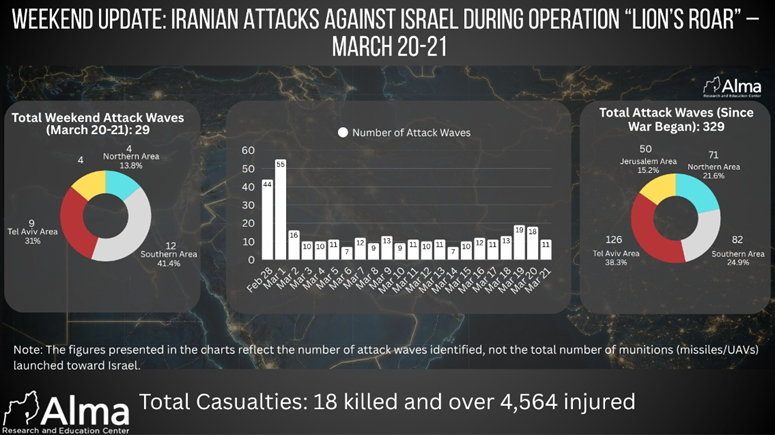
Over the weekend (March 20–21), 29 Iranian attack waves against Israel were identified, carried out using ballistic missiles. Friday stood out as a relatively intense day in terms of the scope of attacks, with a higher concentration of attack waves compared to the preceding days.
Geographically, the attacks were distributed across several key areas: 12 attack waves (41.4%) were directed at southern Israel, 9 attack waves (31%) at the Tel Aviv area, 4 waves (13.8%) at the north, and 4 additional waves (13.8%) at the Jerusalem area. These figures indicate a notable focus on southern Israel over the weekend, alongside continued targeting of the central region.
During the weekend, impacts were recorded in civilian areas as a result of the Iranian fire, both in the Tel Aviv area and in southern Israel. In particular, on Saturday, direct hits were recorded on residential buildings in the cities of Arad and Dimona, where dozens of civilians were injured, including children.
Since the beginning of the campaign, a total of 329 Iranian attack waves against Israel have been identified. In cumulative distribution, the central region remains the primary target, but there is a noticeable expansion and intensification of attacks toward southern Israel, particularly during the current weekend.
An examination of the trend indicates that from the third day of the campaign—when there was a decline in the intensity of the initial attacks—a relatively steady pace of activity has been maintained, with an average of about 11 attack waves per day. Nevertheless, localized events such as the recent weekend indicate the ability to generate temporary increases in the intensity of attacks, as part of sustained pressure.
Since the beginning of the war, 18 civilians have been killed in Israel, and more than 4,564 people have been injured to varying degrees as a result of direct hits, falling interception debris, and secondary damage. In addition, extensive damage has been caused to residential buildings and civilian infrastructure, and the ongoing fire continues to disrupt daily life.
The data indicate that Iran continues to combine a focus on central Israel with an expansion of its attack effort toward the south, while maintaining sustained pressure across all parts of the country.
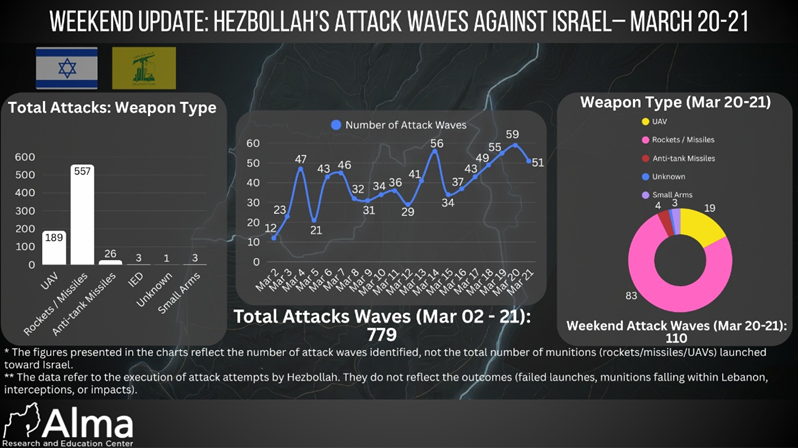
Over the weekend (March 20–21), 110 Hezbollah attack waves against Israel were identified. This reflects a continuation of the trend of increasing activity, with particularly high levels of attacks over the two days of the weekend.
In terms of types of weaponry, most of the attacks were carried out using rockets and missiles (83 waves, approximately 75%), alongside 19 attack waves using UAVs (approximately 17%), 4 attacks using anti-tank missiles, as well as additional incidents involving explosive devices, small arms fire, and other unidentified means.
In addition, 43 of the attacks over the weekend were claimed by Hezbollah as targeting IDF forces operating against it in southern Lebanon. According to the organization’s statements, these attacks were carried out using a combination of high-trajectory fire, anti-tank missiles, and UAVs, as well as three incidents of engagements involving small arms fire. It should be noted that in many cases of fire directed at IDF forces within Lebanese territory, spillover fire is recorded toward Israeli border communities.
Geographically, most of the attacks were directed at border communities and the Galilee, with a focus on areas near the border but also impacts in urban areas in the north that caused property damage. Hezbollah also boasted on Friday of carrying out seven direct attacks against the city of Kiryat Shmona—a city of approximately 25,000 residents—highlighting a focus on urban centers in the north. In addition, there was a direct hit on a residential building in the city of Ma’alot.
As a result of a rocket attack on the area of Kibbutz Misgav Am (March 22), a resident of the kibbutz was killed by a direct hit on his vehicle.
Beyond the fact that Hezbollah is directly firing at civilian communities in any case, Hezbollah is seeking a “victory image” that, from its perspective, will be achieved by causing Israeli residents in communities near the border to leave.
In addition, it was reported that two IDF soldiers were injured as a result of mortar shrapnel.
Since Hezbollah joined the fighting on March 2, a total of 779 attack waves against Israel have been identified. An examination of the trend indicates that after early fluctuations, there has been a continuous increase in the scope of attacks, with a shift to higher and more consistent levels of activity in recent days.
Note: The data refer to the number of identified attack waves, not to the total volume of munitions. In addition, the data refer to the execution of the attempted attack by Hezbollah and do not reflect its outcome (failed launch, impact in Lebanese territory, interception, or hit).
Lebanon and Hezbollah
The United States Ambassador to Lebanon, Michel Issa, expressed doubt regarding the possibility that Israel would halt the fighting against Lebanon, and raised questions about whether Lebanon would enter direct negotiations with Israel while hostilities continue. Issa referred to the initiative of Lebanese President Joseph Aoun to open negotiations with Israel, noting that the United States appreciates the importance of the issue for the president and his responsibility in deciding to meet with the Israeli side. According to him, Israel has decided to continue its attacks, and this means that Lebanon must decide whether it is willing to meet with Israel under these conditions. He further emphasized that peace cannot be achieved without meetings and negotiations, and called on actors in Lebanon to consider engaging in direct dialogue with Israel in order to reach a solution.
At the same time, during a meeting between Foreign Minister Gideon Sa’ar and his French counterpart Jean-Noël Barrot, the latter expressed reservations about a ground operation in Lebanon. In contrast, Sa’ar argued that the Lebanese government and its army are not taking the necessary measures against Hezbollah, both in the military sphere and in other aspects.
The official in charge of the resources and borders portfolio in Hezbollah, Nawaf al-Moussawi, stated in an interview with Al-Mayadeen that if the war ends, it will end on all fronts.
Meanwhile, over the weekend, the IDF continued to carry out strikes in southern Lebanon and Beirut, including attacks on Hezbollah command centers. Earlier today (March 22), the IDF launched a broad wave of strikes against Hezbollah infrastructure in southern Lebanon, including the bombing of a highway bridge in the al-Qasmiya area.
The IDF’s ground activity in southern Lebanon is ongoing.
In addition, the IDF announced that it eliminated in Majdal Selm the commander of the special forces of the Radwan Unit, Abu Khalil Barji.
Syria
Lebanese Foreign Minister Youssef Rajji stated, following his meeting in Riyadh with his Syrian counterpart Asaad al-Shibani, that the Syrian foreign minister assured him that the deployment of Syrian forces along the Lebanon–Syria border is intended solely to defend Syrian territory and control the borders in light of security violations or smuggling attempts. According to him, al-Shibani emphasized that Syria does not intend to enter Lebanon or interfere in Lebanon’s internal affairs in any way.
In response to Israeli strikes against military targets in southern Syria on March 20, the Syrian Ministry of Foreign Affairs issued a statement strongly condemning the attack, describing it as “heinous.” The statement claimed that this aggression is carried out under false pretexts and constitutes a continuation of Israel’s “escalation policy,” as well as continued interference in Syria’s internal affairs aimed at undermining the security and stability of the region. It further stated that the Syrian regime holds Israel responsible for the consequences of this dangerous escalation and called on the international community and the UN Security Council to act to end Israel’s policy toward Syria and the region as a whole.
The International Arena
The United States is easing sanctions on Iran and has issued a temporary one-month waiver on sanctions related to the sale of Iranian oil (referring to oil already located on vessels at sea), in an effort to stabilize oil prices. At the same time, the CEO of QatarEnergy told Reuters that he had warned the US Secretary of Energy and senior officials in the administration about the severe consequences that could result if Iran’s oil and gas facilities are attacked.
According to a report in the Daily Mail, the British nuclear submarine HMS Anson has arrived in the Arabian Sea. A spokesperson for the Cypriot government stated that the UK confirmed its bases in Cyprus will not be used for offensive military operations against Iran. In addition, the UK Ministry of Defense condemned Iran’s “reckless attacks,” stating that they threaten freedom of navigation in the Strait of Hormuz and pose a threat to British interests and its allies.
Twenty-two countries, including the United Arab Emirates, issued a joint statement strongly condemning the effective closure of the Strait of Hormuz by Iranian forces and expressing concern over the escalation of the conflict. The countries called on Iran to immediately cease its actions and threatened to act to ensure safe passage in the strait. Bahrain also announced its willingness to join efforts to ensure freedom of navigation.
Saudi Arabia announced that it is expelling the Iranian military attaché, his deputy, and three additional staff members from the Iranian embassy.
Meanwhile, Qatar’s ambassador to Saudi Arabia, Bandar al-Attiyah, stated in an interview with Al Arabiya that the Iranian attack against Qatar and the Gulf states has significantly damaged trust between the sides and will affect the future of regional relations. According to him, the Gulf states will act decisively to defend their sovereignty and repel threats from their territory.
It was also reported that officials in the United Arab Emirates expressed dissatisfaction with Egypt’s neutral stance and raised questions regarding the continuation of economic cooperation, including the possibility of reconsidering investments in the country. In a broader regional context, the foreign ministers of Turkey, Saudi Arabia, Egypt, and Pakistan discussed on March 19 the possibility of advancing a security agreement between the four countries.
In a phone call between the Prime Minister of India and the President of Iran, Masoud Pezeshkian, Narendra Modi emphasized the importance of maintaining freedom of navigation and ensuring open and secure shipping routes. Modi condemned attacks on critical infrastructure and warned that they undermine regional stability and disrupt global supply chains.
Russian President Vladimir Putin congratulated Iran’s leadership on the occasion of Nowruz and emphasized that Moscow remains a reliable partner of Tehran.
In contrast, Ukraine’s National Security Advisor, Rustem Umerov, stated that he visited several Middle Eastern countries over the past week, including Qatar, Saudi Arabia, the United Arab Emirates, Kuwait, and Jordan, noting that Ukrainian experts are operating in the region to expand the protection of critical infrastructure, including the deployment of teams to assist in interception efforts.
